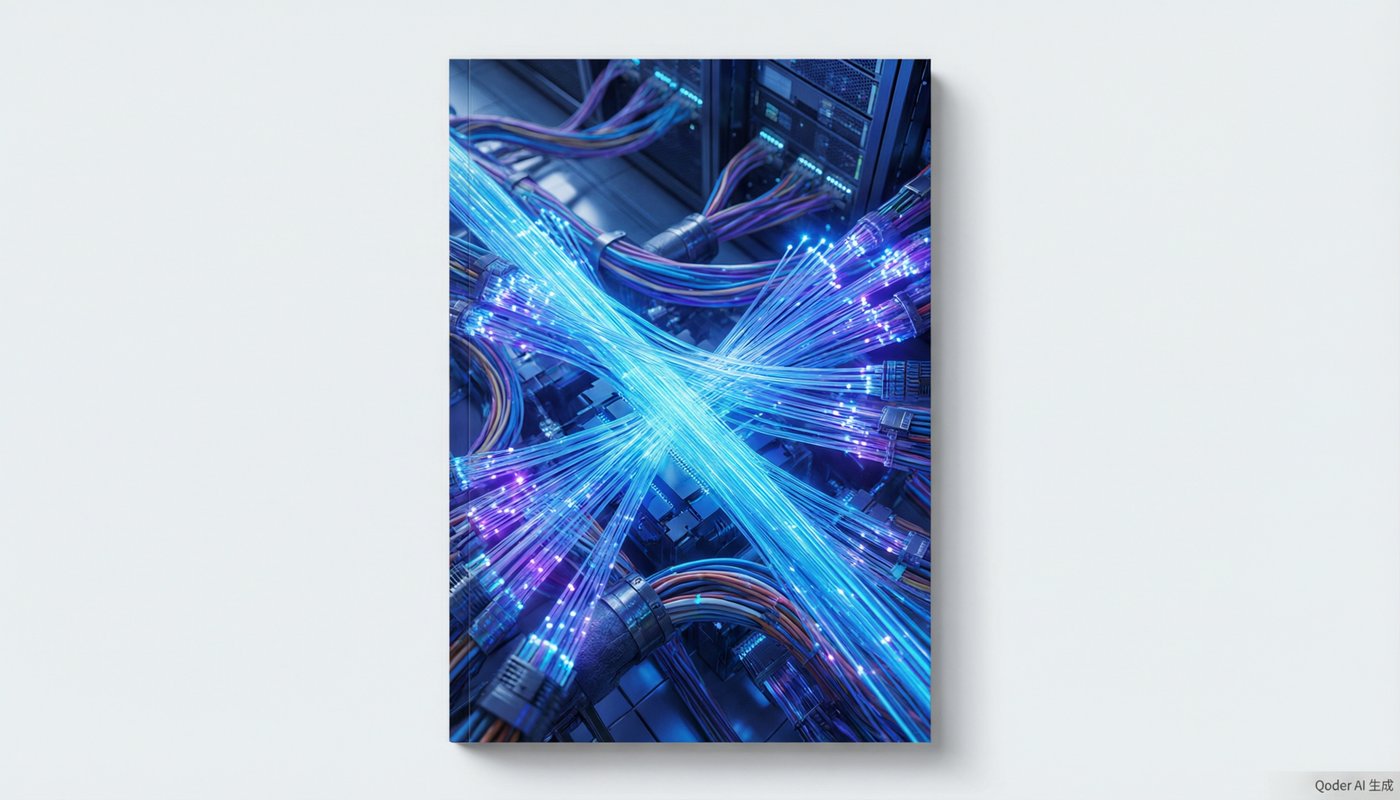
The announcement, made this week, describes a technology that has been discussed in data-center circles for years and demonstrated in laboratories for almost as long: replacing the electrical signals that connect chips with light. AMD said it has achieved the first commercial deployment of a photonic AI network, built with a photonics startup partner, and the implications reach into the heart of how AI computing is built — the connections between the thousands of chips that work together to train and run the largest models.
The problem the technology addresses is increasingly the industry’s biggest. AI models are trained on clusters of chips — tens of thousands of accelerators working in parallel — and the connections between them are the bottleneck. Electrical interconnects consume power, generate heat, and limit the speed at which data can move between chips. As models grow, the interconnect problem grows faster than the compute problem: the cost of moving data between chips can rival the cost of computing on them. Photonic links, which carry data as light through fiber, offer a way out — faster, cooler, and more efficient than electrical connections.
AMD’s deployment, in partnership with a photonics startup, is the first time the technology has been used commercially in an AI network, and the significance is in the validation as much as the engineering. Photonic interconnects have been the subject of academic research for decades, and their adoption has been predicted for just as long. The commercial deployment is evidence that the technology has reached the point where it can be operated at scale, in production, by a company whose customers depend on reliability.
The competitive context gives the announcement its edge. The dominant approach to chip-to-chip communication in AI systems is Nvidia’s NVLink, an electrical interconnect that has become the standard for AI clusters — and a moat: the network, like the chips and the software, is designed to work together, and it locks customers into Nvidia’s ecosystem. AMD’s photonic network is an attempt to build a different path, one that does not depend on Nvidia’s standards. The deployment is a small crack in the NVLink story, and a signal that the interconnect layer of AI computing is becoming contested territory.
The technical advantages of photonics are the argument for the bet. Light carries data faster than electricity, with less power consumption and less heat — the two resources that limit the scale of AI data centers. In a field where a few percentage points of efficiency translate into millions of dollars of operating cost, the difference is material. AMD and its partner said the photonic network reduces both energy use and latency compared with electrical alternatives, and those are the metrics that matter when clusters run at full capacity for months at a time.
The obstacles to adoption are equally real. Photonic networks require different manufacturing, different packaging, and different expertise than the electrical systems they replace, and the supply chain is young. The technology also competes against the inertia of the industry standard: NVLink is embedded in the software, the systems, and the skills of the engineers who build AI clusters. AMD’s commercial deployment is a proof that the alternative works; it is not yet a proof that it will be adopted at scale.
The economics of the technology will determine its fate. Photonic interconnects have historically been more expensive than electrical ones, and the cost per connection has been the barrier to adoption. The startup partner’s contribution, according to people familiar with the deal, is manufacturing know-how that brings the cost down to the point where the technology competes with electrical alternatives on price as well as performance. If that holds, the deployment could be the first of many.
The broader significance is the direction it points for the AI infrastructure industry. The race to build bigger AI systems has focused on chips — more transistors, more accelerators — but the systems that emerge in the next few years will be defined as much by their connections as by their processors. Photonics is one of the technologies competing to become the standard for those connections, and AMD’s commercial deployment gives it a credible claim. The company has positioned itself as the alternative to Nvidia across the AI stack, and the photonic network is its answer in the layer where Nvidia’s grip is tightest.
For the data-center operators who will decide the technology’s future, the deployment is a data point rather than a decision: a working photonic network, operated commercially, with measurable results. The numbers will be studied, the reliability will be tested, and the costs will be compared. The technology that connects the chips of the next generation of AI systems is being chosen now, and AMD’s announcement ensures that photonics will be part of the selection process — a place it has not occupied before.