
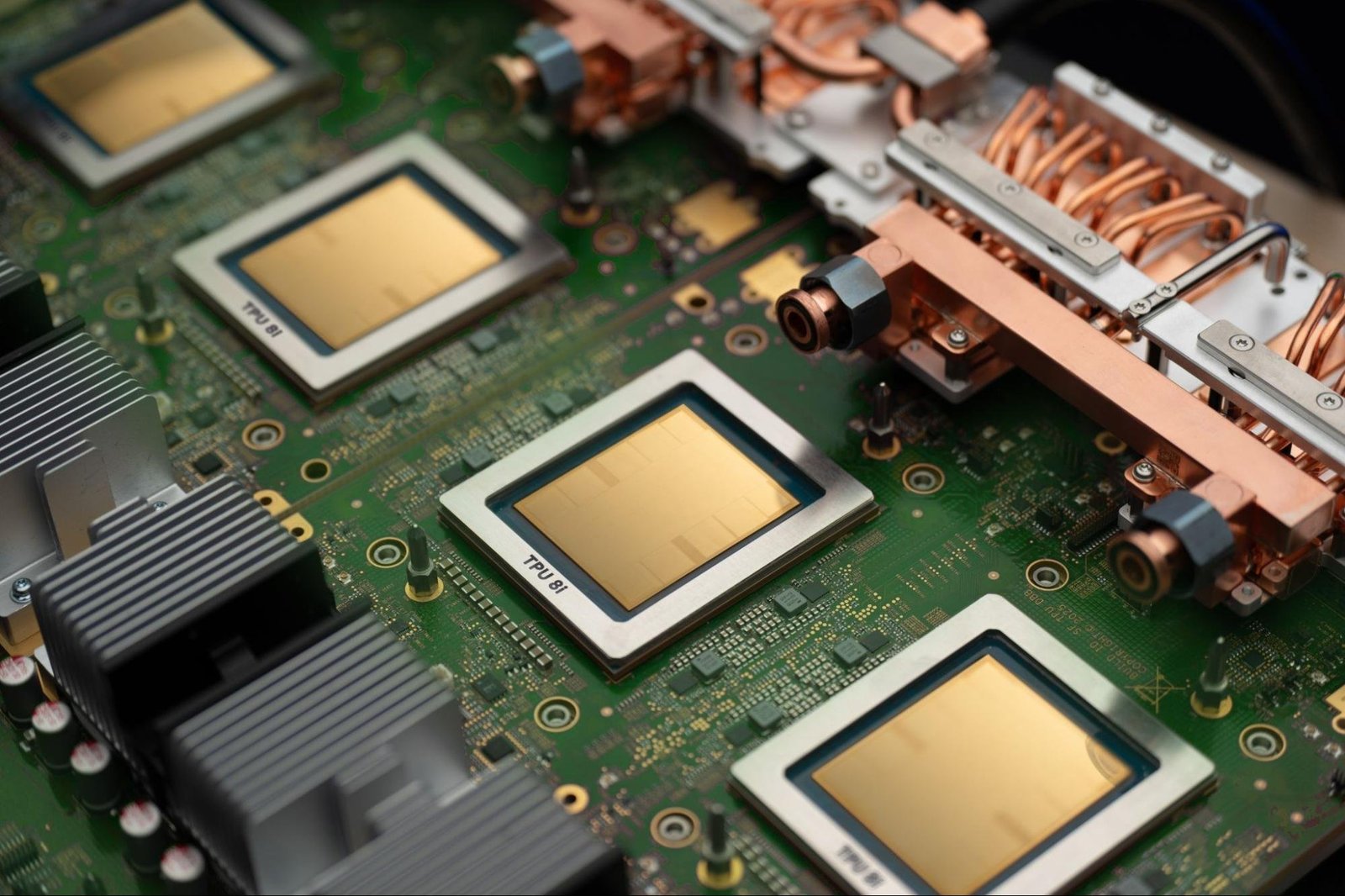
The warrant is dated Aug. 18: Google may buy up to 58.97 million shares of Marvell Technology at $206.58 each, a document that ties the chip maker’s stock to the health of the search giant’s custom silicon program.
Marvell said it reached a commercial agreement with Google to develop custom semiconductors for the company, an expansion of a partnership that now spans multiple chip categories tied to Google’s TPU ecosystem. The scope covers AI inference accelerators, storage controllers, network interface controllers, memory interface controllers and near-memory computing, Marvell said in a statement on Aug. 19. To cement the arrangement, Marvell issued Google a warrant on Aug. 18 permitting the purchase of up to 58.97 million common shares at $206.58 apiece, worth about $12 billion if fully exercised.
The deal deepens a relationship that has grown quietly for years. Marvell has supplied Google with custom networking and compute silicon for its data centers, and the expanded agreement turns Marvell into a broader partner across the TPU supply chain. The warrant structure gives Google a stake in Marvell’s success, aligning incentives in a way that analysts said is unusual even for the custom-chip business, where multi-year supply agreements and shared engineering roadmaps are the norm.
Custom silicon has become one of the fastest-growing corners of the semiconductor industry. Hyperscale cloud companies, frustrated by the cost and scarcity of general-purpose AI accelerators, have increasingly designed their own chips and hired outside specialists to build them. Marvell and Broadcom have emerged as the two dominant merchant suppliers of this work, splitting a market that analysts estimate will grow rapidly as Amazon, Google, Meta and Microsoft scale their internal chip programs.
For Google, the arrangement reduces dependence on any single supplier. The company’s TPU line, now in its sixth generation, is central to its AI strategy, powering both internal workloads and cloud customers who rent Google’s accelerators. Adding Marvell to the mix alongside existing partners gives Google negotiating room and supply-chain resilience in a market where advanced packaging capacity and high-bandwidth memory are scarce. The warrant, analysts said, is effectively an equity sweetener that rewards Marvell if the partnership expands.
Marvell’s financial stake is substantial. The company has been reorganizing its business around custom compute, and analysts said Google’s commitment could add billions of dollars in annual revenue if the full program ramps. Marvell shares rose after the announcement, and the warrant’s strike price, well above the stock’s recent trading levels, signaled that management expects meaningful upside from the expanded relationship. Google, for its part, gets a supplier with deep experience in the memory and interconnect technologies that surround AI accelerators.
The deal also pressures competitors. Broadcom, which has long worked with Google on custom accelerators, saw its shares fall sharply in the sessions after the announcement, with investors marking down its expected share of Google’s supply chain. The message to the market, analysts said, is that hyperscalers intend to multi-source custom silicon rather than rely on one partner. For AMD, which had hoped to supply Google’s AI infrastructure with merchant GPUs, the expansion of in-house custom programs narrows another avenue of growth.
The technical scope is telling. Marvell will build not just accelerators but the entire supporting cast: storage controllers that manage data flow, network controllers that move traffic between accelerators, memory interface controllers and near-memory compute blocks that push processing closer to where data sits. Analysts said the breadth suggests Google is designing a full system architecture around the TPU, with Marvell responsible for the peripheral silicon that determines how efficiently the accelerators run.
Execution risk remains. Custom-chip programs run on multi-year cycles, and the revenue from the agreement will take time to appear in Marvell’s results. The warrant’s strike price, well above the market, implies management confidence but also means Google only profits from exercising it if the stock rises substantially. If the partnership stumbles, the equity incentive loses its value and Marvell’s pivot toward custom compute faces a setback.
For the industry, the deal reinforces a central fact of the AI build-out: the computing that powers large models is no longer a product off a single vendor’s shelf. It is a portfolio of tailored silicon, financed by warrants, negotiated by procurement teams and spread across multiple suppliers. Marvell’s expanded role at Google, analysts said, is another sign that the custom-chip market is becoming one of the semiconductor industry’s defining battlegrounds, with the search giant’s engineering agenda setting the terms.
The timing of the announcement matters as much as its content. Google is in the middle of a record year of capital spending, most of it aimed at AI infrastructure, and the supply of advanced packaging and memory that custom chips require remains tight. Marvell’s expanded role gives Google a second source for components that were increasingly bottlenecked, and it gives Marvell a revenue line that analysts expect to grow faster than its traditional businesses. The company’s custom-compute group already counts Amazon’s Trainium and Inferentia programs among its customers, making Google a second anchor account of comparable scale. That combination, two hyperscalers with long roadmaps and deep pockets, is the kind of visibility semiconductor investors prize, and it is why the stock barely paused after the warrant’s dilution was disclosed. The remaining question is whether Marvell can staff and fund the engineering programs both customers demand without stretching its balance sheet. Analysts who follow the company said the Google agreement answers the demand question but raises the execution one, and the next few quarters will show whether the ramp matches the ambition.



