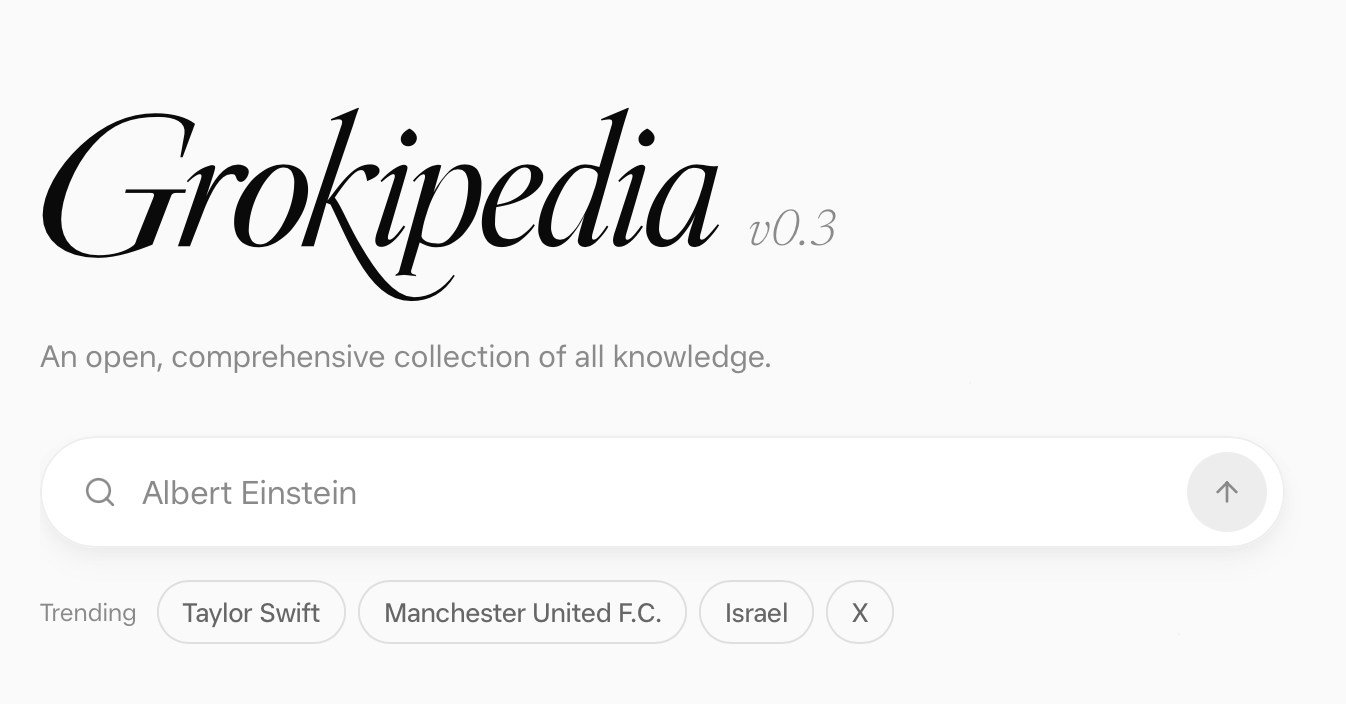
Grokipedia, Elon Musk’s artificial-intelligence answer to Wikipedia, quietly replaced itself on Tuesday evening. xAI pushed out version 0.3 of the encyclopedia with a new logo, a rebuilt homepage and a redesigned page for the one thing the site does that its human-run rival cannot: watch itself edit in real time.
The old homepage was almost nothing — a logo and a search box. The new one surfaces curated entries, a list of the most-read articles, and a tracker of the latest edits flowing through the site. Benji Taylor, a designer at xAI, called it “a refreshed Grokipedia.” The article pages themselves received only minor changes: cleaner infobox tables and tighter line spacing, cosmetic fixes rather than a rethinking of the writing.
Grokipedia launched on Oct. 27, 2025, labeled version 0.1, with roughly 800,000 articles generated and fact-checked by Grok, the large language model built by xAI. It has since grown past five million entries, though many were compiled rather than written from scratch: Musk later said the team instructed Grok to take Wikipedia’s top one million articles and modify them. Readers cannot edit pages directly; they submit suggestions that Grok reviews and approves.
Musk has been explicit about the target. He has called Wikipedia “woke” and an “extension of legacy media propaganda,” and framed Grokipedia as a way to purge what he considers bias from the reference the world reaches for first. Wikipedia, built by volunteers with public revision histories and open discussion pages, represents the model he is trying to displace. Grokipedia’s version of the same task hands editorial authority to a model his company controls.
The project began with a suggestion on a podcast. In September 2025, on the All-In show, venture investor David Sacks, now a White House adviser on artificial intelligence, told Musk that Grok already read Wikipedia and other sources and proposed publishing that knowledge as a site called Grokipedia. “Wikipedia is so biased, it’s a constant war,” Sacks said. Within days, Musk had announced xAI would build it.
The live-edit page sits at the center of that distinction. Wikipedia’s real-time stream of changes is a point of pride, evidence of a community at work. Grokipedia now shows its own feed of recent edits — but on Grokipedia, more of those edits are increasingly made by Grok itself. A February report by the Columbia Journalism Review, citing Tow Center research, found AI-generated edit suggestions overtook human submissions in December 2025 and accounted for more than three-quarters of proposed changes.
The redesign lands against a backdrop of thinning traffic. Grokipedia peaked at more than 460,000 U.S. visits on Oct. 28, 2025, the day after launch, then settled to roughly 35,000 a day within two weeks, according to Similarweb. A homepage that surfaces what is popular, and a feed that shows the site is moving, are in part an attempt to give returning readers a reason to stay rather than type a query and leave.
The version numbers tell the story of a product still finding its shape. Version 0.2 arrived in November 2025 and introduced the workflow for suggested edits. Musk has said he eventually plans to rename the site Encyclopedia Galactica, a name borrowed from Isaac Asimov and Douglas Adams, once it is “good enough” — a caveat he offered in the same breath as admitting the project had a long way to go.
Wikipedia’s founders have not conceded the framing. Jimmy Wales, who co-founded the encyclopedia in 2001, has called the bias claims factually incorrect, arguing that a volunteer base spanning hundreds of languages is harder to capture ideologically than a single owner’s project. Grokipedia’s own pages quietly concede part of the debt: entries adapted from Wikipedia carry a Creative Commons attribution note, a licensing obligation the project could not shake off even as it promised to correct what it saw as Wikipedia’s flaws.
xAI’s bet is that the encyclopedia’s audience can be rebuilt with better presentation. The company’s Grok models already write, rewrite and fact-check millions of pages, and the site can refresh a page within minutes of a news event, far faster than volunteer editors can verify and post. What has been missing is the habit — the sense that the site is alive, curated and worth returning to. A front page that shows readers what everyone else is reading, and what was just changed, is a step toward building one.
What the redesign does not change is the fundamental question Grokipedia has posed since launch: whether an encyclopedia whose author is also its reviewer can earn the trust Wikipedia built through two decades of open argument. Cleaner tables and tighter line spacing do nothing to answer that. They do, however, make the site look more like the thing it is competing with, and easier to read when a curious visitor arrives to compare the two side by side.