
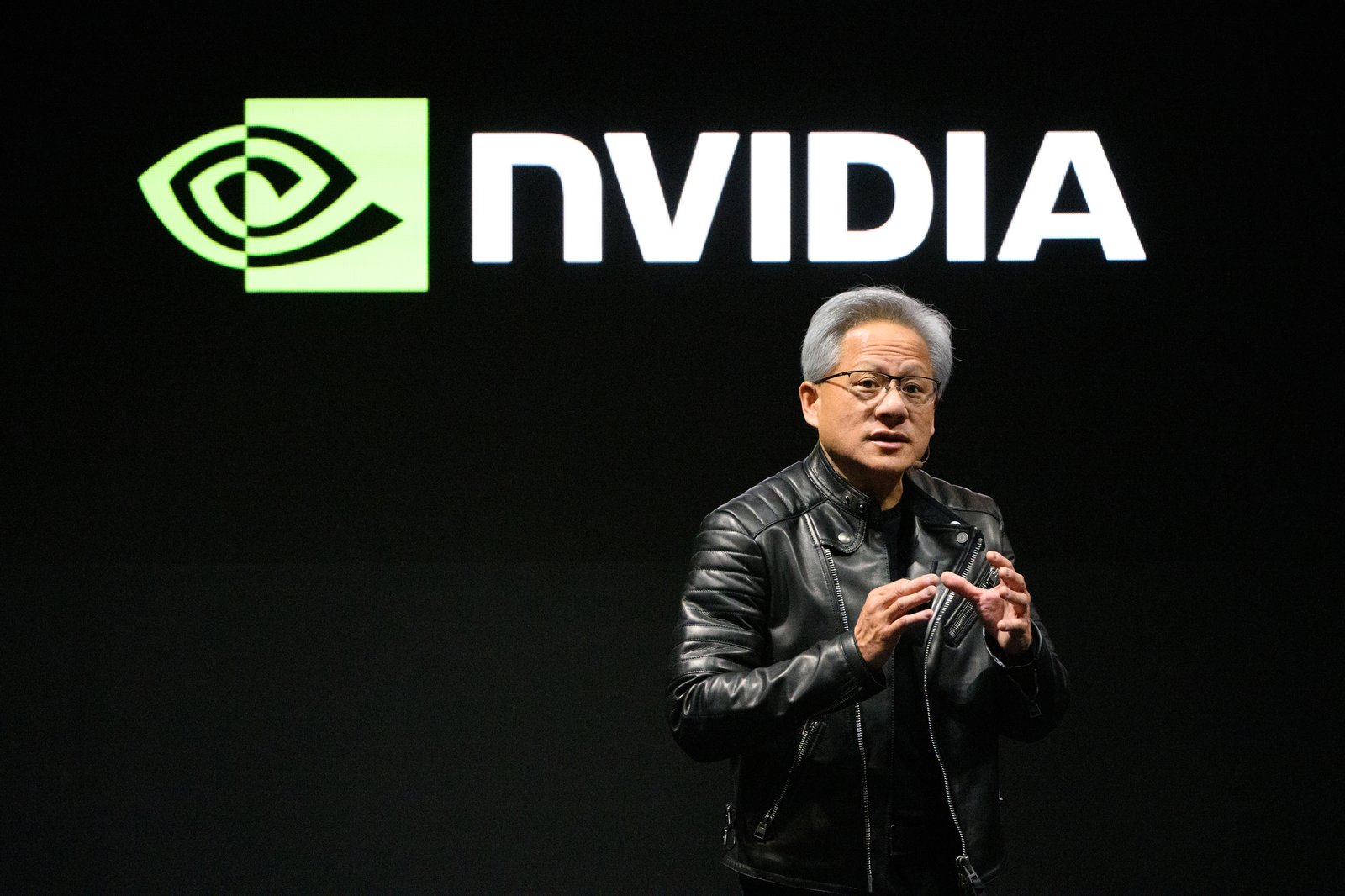
The stage was set in Tokyo, and the setting was unusual even for NVIDIA. Chief executive Jensen Huang appeared on July 16 alongside Japan’s trade minister, Ryosei Akazawa, to announce what the two governments are calling the world’s first national AI infrastructure, a state-backed computing base built specifically for physical AI, the field that gives machines the ability to perceive and control the real world. Prime Minister Sanae Takaichi joined by video.
The hardware list is the headline. The facility, to be built and operated by Noetra, a consortium of about 44 Japanese companies, will run 13,750 NVIDIA Vera central processing units and 27,500 Rubin graphics processors across 140 megawatts of data center capacity. The machines will be arranged in Vera Rubin NVL72 racks, connected with NVIDIA’s Spectrum-X Ethernet networking and BlueField data processing units, and are scheduled to come online in 2028.
The facility is a national project in a way few AI data centers are. It will support METI’s FRONTia program, a government effort to develop multimodal foundation models for AI robotics, and the models’ pretrained weights are to be shared broadly with Japanese developers, alongside NVIDIA’s Nemotron, Cosmos, Isaac GR00T and NeMo software stacks. Tokyo has pledged up to $6.2 billion to the effort, according to reports, and Noetra’s members include SoftBank, Sony, NEC and Honda.
The three-stage roadmap attached to the project shows how Japan plans to use the machine. Noetra’s first model, a reasoning system strong in Japanese-language skills, is scheduled for fiscal 2026. An omni-modal version handling text, images, video and audio is planned for 2028. A “real-world native AI” built to operate robots is targeted for 2030. Each stage is designed to turn the national compute base into working industrial technology, not just research output.
The robotics coalition announced the same day is where the project touches the real economy. NVIDIA said it is working with Fanuc and Yaskawa Electric, the two largest industrial robot makers in the world by market share, to bring AI into the robots used on factory floors. Kawasaki Heavy Industries plans to deploy the technology across healthcare, transportation, aerospace, energy and shipbuilding. Kubota is applying NVIDIA’s Cosmos models to autonomous agriculture. Fujitsu signed on as well, and Toyota expanded its existing partnership to cover factory simulation and vehicle software.
The commercial logic for NVIDIA is clear. Huang has spent the past two years arguing that the next phase of AI growth lies in physical AI, the software that controls robots, vehicles and machines, and Japan is one of the few countries that combines a leading industrial base with a government willing to fund AI infrastructure. “With AI, robots will become smart, easily adaptable and accessible,” Huang said at the Tokyo event.
Japan’s motivation is equally concrete. The country’s workforce is shrinking, its manufacturers face intense competition from China, and its government has made AI and semiconductors the centerpiece of its growth strategy. A March policy paper set a target of capturing more than 30% of the global AI robotics market by 2040, an opportunity the government sizes at about $133 billion. Building the models and the machines at home, rather than importing them, is the point of the exercise.
The deal also extends NVIDIA’s reach beyond the data center. For years the company’s business has been dominated by chips sold to cloud providers and AI companies in the United States. The Japan agreements add a new category: national digital infrastructure, purchased by governments and their partners for industrial purposes. Analysts said that category could become one of NVIDIA’s largest growth markets, with robotics alone representing a potential hundred-billion-dollar revenue stream over the next decade.
There are risks embedded in the arrangement. The facility will not open until 2028, by which time the competitive picture may look different, and the reliance on NVIDIA hardware gives the company a degree of control over a national program, a fact that has drawn attention from regulators in other countries. The open release of model weights is also a policy choice that could complicate export-control conversations, since the models will be trained on American-designed chips.
For Japan’s industrial companies, the timing could not be more important. Fanuc and Yaskawa dominate the global market for industrial robots, but their products have historically been programmed machines rather than intelligent ones. Adding AI that lets robots adapt to new tasks without reprogramming could decide whether Japanese manufacturers keep their share of the robotics market as Chinese rivals scale up.
The government’s involvement gives the project a scale that private investment alone would not support. Noetra is being built as a consortium precisely because no single Japanese company wanted to carry the cost alone, and the state’s commitment, through METI and the FRONTia program, provides the patient capital that infrastructure of this kind requires. Whether the consortium can move at the speed of the AI industry, where eighteen-month roadmaps are common, remains to be seen.
Huang’s visit left Japan with what his company hopes will be a template. The combination of national compute, open model development and industrial adoption is one NVIDIA can pitch to other governments, from the Middle East to Southeast Asia, that want a share of the AI economy. Japan, with its aging factories and its robotics expertise, was the natural first customer.
The orders of magnitude matter. Twenty-seven thousand Rubin GPUs in a single facility is enough compute to train trillion-parameter models, the class of systems Noetra’s roadmap contemplates. If the facility comes online on schedule and the models perform as planned, Japan will have what no other country has: a national AI infrastructure pointed at the one industrial segment where it still leads the world.



