
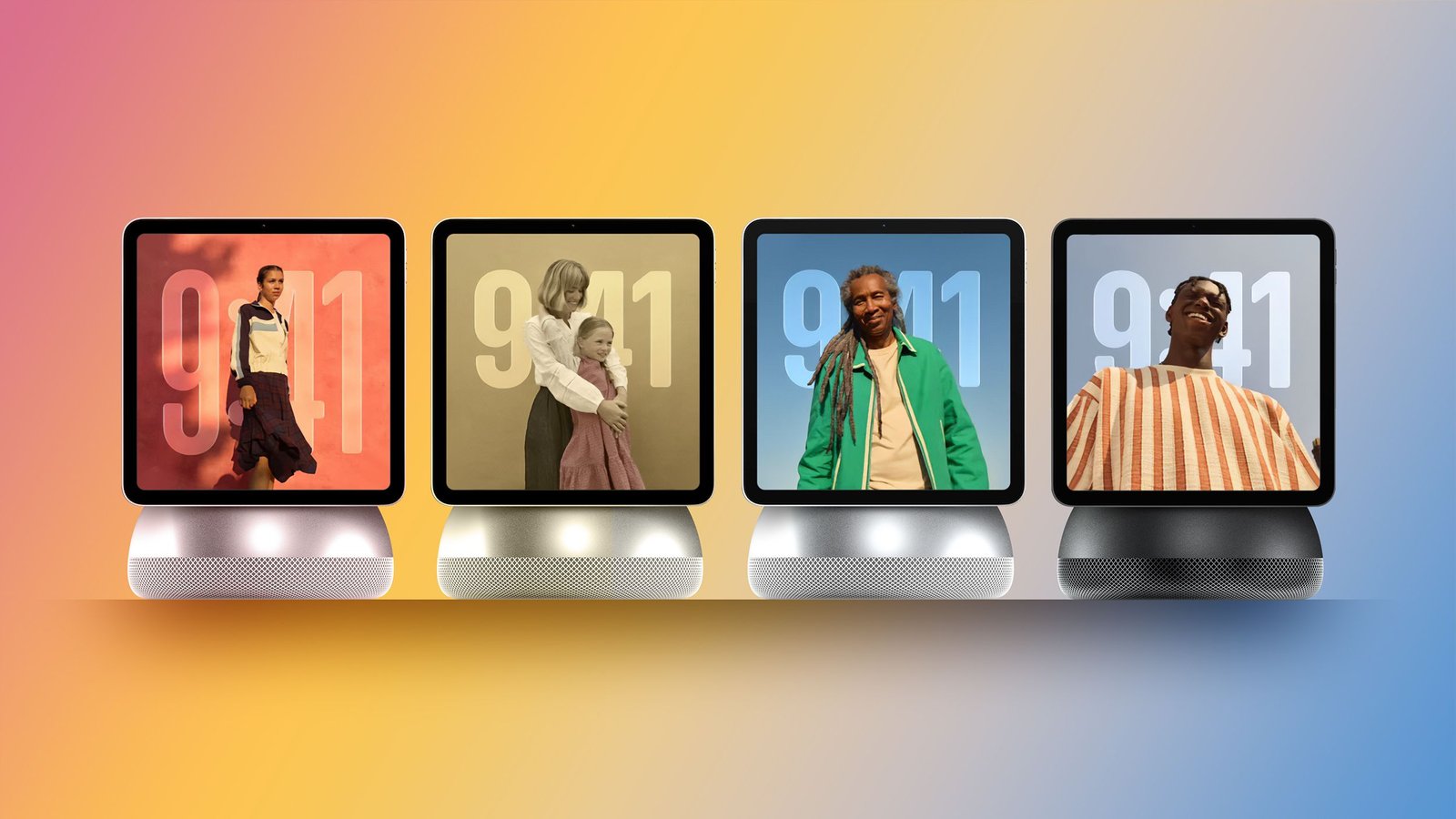
Apple has spent a decade selling devices that sit in your hand, on your wrist and on your desk. On Tuesday morning, eastern time, it will make its pitch for the room it has never owned.
The event is billed as “Welcome Home,” and the product at its centre is a smart home hub called HomeView, according to Bloomberg’s Mark Gurman, whose reporting on the device has been consistent since July. The name also turned up in a trademark filing that trade publications noticed before the company confirmed anything.
Apple has said nothing about the hardware, and the details come from people familiar with the company’s plans rather than from a product page. Those details describe a device built around a 6-inch display and the A18 chip that powers the iPhone 16, paired with 8GB of memory. It will come in two forms: a version that sits on a surface on a speaker base, and one that mounts on a wall. It will run on Siri and control lights, locks and thermostats rather than apps, and it will not have an App Store.
Apple is expected to ship it in mid-November, after the event but ahead of the holiday shopping weeks, according to the same reporting. The hub will not be alone on stage. Apple is also expected to show a new Apple TV 4K and the first substantial redesign of the HomePod mini in six years.
The absence of an App Store is the most telling choice. Apple’s other screens exist partly to sell software and services; a hub that only controls the home is an appliance, closer to a thermostat than to an iPad. That keeps the device cheap to support and hard to break, and it keeps the data on Apple’s terms. It also means the hub’s value depends almost entirely on the assistant inside it.
Which is the company’s real problem. Apple announced a rebuilt Siri with generative AI features in 2024 and then pushed the launch back more than once, leaving its devices with an assistant that trails its rivals. A control panel whose main input is voice is only as good as the voice. The new hardware gives Apple somewhere to put the upgraded Siri when it arrives, and gives the assistant a reason to exist beyond answering questions on a phone.
Apple is arriving at a crowded table. Amazon sells Echo Show displays and has tied its home hardware to Alexa+, a paid assistant. Google announced Gemini for Home alongside new Nest devices. Both have years of installed base, lower prices and assistants that already answer the questions people ask in kitchens.
Apple’s counterargument is the iPhone. Its installed base in the United States is the largest pool of customers in consumer hardware, and the smart home standards it bet on years ago, Thread and Matter, are now supported by most of the industry, which means its hub can command devices made by companies it does not control. HomeKit’s weakness was never the protocol. It was the lack of a screen in the hallway.
The stakes are small in revenue terms and large in strategy. Apple’s home and audio business is a fraction of the roughly $200 billion a year it collects from iPhones, and a hub priced like a HomePod will not move that number. What it could move is how tightly customers stay attached to the ecosystem, and the surface where services such as Apple Music, Apple TV+ and iCloud get their first exposure in a household.
The company has been closing gaps in its ecosystem for years. Watches became health devices, AirPods became hearing aids, and the iPad became a laptop for some buyers. The home was the one place Apple had no screen of its own, and the wall is the last surface it has never occupied.
Analysts said the deciding factors will be price and the assistant, neither of which Apple has disclosed. A hub that sells for $399 competes with tablets; one that sells for $150 competes with alarm clocks. The middle of that range is where a screen that mostly answers questions has to justify its place in a kitchen.
The timing also puts the product in front of reviewers and regulators during a holiday quarter, with the new Siri still absent in finished form. Apple has been here before with devices that arrive ahead of the software that makes them worth owning: the first Apple Watch, the first HomePod, the first Vision Pro. Each eventually found its users, after months of criticism and several software revisions.
That is the bet HomeView represents. Apple is not trying to win the smart home in November. It is trying to be in the room when the answer to what a home’s screen should do is finally settled.



