
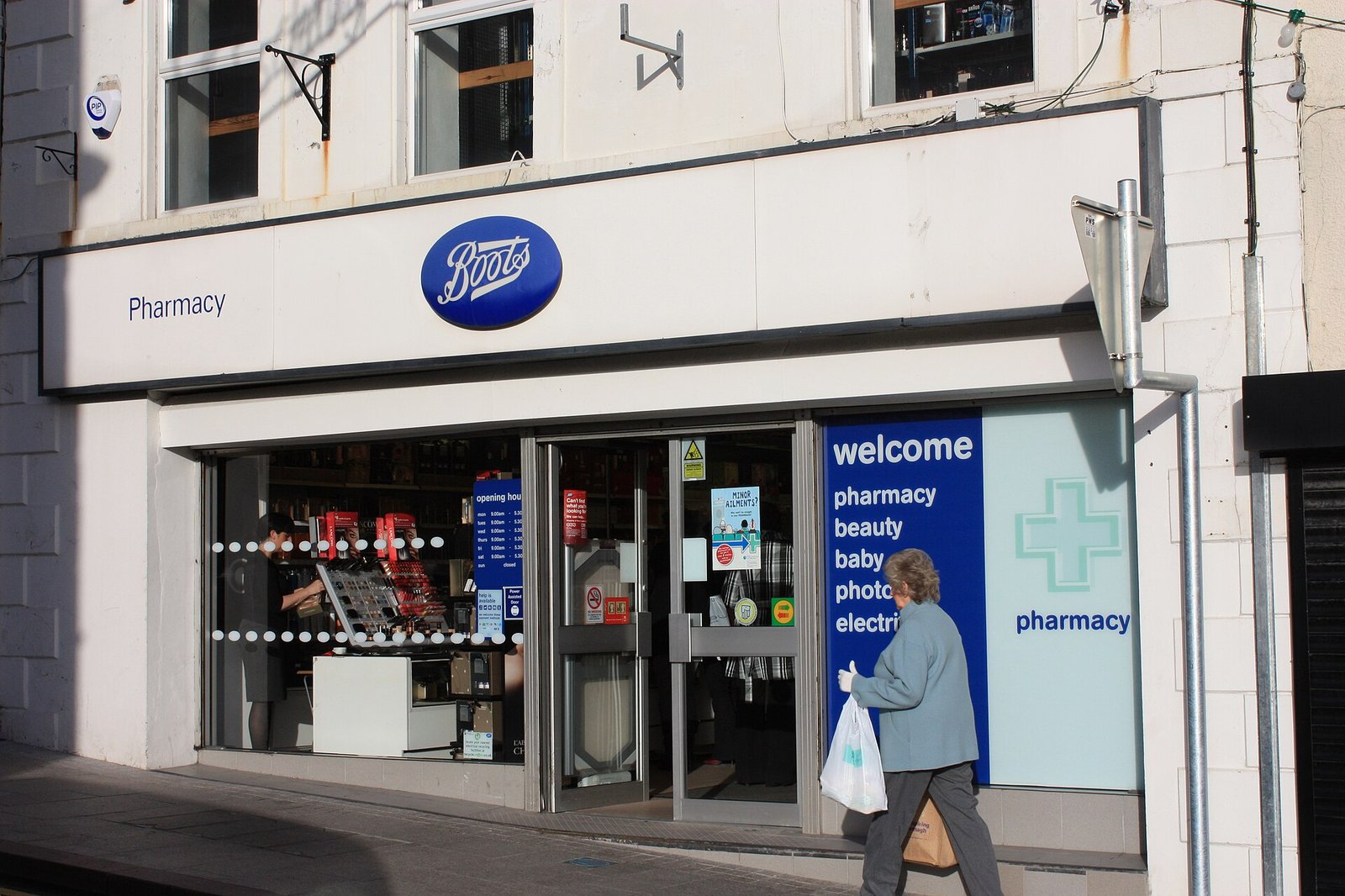
The Boots name has been on British high streets for 177 years, long enough that a pharmacy chain of its size reads as infrastructure rather than retail. On October 7, Wittington Investments, the holding company of Canada’s Weston family, agreed to buy it for $8.9 billion including assumed debt, from the private equity firm Sycamore Partners and the Pessina family.
The package includes Boots’ retail operations in the U.K. and Ireland, its opticians business, the No7 Beauty Company, and its operations in Thailand and franchised markets. Fairfax Financial Holdings, the Toronto insurance group run by Prem Watsa, is partnering on the transaction.
To a Canadian, the structure is legible. Wittington’s interests include Loblaw, the country’s largest grocer, which bought Shoppers Drug Mart in 2014 for about C$12.4 billion. That chain learned to run three businesses in one building. Cosmetics and skin care at the front door pull in traffic, particularly younger customers. The pharmacy counter behind them fills the higher-margin prescriptions. The loyalty program connects the two and tells the owner what each customer buys, and when she is due to buy it again.
Weight-loss medicines are the part of that model with the most momentum. GLP-1 drugs are chronic treatments, which means a patient who starts one is a customer for years, provided the prescription is renewed, the side effects are managed and the refill arrives on time. A pharmacy that handles all three keeps the relationship. A pharmacy that fills a bottle and does nothing else loses the patient to a mail-order competitor within two months.
That is the argument for buying a chain rather than a molecule. Analysts said the price reflects Boots’ real estate, its brand and, above all, its patient base, which is expensive to assemble and impossible to replicate with marketing spend alone. In Canada the same logic has been tested long enough to be boring, and boring is what a large acquirer wants.
For the GLP-1 developers listed in Hong Kong, the deal points somewhere specific. Over the past two years Chinese metabolic drugmakers have moved from selling compounds outright to licensing them to global partners. Jiangsu Hengrui Pharmaceuticals agreed in late September to license HRS-1596, an experimental once-weekly oral GLP-1 and GIP candidate, to Novo Nordisk, which will pay $300 million upfront and up to $2.3 billion more in later payments tied to development and sales targets, for rights outside Greater China.
The lesson of Boots is that the commercial layer on top of those molecules is a business in its own right, with its own assets and its own buyers. A Chinese developer that wants its drug sold in Britain, Germany or the United States has three options: build a sales force, hire a contract organization, or hand the product to someone who already owns the counter. Only the third comes with refill data.
A person close to the deal said the acquired businesses will be run for cash flow and health care services rather than store expansion, which matches what the Canadian owner has done elsewhere. Boots’ footprint is large, its high street locations are costly, and the U.K. pharmacy funding system has squeezed margins for years. The buyer is not paying $8.9 billion for the shopfronts.
The buyer has said as much in public. Wittington pledged to invest in Boots’ stores and online operations and to expand health care services, which is the language of a company buying a platform rather than a portfolio of leases. In Canada the health care side includes pharmacist-led clinics, travel and vaccination services, and the kind of repeat contact that turns a shopper into a patient.
Britain is a harder market than Canada in one respect and easier in another. Pharmacy funding is set nationally and has tightened for years, which limits what a counter can earn on a standard prescription. Against that, the population is aging, the National Health Service is handing more routine care to community pharmacies, and a chain with national scale can negotiate with suppliers and with payers in a way independent chemists cannot.
There is a version of this transaction that goes wrong in a familiar way. Chains assembled by private equity are usually trimmed of cost, and chains bought for their customer relationships need investment in exactly the places that trimming targets: staff behind the counter, software that tracks adherence, digital tools that keep a patient on therapy. Weston has the balance sheet to fund that, and it has run the experiment before, which is the strongest argument the deal has.
An equally familiar risk sits on the pharmaceutical side. The pharmacy model depends on prescription volume and reimbursement rates, both of which governments set. A drug that moves from a weekly injection to an oral tablet changes the dispensing economics. A therapy that ends after a fixed course would end the refill annuity that makes a patient base valuable in the first place.
Analysts covering the Asian developers said the transaction is unlikely to move share prices on its own. Its importance is directional. It shows where returns accumulate in the obesity market, and it shows that much of the value sits downstream of the molecule, in a building with a pharmacist behind the counter and a customer who comes back.



