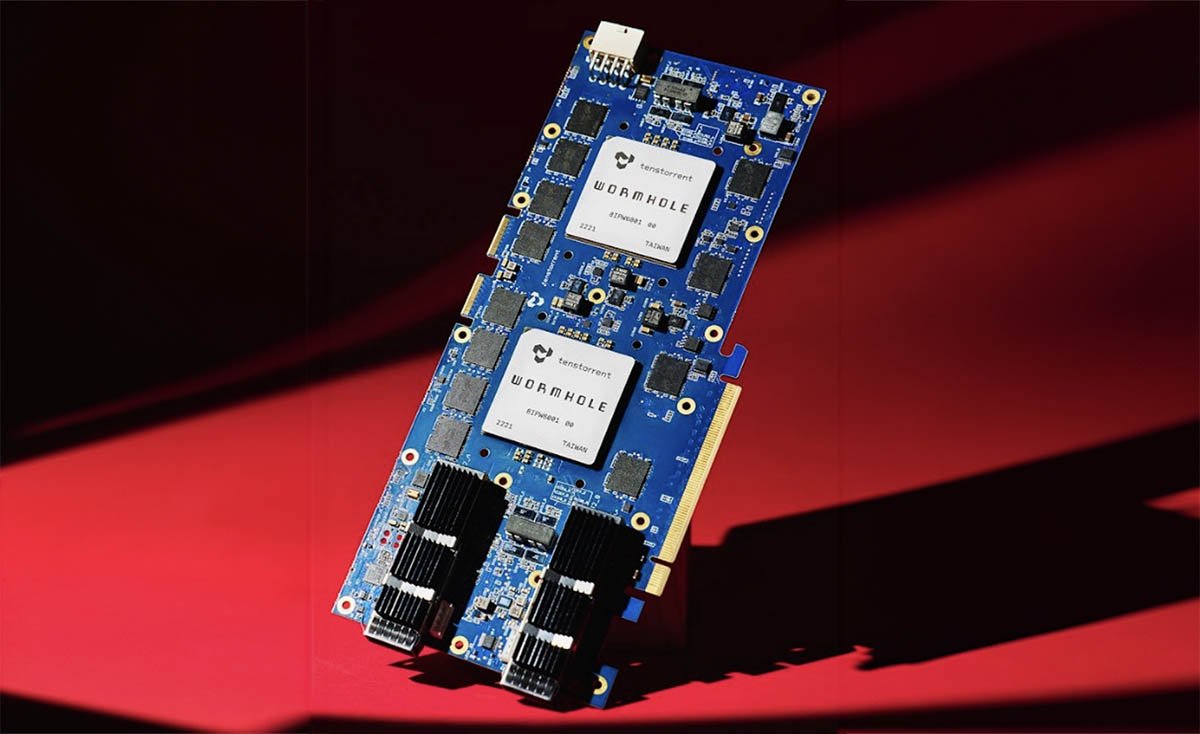
For five years Tenstorrent has sold itself as the chip company that would rather license its designs than become another capital-hungry manufacturer of accelerators. On October 17 the company hired investment banks, according to Bloomberg, and the mandate covers two jobs at once: raising another round and fielding interest from buyers.
Intel and Qualcomm have both made contact, the report said. Qualcomm had earlier denied a report that it was weighing an acquisition at a valuation of 8 billion to 10 billion dollars, a denial that now reads less like a rejection of the strategy than a dispute about the price.
Running a financing and a sale process in parallel is standard practice for a company of this size, and it is usually a statement about the shape of the market rather than about the intentions of management. A startup that can raise privately at a good price does not need to talk to strategic buyers. A startup that talks to two of them at once is telling the people who might fund it that there is another bidder in the room.
Tenstorrent was founded in Toronto in 2016 and has spent most of its life in the part of the semiconductor business that does not require a fabrication plant. It designs artificial intelligence accelerators and RISC-V processors, sells chips and systems to researchers and smaller cloud operators, and licenses pieces of its design to manufacturers that want to put AI silicon into their own products. Jim Keller, who took over as chief executive in 2023, is the most prominent argument the company has: a designer with a record at Apple, Tesla and Advanced Micro Devices who has been publicly skeptical of the amounts of money being spent on the largest training clusters.
That skepticism is now the company’s problem as much as its pitch. The buyers who set the terms of the AI hardware market are spending against forecasts of demand that assume continued growth in the largest models. Tenstorrent’s products are aimed at inference, at the cheaper work of running a model once it has been trained, and at customers who want the silicon inside their own products rather than in a rented data hall. Both are real markets. Neither is the market where the largest checks are being written.
The licensing business explains why a sale is plausible and why it is complicated. A company that sells chips has customers who can be counted and revenue that arrives with each shipment. A company that licenses designs has partners whose products will not ship for two years, and whose payments are tied to delivery dates the licensor does not control. Buyers pay less for the second kind of revenue, which is one reason the valuation conversation has been difficult. Tenstorrent has announced licensing agreements with Korean manufacturers and has positioned its RISC-V cores as an alternative to the instruction set architectures that dominate the market, but licensing revenue arrives slowly and in lumpy increments.
For Intel, the logic is a mix of technology and talent. The company is trying to build a foundry business that needs customers willing to design chips for its process, and it has a product line that competes for the same inference workloads Tenstorrent targets. Buying a design team would give it both, at a moment when its own roadmaps have slipped and its credibility with customers depends on shipping on schedule. The counterargument is that Intel has spent the past three years cutting costs, and a large acquisition would be hard to explain to investors who were promised discipline.
For Qualcomm, the appeal is diversification away from phones. The company has been pushing into automotive and personal computers and has said it wants a larger share of data center spending. Its denial of the earlier report suggests that any conversation is at an early stage, and that the number being discussed is below what the company considers reasonable.
Analysts who cover the sector said the more informative signal is not which buyer appears but what a deal would do to the licensing model. A strategic owner has every reason to keep a design out of the hands of competitors, which is precisely what a licensing business cannot do. Customers who chose Tenstorrent because its cores were available to anyone would have to price in the risk that the next generation arrives only inside a rival’s product.
There is also the question of what the banks were hired to find. A sale of the whole company at 8 billion dollars would be a modest outcome for a business that has raised money on the premise of competing with Nvidia. A licensing deal, a minority investment from a strategic partner, or a sale of a business unit would each produce a different headline and a different set of obligations for the engineers who remain.
The people who matter most in this decision are the customers with designs in progress. A chip design takes years, and a change of ownership in the middle of one is the kind of event that gets written into contracts as a termination right. Whatever Tenstorrent announces, the first calls its sales team makes afterward will be to the partners whose products depend on the company still being the company they signed with.