The number announced in Berlin on October 20 was more than 16 billion euros, about 18 billion dollars, and the detail that mattered was buried in the qualifier: this is the 2027 figure, not a multi-year total. Amazon said the money would go to data centers and artificial intelligence infrastructure, to its Leo satellite broadband service, to the logistics network, and to German programming for Prime Video.
The distinction is not pedantic. Corporate investment announcements in Europe usually aggregate commitments across five, ten or fifteen years, which lets a company describe a decade of ordinary capital spending as a single gesture. A one-year figure of this size implies either a sharp increase in the German buildout or a bundling of categories that would normally be reported separately.
Both readings are probably right. Amazon Web Services has been building in the Frankfurt region since 2014 and announced a separate multi-year plan for Brandenburg in 2024, tied to the sovereign cloud it sells to European governments and regulated industries. Data centers are the most capital-intensive part of the company and the part most constrained by permits and grid connections.
The announcement was made at a summit the German government calls Invest in Germany, with Chancellor Friedrich Merz in the room. Merz used the occasion to tell German companies to adopt artificial intelligence faster, a message that has become a refrain in Berlin as the country’s industrial base reports weak orders and its automakers cut jobs.
The political logic is easy to follow. Germany is competing with Britain, France, the Gulf states and a dozen American states for the same capital, and the competition is no longer about tax rates. It is about how quickly a large electrical load can be connected, how much the power costs, and whether the planning authority that controls the site can be moved.
On two of those three, Germany struggles. Industrial electricity prices remain well above American levels, and the permitting process for new transmission runs into the same local objections that slow projects in the United States. What Germany offers is engineering talent, a dense base of industrial customers, and a government that has decided compute is a strategic industry.
The satellite piece is the newest. Amazon Leo, the constellation the company once called Project Kuiper, is being positioned as a consumer and enterprise broadband service that competes with Starlink. Germany is one of the largest broadband markets in Europe and one of the most regulated, with rules on spectrum, landing rights and universal service that a new entrant has to satisfy before it can sell a subscription.
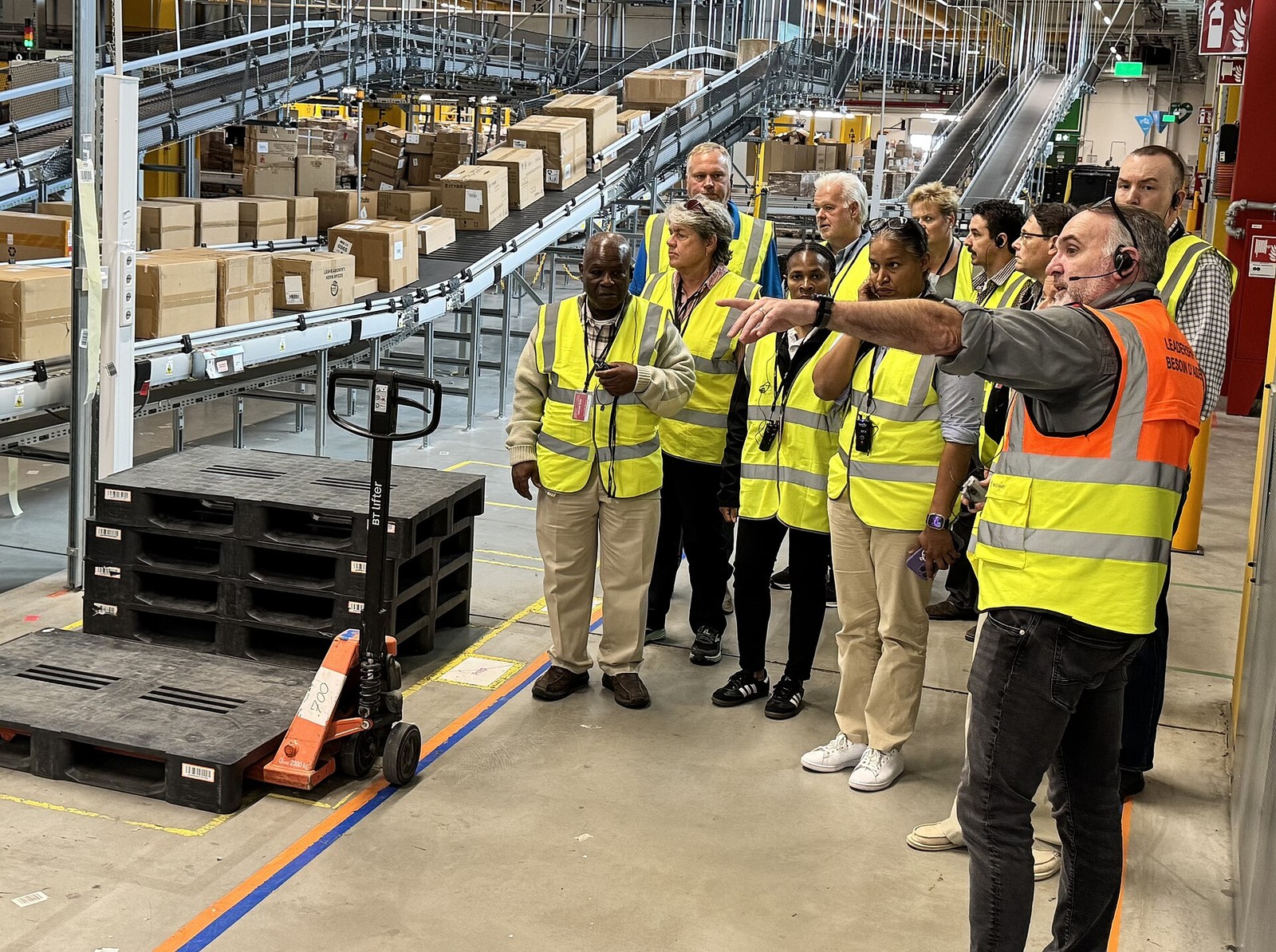
Logistics is the part of the plan that pays back fastest. Amazon’s German fulfillment network handles the company’s largest market outside the United States, and each new delivery station is a smaller, more predictable outlay than a data hall. The company has been expanding same-day delivery in German cities, which requires sorting capacity close to customers rather than one large building on a motorway.
Prime Video’s German content budget is the smallest line item and the one with the clearest political return. Local production creates visible jobs in a sector governments like to be seen supporting, and it gives the company a reason to be in the room when cultural funding is discussed.
None of this is unusual on its own. What is unusual is the compression. A single year of German spending at 16 billion euros would exceed what most American technology companies have committed to the country over a decade, and it would make Germany one of the largest recipients of Amazon capital outside the United States.
The comparison that will be made is with the company’s American buildout, where the capital budget has reached roughly 220 billion dollars this year and where the cost has begun to show in free cash flow. Amazon reported negative free cash flow of 7.6 billion dollars over the twelve months to June, against positive 1.8 billion a year earlier. A German program of this size is small against that number and large against anything the country has seen.
What the announcement does not establish is how much of the 16 billion euros is new. Companies routinely count spending they had already planned, and the categories here span four businesses with different approval cycles and different returns. The data center portion is the one that will be watched, because it is the one that requires power.
That is where the German plan runs into the constraint that has slowed projects everywhere. A hyperscale campus needs hundreds of megawatts, delivered on a schedule, and the German grid operators are working through a queue of applications from data centers, heat pumps and electric vehicles at the same time. Amazon’s own answer in the United States has been to buy nuclear output directly, an option Germany does not have after closing its last reactors in 2023.
The company has said it will invest, and the government has said it welcomes the investment. What neither has published is a list of sites, a megawatt figure, or a date by which the capacity will be energized. Those are the three numbers that turn an announcement into a building, and they will be the ones to check in 2027.