For most of its twenty-four years, SpaceX sold one thing: the ability to put mass in orbit more cheaply than anyone else. On Tuesday evening, Elon Musk spent the opening stretch of an earnings call talking about data centers.
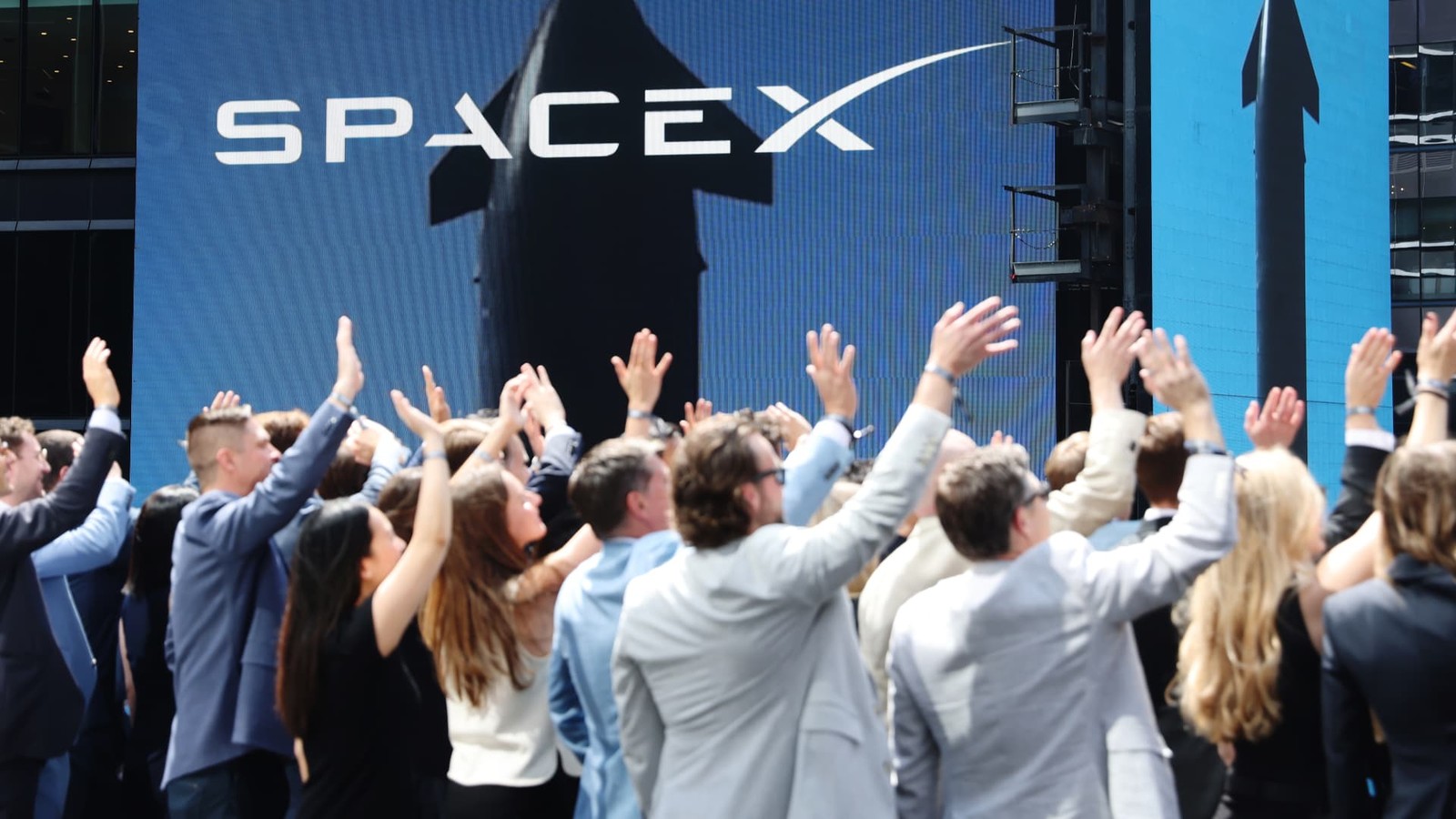
The company reported third-quarter revenue of $14.6 billion, up 161% from a year earlier and well above the $12.86 billion that analysts surveyed by Visible Alpha had expected. Net income was $4.4 billion, against a loss of $1.1 billion in the same period last year. It was the second quarterly report since SpaceX listed in June, and the first to show an operating profit.
The mix of that revenue has changed faster than the totals. The unit SpaceX calls Super Intelligence, which rents computing capacity to customers including Anthropic, Google, and Musk’s own X and Grok, booked $7.6 billion, against $6.3 billion expected and about $2.6 billion in the prior quarter. Connectivity, mostly Starlink, brought in $5.3 billion, up 69%. Space, the launch business that built the company, contributed $1.8 billion, an 84% increase from the second quarter and now a small slice of the whole.
Adjusted earnings before interest, taxes, depreciation and amortization came to $8.8 billion, a 306% increase. Capital spending was $19.6 billion in the quarter.
Shares rose about 8% in extended trading. The stock has been volatile since the June listing, which priced the company at a valuation that assumed the rocket business would eventually be joined by something larger. That assumption now has a quarterly number attached to it.
The mechanics behind the AI line are simple and uncomfortable for anyone who expected the compute trade to belong to the chipmakers and the hyperscalers. SpaceX built launch capacity, then satellite broadband, then ground stations and power contracts, and discovered that the same industrial base could host racks of accelerators. Musk said on the call that compute remains so scarce that older Nvidia chips rent for more per hour than newer ones, a statement that describes a market where the constraint is electricity and floor space rather than silicon.
Starlink added 1.6 million consumer subscribers in the quarter, short of the 2.29 million analysts had penciled in. Connectivity operating income nearly doubled to $2.37 billion, which suggests the satellite business is now generating cash rather than consuming it. That cash is being spent. Capital investment is expected to rise from roughly $70 billion this year toward $197 billion in the 2028 fiscal year, according to figures cited by Melissa Otto, who leads Visible Alpha research at S&P Global.
That spending plan is the part of the story that carries the most risk. A company that once priced rockets against a handful of government and commercial contracts now buys electricity, land and cooling at a scale that only a few utilities can serve. Otto’s figures imply debt rising from about $50 billion in 2025 to $350 billion by 2029, a balance sheet that would make SpaceX one of the largest corporate borrowers in the country.
The AI unit also carries a customer problem that the launch business never had. Its tenants are the same companies building models that compete with Musk’s own products, and at least two of them operate their own data centers. Capacity is scarce enough this year that they will pay for his. Whether they will keep paying once their own campuses come online is a question the quarterly numbers cannot answer.
Then there was the other announcement, delivered almost as an aside. Musk confirmed that the boards of Tesla and SpaceX have each formed a special committee to evaluate a merger, and that he is not a member of either. The combined company would be worth about $3.5 trillion.
The structure he described is unusual in one respect. Musk said the transaction would require approval from a majority of Tesla’s shareholders, not merely a majority of votes cast at a meeting. Delaware courts have spent years distinguishing between those two standards in cases involving controlling shareholders, and the stricter one is the safer ground when the chief executive of both companies stands to gain.
For Tesla holders, the trade is a swap of an automaker’s margin problem for a launch and compute company’s capital problem. For SpaceX holders, it is the reverse. Neither side has been given a price yet, and the committees have not said whether they will recommend anything at all.
What the quarter does establish is that the company Musk has described for years as a transportation business now earns most of its money from renting time on machines that think. The $1 trillion revenue target for 2028 that he floated on the call is a forecast, and forecasts from this chief executive have historically been directions rather than destinations. But the base it would grow from is no longer hypothetical.
One date matters more than the rest this week. About 1.3 billion SpaceX shares become eligible for sale on Thursday, the first real test of whether public holders treat the AI revenue as durable or as a cycle. The stock’s reaction to a lockup expiry will say more about investor conviction than any projection offered on the call.
Musk framed the $1 trillion figure as an arithmetic possibility rather than a promise, telling analysts the target had stopped being impossible. That is a lower bar than it sounds, and a far higher one than the company could have cleared two years ago, when the largest single line of revenue was a satellite dish.