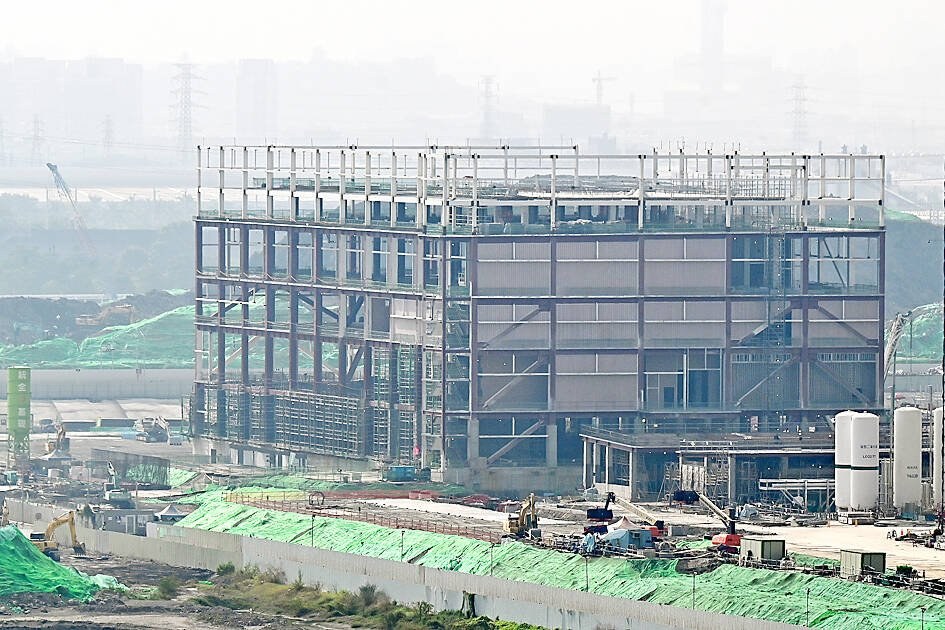
The call reached the Kaohsiung fire department at 4:53 p.m. on Tuesday. Four workers had fallen from a steel structure being erected at TSMC’s Fab 22 in the city’s Nanzih District. All four were taken to hospital. None survived.
The last of them died on Wednesday morning, and the Southern Taiwan Science Park Bureau confirmed the toll of four that day. It was the deadliest accident at the site since construction began, according to the Liberty Times, the Chinese-language sister paper of the Taipei Times.
TSMC suspended steel structure work at all of its construction sites in Taiwan and said it would cooperate with labor inspections. The suspension covers projects beyond Kaohsiung, which is a recognition that the method, not the site, is the issue: the same contractors pour and bolt steel frames at every fab the company is building.
The bureau said a preliminary assessment pointed to aged bolts. According to the Central News Agency, connecting plate screws snapped while workers were hoisting and installing steel beams, and the four fell several storeys. The workers were employed by Shang Hao Machinery, a contractor, not by TSMC.
That detail shapes what happens next. The bureau said work would resume only after Shang Hao submits an improvement plan that passes review, and that penalties would be determined by the investigation and the relevant occupational safety law. The immediate power to restart the work sits with a subcontractor, while the schedule that produced the pressure sits with the company at the top of the chain.
Fab 22 is central to TSMC’s most important product transition. The Kaohsiung complex, together with the company’s Hsinchu sites, is where 2-nanometer production is being installed, the process that makes the accelerators and processors at the center of the AI buildout. The site has been on an accelerated schedule, and the section where the accident happened was part of that push.
The competitive cost of a delay is easy to state. Samsung and Intel are both trying to win 2-nanometer customers in the same window, and the first company able to deliver volume at acceptable yield sets the price that the others have to match. Every week of construction slippage moves that window, which is why completion dates on these projects are set by commercial commitments rather than by the trades doing the work.
Construction accidents in Taiwan’s semiconductor buildout are not new, and the pattern is familiar: a global shortage of leading-edge capacity, aggressive completion dates, and work subcontracted through several layers, with the workers at the bottom of the chain carrying the physical risk. The industry’s answer has been inspection and penalties after the fact, which is the response available when a schedule is treated as fixed and safety as a constraint to be managed around.
Whether the accident moves TSMC’s output plans is a question the company has not answered. Steel erection is an early stage of fit-out; tool move-in comes later, and the cleanroom work that determines when wafers start is done by different trades. A short suspension of structural work at other sites costs days. A prolonged review of hoisting procedures across every project costs more, and TSMC has not said how long the pause will last.
The company’s customers have no alternative that is cheaper. Advanced packaging and leading-edge logic are concentrated in Taiwan to a degree that governments now treat as a strategic risk, which is why TSMC is building in Arizona, Kumamoto and Dresden. Every one of those projects also competes for the same experienced construction crews and the same safety supervision, and the fabs that are behind schedule are the ones under the most pressure to compress the work.
The bureau’s finding of aged bolts, if it holds, will focus attention on inspection of fasteners and on whether the contractor’s material controls were adequate. Those are narrow answers to a broader question about how a company that runs its factories to tolerances measured in atoms supervises the firms that build them. TSMC’s own safety record inside operating fabs is strong. The record on construction sites belongs to a chain of suppliers it hires and does not directly employ.
For the four workers, the sequence of decisions that ended at 4:53 p.m. will be reconstructed by inspectors over the coming weeks, and the file will produce a penalty and a written procedure. What the file will not produce is a schedule change unless the company chooses one.
TSMC has spent this year telling investors that its capacity is sold out and that its customers are asking for more. That is the pressure under which the Kaohsiung site has been built. The company now has to decide whether the pause stays limited to steel work or extends to the pace of the whole project, and it has given no indication which way it is leaning. The bureau, for its part, has set one condition that is easy to state and hard to verify: a plan that passes review.