The number that matters in OpenAI’s latest release is not a benchmark score. It is the dollar figure attached to finishing a task.
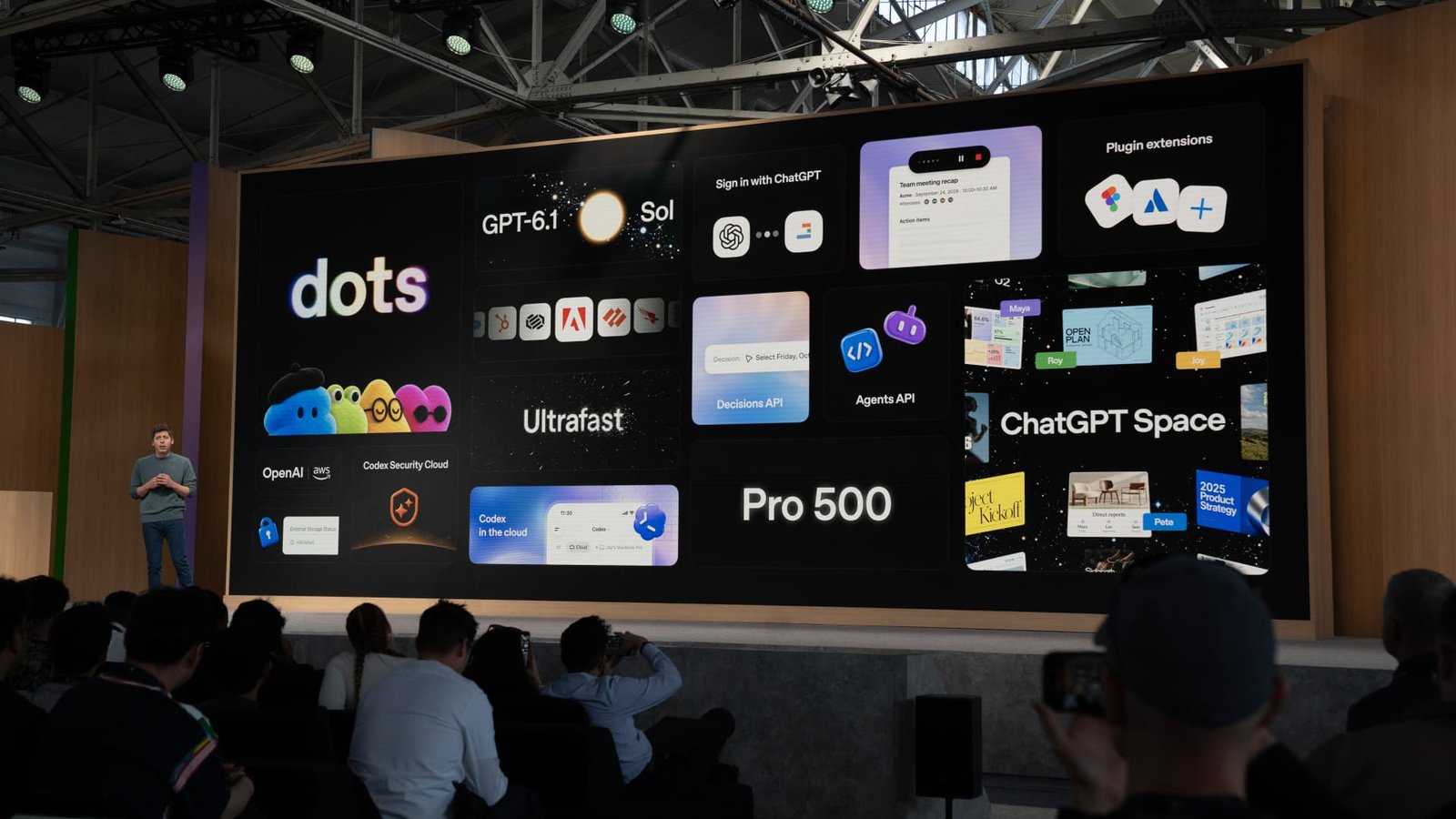
GPT-6.1 Terra, released on Oct. 26 as gpt-6.1-terra, carries list pricing of $1 per million input tokens, $0.05 per million cached input tokens and $5 per million output tokens, according to the company’s rate card. That is half what OpenAI charged for the model it replaces, GPT-5.6 Terra, and half the input price of GPT-6.1 Sol. The model is available in the API, in ChatGPT Work and in Codex. It is not in the consumer chat product.
OpenAI describes the release as a fast, efficient model for visual reasoning, precise computer use and writing. The tasks it names are the ones that fill an office day: drafting proposals, reading technical drawings, filling in forms, editing video. The company says the model completes agentic work about three times as efficiently as its predecessor, a claim that will be tested by customers rather than by a press release.
The more useful disclosure came with the benchmark table, which paired accuracy with cost per task. On Agents’ Last Exam, an evaluation built from professional work, Terra scored 60.0% at maximum effort at a cost of $1.01 per task. GPT-5.6 Terra scored 50.7% at $3.58. GPT-6.1 Sol scored 58.6% at $2.00. The flagship, GPT-6 Astra, scored 59.3% at $7.24. Anthropic’s Claude Opus 5.5 scored higher at 63.2%, at $8.82 per task.
Read that column twice. The new mid-tier model is about as accurate as the flagship on that evaluation and costs a seventh as much to run. It is slightly behind a rival’s best model on accuracy and nearly nine times cheaper per completed task.
On MMMU-Pro, which tests visual reasoning, Terra reached 85.5% at $0.012 per task, against 81.7% at $0.079 for its predecessor. Sol scored 86.3% at $0.013 and Astra 86.7% at $0.065. The gap between the cheap model and the expensive one, in accuracy, is measured in tenths of a point. In cost, it is measured in multiples.
This is how a model family gets priced when the constraint moves from capability to deployment. For two years the question buyers asked was which model could do the work. The question now is which model can do it at a cost that leaves a margin, because the work has become routine: reading an invoice, transcribing a form, watching a screen and clicking the right field.
Pareekh Jain, chief executive of the consulting firm EIIRTrend, said enterprises need models that balance intelligence, speed and cost, and that frontier models remain too expensive for routine tasks while smaller ones lack the ability. Terra, he said, is aimed at that gap, where Anthropic’s Claude Sonnet and Google’s Gemini Flash also compete.
The tiering inside OpenAI’s own lineup tells the same story. GPT-6 Luna sits below Terra on price. GPT-6.1 Sol and GPT-6 Astra sit above it on capability, with Astra priced at $5 per million input tokens and $25 per million output tokens. A customer with a hundred thousand documents to process picks by arithmetic, not by preference, and the vendor that owns the cheapest adequate option captures the volume.
Volume is where the money is moving. Agentic workloads do not consume tokens the way chat does. A single task that opens a browser, reads a page, fills four fields and checks a confirmation can run through tens of thousands of tokens, most of them the same system prompt and context sent over and over. Cached input priced at $0.05 per million tokens is the mechanism that makes repetition affordable, and it is why the input price cut matters more than the output price.
There is a countervailing cost that the rate card does not show. Agents that run unattended fail in ways that require a human to notice, and the expense of noticing falls on the customer. A model that is 85% accurate on a form is useful only if the remaining 15% is caught cheaply. OpenAI’s answer is that threefold efficiency, which in practice means fewer retries and shorter loops, and it is the claim most worth verifying in production.
The release also carries an administrative footnote that matters to some buyers. Terra does not support inference residency in the United Arab Emirates, a restriction OpenAI attributes to where the computation runs rather than to where the customer is. For companies with data-locality commitments in the Gulf, the cheapest adequate model is not available.
Competitors are moving on the same logic. Anthropic has priced its mid-tier models to undercut its flagship, Google has done the same with the Flash line, and Chinese developers have pushed list prices lower still. The direction of the market is toward capability that arrives at a lower price each quarter, which is good for buyers of automation and awkward for anyone who underwrote a business on premium per-token margins.
For OpenAI the calculation is different from a pure price war. The company sells subscriptions, an API and, increasingly, capacity booked years in advance. Cheap tokens expand the set of jobs customers are willing to hand to a model, and each additional job is another reason to keep the subscription. The 50% cut is a bet that the volume it unlocks is worth more than the margin it gives up.
The test will show up in usage data over the next two quarters, not in a launch post. What the launch does establish is a price: a professional task, executed by a model that scores within a point of the frontier, for about a dollar. Whatever else changes, that is the number competitors now have to beat.