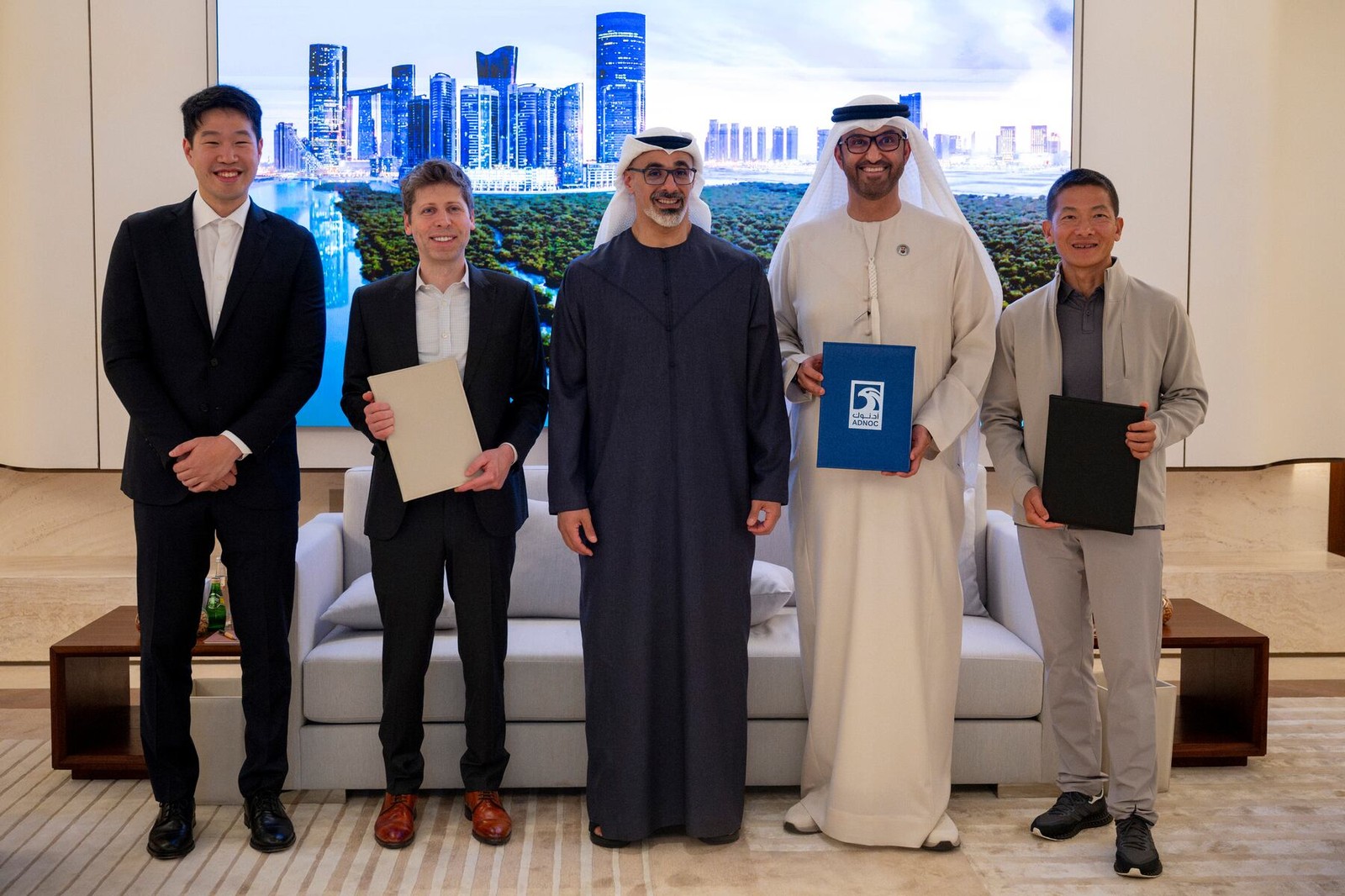
The agreement was signed on the exhibition floor at ADIPEC on Monday morning, with the crown prince of Abu Dhabi in the room and a state oil company on the other side of the table. It was one of four agreements announced the same day between Abu Dhabi entities and OpenAI, spanning energy, government and investment.
Abu Dhabi National Oil Co., G42 and OpenAI signed a multi-year partnership that makes ADNOC the first company in the energy sector to deploy OpenAI’s Frontier platform, according to a statement from the companies. The work will run across ADNOC’s operations, tying together operational, investment and commercial decisions in what the company describes as a single decision layer. The models will run on inference infrastructure based in the United Arab Emirates.
G42 signed through its subsidiary Inception42, which has become the vehicle for most of the group’s work with American AI labs. Sheikh Khaled bin Mohamed, crown prince of Abu Dhabi and chairman of the Abu Dhabi Executive Council, met OpenAI chief executive Sam Altman before the signing and witnessed the agreements.
The other three deals explain why the energy contract is the smallest part of the announcement. Mubadala, Inception42 and OpenAI agreed to apply the models to investment analysis, opportunity screening and risk assessment. The Abu Dhabi government and OpenAI launched an initiative to publish policies and regulations in machine-readable form, so that software can check compliance on permits and certificates while officials keep the final decision. Its first pilot, run by the Department of Government Enablement with the Abu Dhabi Agriculture and Food Safety Authority, covers food imports. Inception42 and OpenAI also signed a five-year agreement to spread frontier models across government, enterprise and education in the emirate.
“Abu Dhabi and the UAE are setting a bold, global standard for AI integration across both the public and private sectors to make sure the benefits of AI reach everyone,” Mr. Altman said in a statement. “We are proud to support the UAE’s ambition, anchored in a shared commitment to safety, accessibility and responsible innovation.”
Speaking at the conference, Mr. Altman described the constraint on this kind of deployment in physical terms: costs can fall almost everywhere in a business, he said, but atoms remain atoms. The line lands differently at an oil company than at a software company. ADNOC’s operations involve wells, pipelines, LNG trains and a workforce of tens of thousands, and the returns from better scheduling or faster maintenance decisions are measured in barrels rather than in keystrokes.
The Abu Dhabi relationship is also a financing relationship, and that is where the day’s arithmetic sits. OpenAI is seeking up to $20 billion in a new round co-led by investors from the UAE, CNBC reported on Saturday. The round has been discussed at a valuation of about $1.25 trillion, below the $1.4 trillion the company had hoped for, according to people familiar with the discussions. MGX, the Abu Dhabi fund, has backed both OpenAI and Anthropic, co-leading the $122 billion OpenAI round in March and Anthropic’s $30 billion raise in February.
Mr. Altman has been racing to close that round before Anthropic’s expected listing in mid-November, a timetable that has shaped his travel. He arrived in Abu Dhabi days after reports that the OpenAI round had been trimmed. The Gulf, which spent the past two years promising to become an AI hub rather than an oil exporter, is now the largest single source of external capital for both leading labs.
There are limits to how much of this the deals can lock in. Advanced American chips shipped to the region remain subject to U.S. export licensing, and any tightening in Washington would weigh directly on the inference capacity that ADNOC’s deployment depends on. The region’s appeal has also been tested by conflict, which has complicated the data-center build-out that Gulf funds have underwritten.
For ADNOC, the commercial logic is narrower and older than the artificial intelligence story around it. State oil companies have run optimization software for decades, from reservoir simulation to refinery scheduling, and have generally bought it from Schlumberger, Halliburton or in-house teams. Buying frontier models as a service, with a partner that also holds a stake in the vendor’s financing, is a different kind of procurement: less capital tied up in software, more dependence on a single American supplier.
Executives at the company have said publicly that the aim is to be the most AI-enabled energy company in the world, a phrase that appears in its own materials and now has a contract behind it. Whether the models improve recovery rates or shorten maintenance outages will not be visible in a press release. It will show up in unit costs over several years, and in whether the emirate’s other state enterprises follow with their own deployments.
The machine-readable government initiative may be the more consequential of the four. Turning regulations into a format that software can parse is a precondition for any government that wants automated compliance, and it raises questions the announcement did not address: who audits the translation from legal text to machine instruction, and what happens when a model reads a rule differently from a regulator.
Mr. Altman left Abu Dhabi with four signatures and a funding round still open. The crown prince left with a pilot program on food imports and a partner whose models now sit inside the country’s oil operations. Both sides described the day as the start of something. The contracts will decide how much of it survives the first budget cycle.