
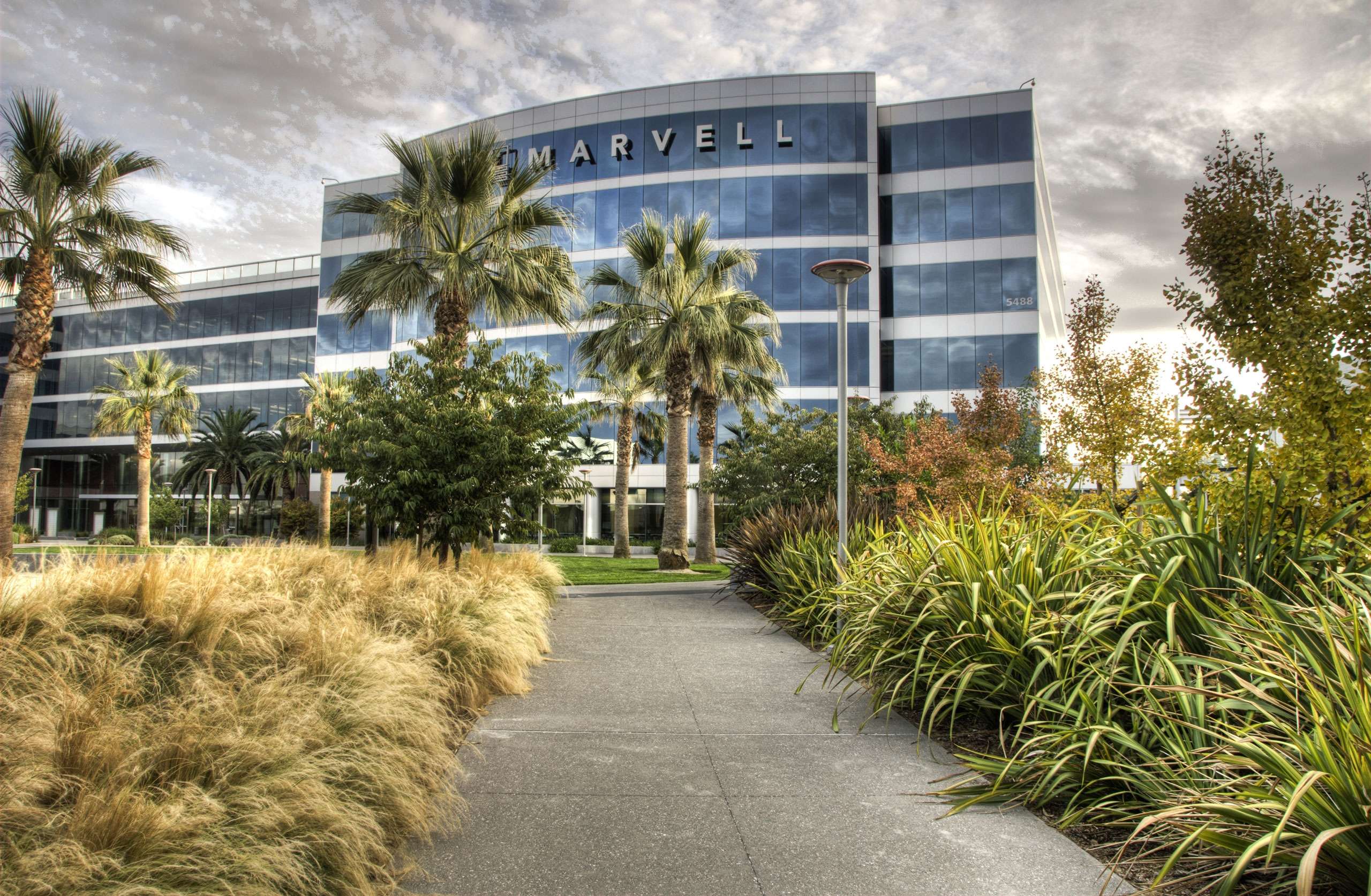
On the screen, the arbitrage looks almost mechanical. Lumentum Holdings trades 14% below the value of the stock Marvell Technology has offered for it, and that gap has widened rather than closed since the two companies announced the deal.
Merger arbitrage desks read that spread as a probability. Bloomberg reported on Nov. 10 that traders are assigning roughly even odds to the $115 billion all-stock transaction closing, a level that would be unusual for a friendly deal between two U.S. semiconductor suppliers and unremarkable for one facing a long regulatory path.
The share prices tell a matching story. Marvell has fallen nearly 40% since the announcement and Lumentum about 35%, a pattern that says investors are not simply discounting the target’s standalone value. When both sides of an all-stock deal sell off together, the market is marking down the combined company, not betting on which side wins.
Marvell is paying in shares, so the exchange ratio ties Lumentum’s holders to Marvell’s equity. The 14% discount as of Monday is the cost of waiting until 2028, the year the companies expect to complete the transaction, plus the probability that they never do.
The industrial logic is easy to state. Marvell designs the signal processing and optical interconnect silicon that moves data between accelerators in AI clusters. Lumentum makes lasers and optical components, the light sources those links depend on. Putting them together gives Marvell a supply of the component that has been hardest to secure as data center builders race to wire up ever-larger collections of GPUs.
That vertical ambition is why the price is so large and why the review will be so slow. Jennifer Rie, an analyst at Bloomberg Intelligence, identified foreign regulatory review as the main risk to the timeline. Deals of this scale in semiconductors draw scrutiny in several jurisdictions at once, and each one runs its own clock.
Marvell has been assembling this position for years. It bought Inphi, the analog and optical specialist, in 2021, and has steadily added the mixed-signal building blocks that sit between a switch chip and a strand of fiber. Lumentum, spun out of JDS Uniphase in 2015, brings the light source itself, along with a component business that extends into consumer sensing and industrial lasers.
Rosenblatt offered a partial counterargument. Marvell’s two previous acquisitions cleared in eight months and five months respectively, a pace that suggests the company knows how to shepherd a filing through. Neither of those deals, however, combined two suppliers whose products sit inside the same optical link.
Scale is what changes the calculus. Regulators in Europe and Asia have spent the past several years building files on semiconductor consolidation, and they have shown willingness to block or reshape transactions that would otherwise have passed. A combined Marvell and Lumentum would be the largest supplier of certain optical components by a wide margin, and competitors have every incentive to describe the overlap in the worst possible light.
The demand backdrop complicates the defense. Optical interconnect is the current bottleneck in AI infrastructure, and buyers would prefer more suppliers rather than fewer. Marvell can argue that the deal accelerates capacity, since Lumentum’s manufacturing can be funded and expanded faster inside a larger company. Critics can argue the opposite: that concentration in a constrained market raises prices at exactly the moment hyperscalers are trying to lower them.
There is also the question of what Marvell’s own shareholders think. A stock-funded acquisition transfers risk to the seller’s holders, and a 40% decline in the acquirer’s shares is not the reaction a management team hopes for when it announces one. Some of that decline reflects sector-wide pressure on semiconductor valuations. Some of it reflects dilution.
Arbitrage spreads tend to converge as closing approaches. A 14% gap with two years to run is roughly what the market charges for time value, financing uncertainty and the tail risk of a blocked deal, and traders who specialize in the strategy will hold the position only as long as the annualized return justifies the capital.
What would move the spread is news. A second request from a regulator, a divestiture demand, a revised timeline, or a shareholder vote that comes closer than expected would each reprice the pair within a session. Absent those events, the trade sits and the clock runs.
The strategic question underneath is whether Marvell is buying a component supplier or buying time. If optical interconnect remains the constraint on AI cluster size for the next several years, owning the laser supply is worth a great deal. If the industry standardizes around co-packaged optics with multiple qualified sources, the premium shrinks.
If the transaction falls apart, both companies return to their prior shapes, and the market has already marked what that is worth. Lumentum would trade as a component supplier in a cyclical market. Marvell would compete for optical capacity it does not own, in a queue where its rivals are also buying.
Both companies have described the combination as a way to serve customers who want fewer vendors and tighter integration. That argument has persuaded investors before. Whether it persuades regulators in three jurisdictions, on a schedule that stretches into 2028, is a different question, and the market’s answer so far has been to price the outcome at close to even.



