
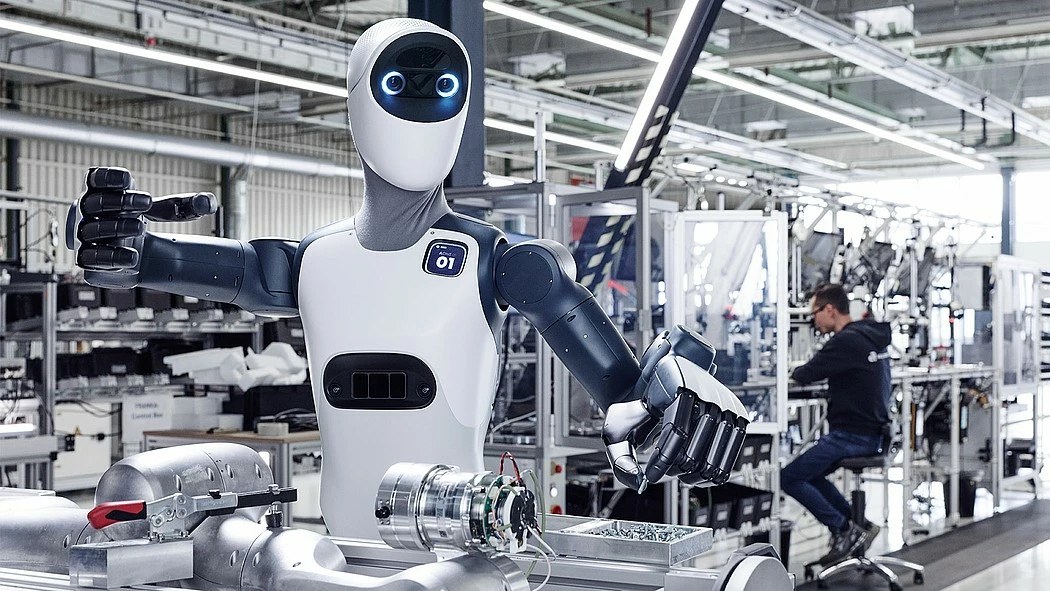
Agile Robots’ machines spend their days picking, assembling and inspecting in plants owned by carmakers and electronics manufacturers. The company’s argument to investors is that the next generation of those machines will need far less supervision, and that the difference is software.
The Munich company said on Nov. 12 that it had raised $500 million in a Series F round at a valuation of $8.5 billion, or about 7.7 billion euros. SoftBank Group led the round, with Nvidia, Hitachi, Hitachi Ventures and T.Capital among the participants. The financing brings total capital raised to $2 billion.
The money is earmarked for expansion in the U.S., additional production capacity including in Germany, and entry into new markets. Agile Robots says it has more than 20,000 robotic systems installed with customers in automotive, consumer electronics, healthcare and services.
Its line runs from industrial arms to mobile platforms to humanoid machines, alongside the software and models that coordinate them. The company describes the whole of it as physical AI, a term that has become the industry’s shorthand for models that act on the physical world instead of producing text.
“We believe Physical AI will transform industries,” Dennis Chang, a managing partner at SoftBank Investment Advisers, said in the announcement. “Agile Robots combines deep robotics expertise with the ability to execute at industrial scale.”
Nvidia’s presence in the round is the part worth pausing on. The chip designer has spent several years building simulation tools and reference hardware for robot developers, and it has an interest in a robotics market that consumes its processors. A stake in a company with 20,000 installed units gives it a view of how those systems are deployed in practice, which is harder to get from a design win.
For SoftBank, the cheque fits a pattern. The group has been the most willing of the large technology investors to fund hardware businesses with long development cycles, and it has done so through several periods in which the returns took longer than expected to arrive. A $500 million round at this valuation is a bet that industrial customers are close to buying robots in volume rather than in pilots.
The obstacle for everyone in the category is not the demonstration. Robots that pick a part or tighten a bolt have worked in controlled settings for years. The difficulty is the last ten percent: the part that arrives at an angle, the lighting that changes between shifts, the task a line worker solves without thinking and a model has not seen.
That gap is where service costs live. Every deployment that needs an engineer on site for a month is a deployment that does not scale, and the labour to support it is scarcer and more expensive than the hardware. Growing an installed base of 20,000 units to something an order of magnitude larger demands a field organisation as much as a factory.
Competition comes from two directions. Industrial automation incumbents have decades of customer relationships and service networks, and they are adding learning software to machines that already work. Chinese manufacturers have compressed prices on arms and mobile platforms, which limits how much margin the software can carry at the low end of the market.
The valuation is hard to test from outside. Agile Robots did not disclose revenue in its announcement, so the multiple implied by $8.5 billion cannot be calculated, and the round’s size says more about the investors’ view of the category than about the company’s current sales.
What the round does confirm is that capital is available for anyone who can show installed units and a plausible path to more of them. Nvidia’s participation and SoftBank’s lead give the company access to two ecosystems that matter: the accelerator road map on one side, and the Japanese industrial conglomerates on the other through Hitachi.
There is a strategic logic to the pairing that has nothing to do with humanoids. The near-term business is arms and cells sold to factories, one project at a time, and that business improves when the vision models can be trained on data from machines already in the field. A larger installed base generates that data, which lowers the cost of the next deployment.
The risk in that logic is timing. Software that improves with scale requires scale first, and scale requires capital that is priced against a market expected to arrive in the late 2020s. If adoption stalls at pilots, the installed base stops growing and the data advantage stops compounding with it.
The question left open is whether industrial buyers move from pilot programs to fleet purchases before the cost of supporting each robot erodes the margin the valuation assumes. Agile Robots now has the money to find out, and the answer will show up in its installed base rather than its announcements.



