
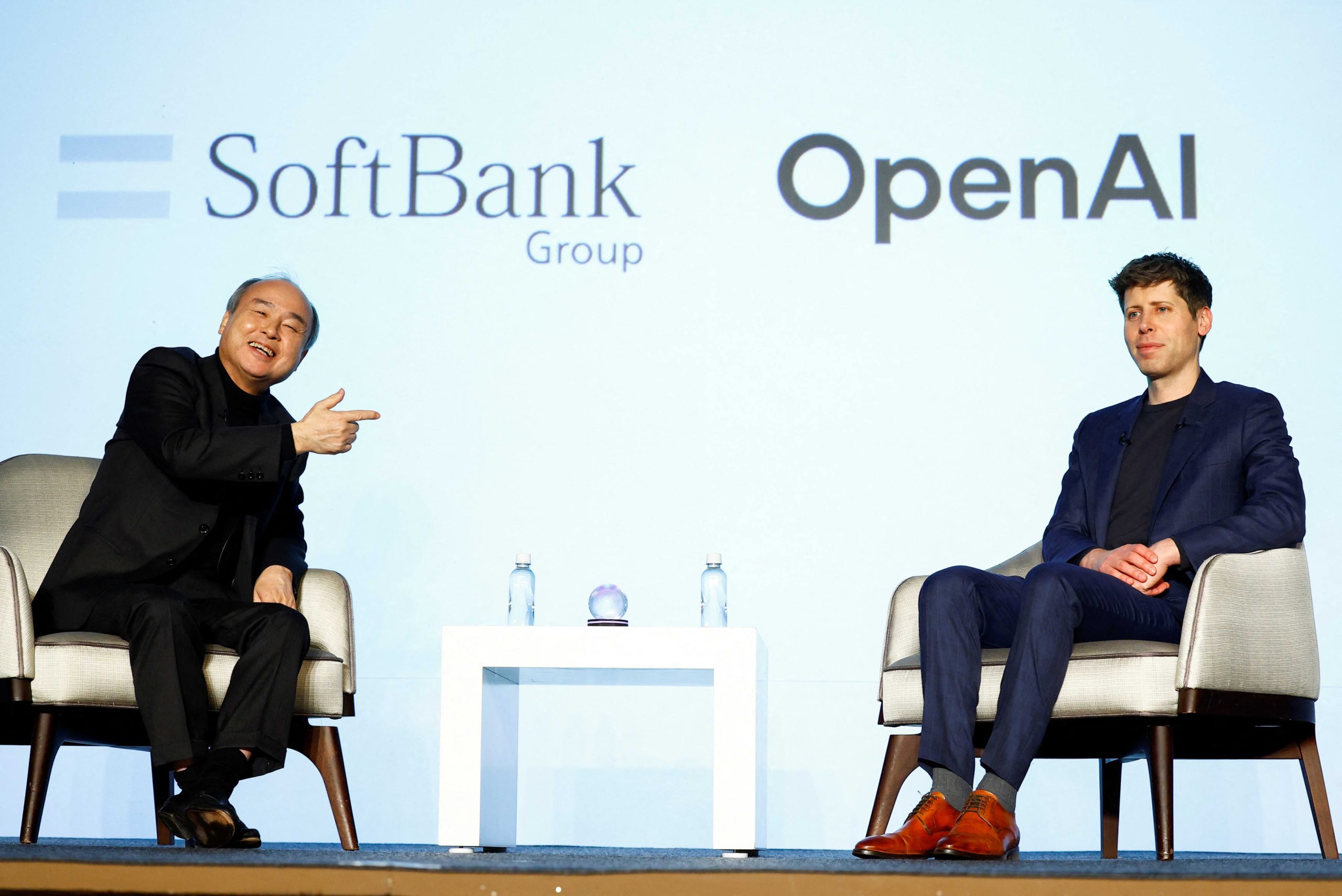
The disclosure came in passing, in the middle of a public appearance, and it was over in a sentence. Masayoshi Son, chief executive of SoftBank, said artificial intelligence systems are already participating in the design of OpenAI’s next model, a remark he offered as evidence that the industry is approaching what he calls superintelligence. CNBC reported the comments.
If the claim is accurate, it describes a shift in how the most advanced AI models get built. Until now, the architecture of large models, including the layers, the training regimes and the data recipes, has been the work of human researchers, with machines executing the ideas. Son’s description points to a loop in which AI itself proposes designs, runs experiments and tunes the next generation, with humans supervising rather than directing.
Son’s word carries unusual weight in this story, because SoftBank is among OpenAI’s largest investors. He has committed billions of dollars to the company across several rounds, and SoftBank anchors Stargate, the joint venture with OpenAI and Oracle that is pouring up to $500 billion into AI infrastructure. When the largest single backer of a company describes its internal process in public, it is disclosure as much as analysis.
The remark fits Son’s long-running script. For more than a decade he has argued that machines will surpass human intelligence, that the arrival is near, and that the companies building it will be worth more than anything before them. He has been early and he has been persistent; the singularity he once promised for 2045 has, in his telling, been pulled forward by the acceleration he says he now sees.
Skeptics will note the incentives. Son’s fortune is tied to the AI buildout in a way few others can match, and his public statements have consistently amplified the case for more investment. Researchers caution that “AI designing AI” is a description that covers a wide range of practices, from models that help write training code, which is common, to models that autonomously conceive new architectures, which remains largely in the future. The distance between those two is the difference between an assistant and a replacement.
The practical reality sits somewhere in between. AI labs already use their models to analyze training runs, debug infrastructure and propose experiments, and that usage has grown steadily as the models have improved. Whether that counts as participation in design is a matter of definition; what is harder to dispute is that the boundary between tool and designer has begun to blur.
The comment also lands at a sensitive moment for the industry. OpenAI is preparing for a public listing, the White House is discussing a government equity stake, and Anthropic has filed confidentially for its own IPO. Claims about superintelligence arriving through self-improving systems tend to raise the temperature of every conversation about regulation, safety and concentration of power.
Safety researchers have long flagged the prospect of models that help build their successors as a moment that demands new oversight. If Son’s description is accurate, that moment is no longer hypothetical. The governance question, who audits a system that contributes to the design of the system that follows it, will move from conference panels to boardrooms.
For SoftBank, the stakes are direct. The firm’s future is a bet on AI infrastructure and on the companies that own the frontier; a self-improving loop at OpenAI would be the strongest version of that bet paying off. Son’s willingness to say it in public suggests he believes the evidence is strong enough to claim.
Son’s remarks also carried a message for the investors who fund the AI buildout. A research process in which AI accelerates its own progress would shorten the time between investment and payoff, and it would raise the ceiling on what the leading labs can achieve. That is precisely the story SoftBank needs to tell as it raises and deploys capital across the sector.
The reaction from researchers was measured. Some said the description matches how modern labs actually work, with models increasingly involved in the mechanics of building their successors; others cautioned that participation in design is not the same as autonomy, and that the gap between the two remains wide. What nobody disputed was that the direction of travel points toward more machine involvement, not less.
For the rest of the industry, the remark is a prompt to look at what is actually happening inside the labs. The truth about whether AI designs AI will show up in published research, in model architectures and in the hiring patterns of the frontier companies, not in pronouncements. Son has said the future is arriving faster than people expect; whether that is true this time will be visible in the next model’s paper.



