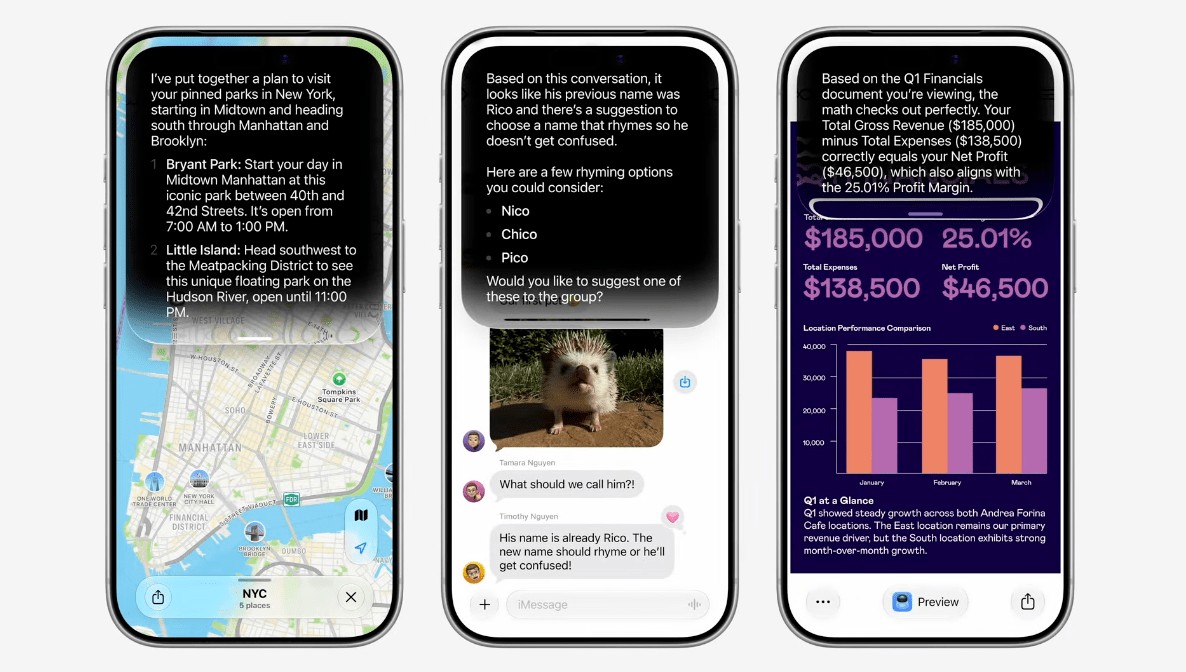
On the stage at Apple’s developer conference this week, a demo showed Siri summarizing a messy email thread, booking a table and layering photos into a trip itinerary. Tim Cook, presiding over what is expected to be his final keynote as chief executive, introduced the assistant as rebuilt from the ground up.
What Apple didn’t say on stage: the reasoning engine beneath that demo is Google’s. According to people familiar with the arrangement, Apple has licensed a customized version of Gemini, a model with roughly 1.2 trillion parameters, for about $1 billion a year. The arrangement came to light this week in reports citing people familiar with the matter.
Apple has built its own family of models, called AFM, with AFM Core handling on-device tasks and AFM Cloud Pro handling heavier server-side work. But its most capable reasoning still runs on Google’s stack, the people said. Apple declined to comment on the terms of the agreement, and Google declined to comment on the commercial relationship.
For Apple, the deal is a pragmatic answer to a hardware problem. The company’s strongest on-device models need at least 12 gigabytes of unified memory, according to engineers familiar with its plans. The standard iPhone 17 carries 8 gigabytes, which leaves the new Siri’s best local features to the Pro models, a split that could drive upgrades but also risks confusing customers about which phone they actually bought.
The strategy amounts to renting a brain while building the surrounding nervous system. Apple’s chip teams have spent a decade on custom silicon, and the AFM family is designed to keep most Siri requests on the device, where they never touch a server and, in Apple’s telling, never touch a third party. The Gemini agreement complicates that privacy story, even though Apple says the data sent to Google is stripped of identifying details and not used to train Google’s models.
The arrangement has a familiar precedent. Apple already pays Google billions a year to remain the default search engine in Safari, a deal that regulators on two continents have spent years scrutinizing. The Gemini contract extends that pattern into AI: Apple owns the experience, Google owns the engine, and the two companies keep their public rivalry and their private interdependence in separate rooms.
Investors noticed. Apple shares have fallen 4.95% since the keynote, erasing about $230 billion in market value, as analysts recalibrated what a rebuilt Siri really is. Analysts said the selloff reflects disappointment that the marquee AI moment leaned on a rival, after years of expectations that Apple would deliver its own frontier model.
The memory tiering is the part customers will feel first. Apple’s own models run on the phone, which is why the base iPhone 17, at 8 gigabytes, cannot run the full local assistant, while the Pro models, with 12 gigabytes or more, can. In stores this fall, the difference will be visible: the same Siri command, answered instantly on one phone and routed to the cloud on another.
For Google, the contract turns its biggest rival into a customer and gives Gemini a distribution channel that no amount of marketing could buy. The two companies have clashed for years over search defaults and app-store fees; now they are bound together on the most visible product in consumer technology, and Google gains a reference account it can show to every other handset maker.
For Apple, the calculus is about time. Building a frontier-class model from scratch would take years, and the next chief executive inherits an iPhone cycle that depends on AI features shipping this fall. Renting Gemini buys Apple the gap, at a cost that is small next to its services revenue, which now runs above $100 billion a year.
The bigger question is whether Apple’s own models catch up. Engineers inside the company describe AFM Cloud Pro as competitive on speed and privacy but behind on complex reasoning, the people said. Apple is said to be expanding its server buildout and hiring model researchers at a pace it has never attempted before, suggesting the company intends the rental to be temporary.
On the ground, the split matters most at the register. The tiering is expected to shape the upgrade cycle this fall, and in markets where rivals bundle free AI assistants, the gap will be tested in stores. The demo worked on stage. The test comes when millions of phones try to do the same thing.
Developers who saw the new Siri at the conference said the software, due this fall alongside the next version of iOS, is fast but conservative: it summarizes, schedules and searches well, while the more creative tasks shown in the keynote remain limited to a small set of approved uses. The cautious rollout reflects the stakes of putting a rented brain inside the world’s most-sold phone, where a single embarrassing answer would land in headlines everywhere at once.