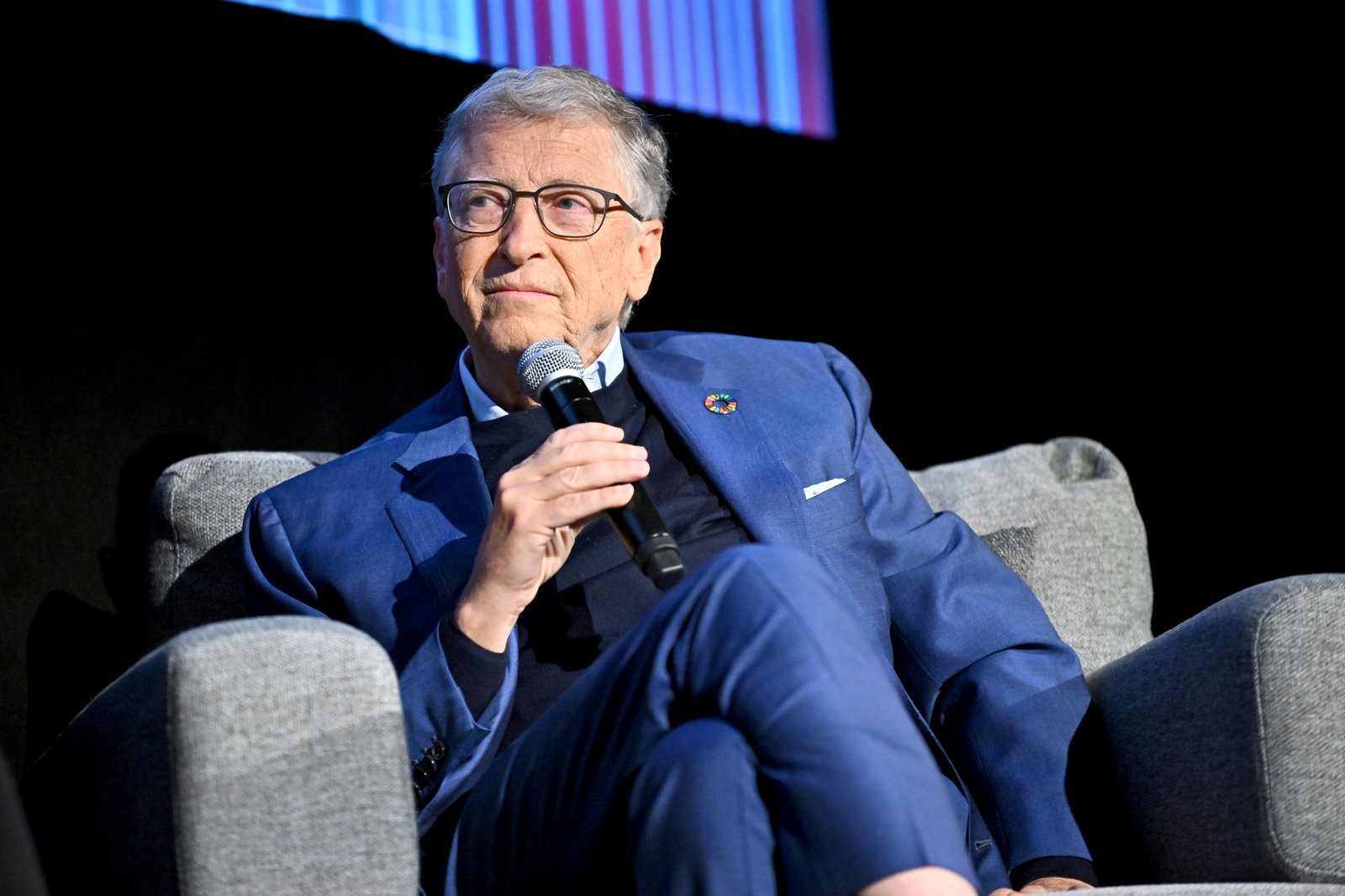
Bill Gates has spent much of the past three years urging caution about artificial intelligence without ever quite sounding like a doomsayer. On Sunday, he did not sound like one either, but the number he chose got attention.
In an interview with Kristen Welker of NBC’s “Meet the Press,” the Microsoft co-founder said that artificial intelligence left unconstrained could “cause a billion deaths,” and that the industry’s assurances of voluntary restraint are not convincing anyone. “No one thinks self-regulation is enough,” he said.
Gates was answering a direct question from Ms. Welker about whether Washington needs to pass legislation. His first answer was one word, repeated for emphasis. “Absolutely,” he said. “You need law enforcement and the politicians to get into the discussion about what safeguards and monitoring look like.”
Then he made the demand explicit. “That has to be a required thing,” Gates said. “It will be a little bit of overhead for the industry, but not a dramatic slowing of what they’re doing.”
The interview aired as federal legislation on AI remains stuck in Congress, more than two years after the technology became a fixture of public debate. In its absence, states have begun writing their own rules. In the same week, governors Wes Moore of Maryland and Kathy Hochul of New York each released plans to strengthen state-level regulation of the technology.
Gates’s position is not new. He has argued for government involvement since the current generation of models arrived, and his foundation has funded research into the technology’s risks. What changed on Sunday was the bluntness of the language and the specificity of the threat he described.
He did not stop at the death toll. Asked about the danger from malicious users, Gates said, “Never has a weapon been more powerful than a bad actor with the latest AI tools.” He also rejected the idea that a technical failsafe alone would suffice, telling NBC it is “not enough to have a kill switch” for the technology.
Gates has used the death-toll framing before. His foundation has spent billions on global health, and he has said for years that the two threats that concern him most are a pandemic and a technology that could be turned against its makers. On Sunday he drew the parallel directly, treating an ungoverned AI as a risk in the same category as a pathogen.
The comments land weeks after the leaders of the largest AI labs began acknowledging that the pace of progress may be outstripping their control. Anthropic’s chief executive, Dario Amodei, wrote publicly this month about the need for stronger oversight, and executives at OpenAI and Anthropic have each said they support slower, more careful development of the most capable systems.
Gates framed compliance as a modest burden rather than a brake on innovation. The rules he wants, he said, would cost the industry “a little bit of overhead” and would not meaningfully slow the work. That framing is a deliberate contrast with arguments from parts of the industry that regulation would hand an advantage to competitors abroad.
Gates acknowledged that writing the law is only half the problem. Enforcement, he suggested, is the other half, which is why he named law enforcement alongside legislators in his list of who must be involved. That position puts him at odds with the voluntary frameworks the industry has spent two years assembling, which carry no enforcement mechanism at all.
His voice carries particular weight because of who he is not: a sitting executive at an AI company. Microsoft, which he co-founded and where he remains a major shareholder, holds a large stake in OpenAI. Gates has mostly kept his distance from day-to-day AI product decisions while speaking as a figure above the commercial fight.
That independence is part of what makes the call noteworthy. When the men who run the AI labs warn about their own creations, skeptics dismiss it as positioning. When a figure with no product to sell and no competitor to beat says the same thing, the warning lands differently.
The plea also arrives in an election year, which gives it a sharper political edge. Independent Senate candidates have already begun attacking both parties for failing to pass AI guardrails, and the interview aired as several races turned the technology into a campaign issue.
Gates stopped short of endorsing any specific bill or agency. His demand was simpler: bring the government in, now, before the technology outpaces the institutions meant to govern it.
The interview did not answer the question that has shadowed every such warning: what a federal law would actually say, and whether it could pass a divided Congress. Gates offered a target, not a text.
What he did provide was the clearest statement yet from one of the most recognizable figures in technology that the era of voluntary safeguards is over, or should be. The industry has promised to police itself for two years. Gates’s argument is that nobody, including the industry itself, believes the promise anymore.