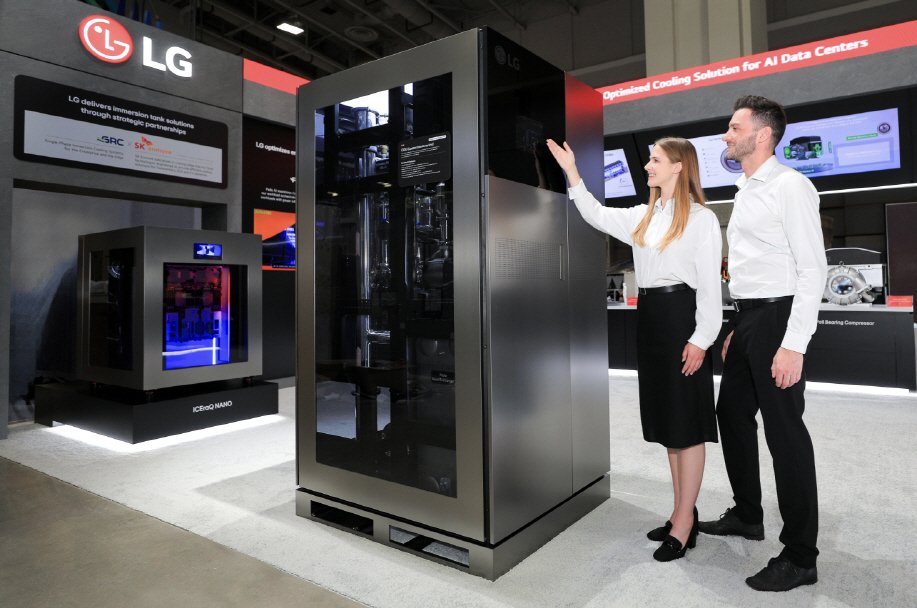
For most of its history, LG Electronics sold refrigerators, televisions and washing machines. The announcement it made on September 27 was about something far less visible to consumers: the liquid that keeps a rack of AI chips from melting down.
LG said it has joined Nvidia’s Partner Network as a preferred partner in the “Power and Cooling” category, a designation that hands the South Korean appliance maker an earlier seat at the planning table when hyperscalers and colocation operators design new data centers.
The prize is North America. LG has said its target customers are the large cloud providers and data center landlords building the facilities where Nvidia’s most powerful chips run, and the earlier a supplier enters a project, the harder it is for rivals to displace it later.
The designation did not come from a marketing pitch. It was earned one certification at a time. In July, LG’s 600-kilowatt coolant distribution unit, or CDU, passed Nvidia’s validation, clearing more than 100 evaluation criteria. A one-megawatt model followed. Then, on September 22, a 2.6-megawatt unit was listed as “DSX Ready.”
That last tier is the meaningful one. Nvidia’s DSX AI factory platform places only CDUs rated at 2.3 megawatts or above into its top category, which means LG is now selling into the largest and densest installations rather than the small ones.
The economics of the shift are visible in Nvidia’s own numbers. A current AI rack draws roughly 120 kilowatts. A group of 20 such racks needs between 2.4 and 2.5 megawatts of cooling capacity, which has made the 2.5-megawatt class the de facto standard for large CDUs.
James Lee, president of LG’s Eco Solution Company, framed the validation as proof the company arrived early. The certification, he said, “solidifies our first-mover position in next-generation liquid cooling.”
LG has built the infrastructure to back the claim. The company runs a dedicated AI data center HVAC testbed at its chiller plant in Pyeongtaek, South Korea, where it simulates AI server environments to test its cooling systems before they reach customers, and it has been piloting liquid cooling with the Korean telecom operator LG U+.
LG is not starting from zero. The company has more than six decades of engineering in heating, ventilation and air conditioning, and it has spent the past two years pitching a “Chip-to-Chiller” portfolio that spans everything from the cold plates bolted to a processor to the chillers cooling an entire building.
The portfolio has already produced orders. LG has cited cooling wins at hyperscaler facilities in North America and at a flagship AI-ready data center in Jakarta operated by the Sinar Mas group, early proof that operators will trust a company better known for kitchen appliances with their thermal infrastructure.
The cooling business is a deliberate second act for a company best known for home electronics. As growth in consumer appliances has slowed, LG has sought to convert its HVAC expertise into a business serving the data center boom, which is expected to keep demanding more power and more cooling for years.
The bet is that liquid cooling will become the default as chip density rises. Air cooling, which has served data centers for decades, struggles to carry away the heat from racks packed with the latest accelerators, which is why coolant distribution units have moved from a niche accessory to a must-have component.
The opportunity is large enough to justify the effort. Data center cooling is expected to keep growing as AI clusters expand, and liquid cooling in particular is forecast to take a rising share as rack densities climb beyond what air can handle. That is why Nvidia’s validation carries weight: it signals to buyers that a CDU will perform in the densest, most expensive installations.
Nvidia’s partner program has become a stamp of approval that data center operators use to shortlist suppliers, and LG’s entry places it in a small group of companies cleared to sell directly into the largest AI builds.
The move also reflects a broader scramble among Asian electronics makers to attach themselves to the AI supply chain. Companies that once competed in consumer markets are now racing to supply the pipes, power and cooling that keep the industry’s most expensive hardware running.
Analysts said the designation matters more for the doors it opens than for any single order. Being named a preferred partner lets LG participate in designs years before revenue arrives, which is how suppliers in this market build durable positions rather than one-off sales.
The question for LG is whether it can convert the certification into volume. The data center cooling market is growing fast but is also crowded with established thermal specialists, and LG is a relative newcomer to the largest hyperscale accounts.
What the company has secured is a credential. What it now has to prove is that a name synonymous with home appliances can also cool the machines on which the world’s most valuable software depends.