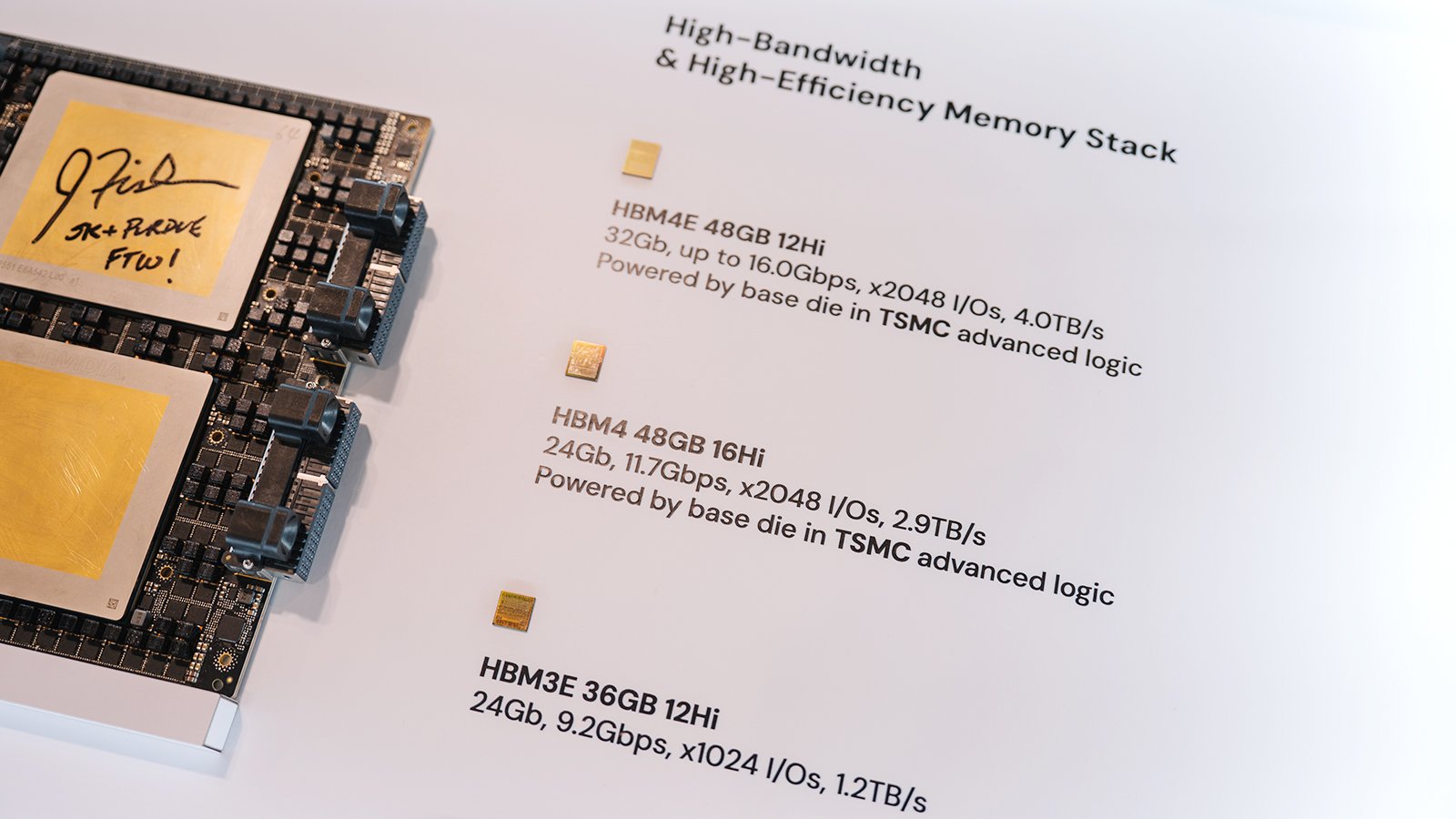
Jensen Huang is scheduled to sit down this week with the two men who control South Korea’s semiconductor industry. The Nvidia chief executive’s meetings with Lee Jae-yong, the chairman of Samsung Electronics, and Chey Tae-won, the chairman of SK Group, were set for the week of September 28, and the agenda is the memory that will power the next wave of AI systems: HBM4E, HBM5 and the infrastructure around them, according to the Korea Economic Daily.
The timing is not a coincidence. SK hynix, the SK Group unit that leads the market for high-bandwidth memory, said on September 28 that its HBM5 had completed joint validation with TSMC. The two companies, one the dominant maker of AI memory and the other the dominant fabricator of AI chips, are now formally aligned on the next generation.
The validation is more than a technical checkbox. High-bandwidth memory is stacked directly beside the graphics processors that do the heavy lifting in AI, and every layer of that stack has to be designed and tested to work with the chip next to it. Having TSMC, which fabricates Nvidia’s processors, sign off on HBM5 means SK hynix has cleared a critical gate in the race to supply the next generation of AI systems.
High-bandwidth memory exists because the processors are getting faster than the memory feeding them. HBM stacks dozens of memory dies on top of a base die and connects them with thousands of channels, moving data far faster than conventional DRAM. Each generation has widened that pipe, and HBM5 promises another step up in bandwidth and efficiency, which is why Nvidia’s roadmap is so closely tied to it.
SK hynix also said it received TSMC’s annual partner award for a second consecutive year, an honor it announced at TSMC’s Open Innovation Platform conference, where it showed off its next-generation memory lineup. The award is a signal of how tightly the two supply chains have become entwined, and of how much the memory maker now depends on the foundry’s process technology.
The collaboration began in earnest around HBM4. The two companies struck a partnership to co-develop the base die that sits at the bottom of each HBM stack, with TSMC manufacturing that layer using its most advanced logic process. The base die is where much of the difficulty lies, and sharing the work let SK hynix lean on TSMC’s process leadership while it concentrated on the memory itself.
Samsung has been trying to close the gap. The Korean rival has struggled to qualify its HBM with Nvidia and has reshuffled its memory leadership as it works to catch up in a market SK hynix has come to dominate. Micron, the American challenger, has also won a slice of the business. Huang’s separate meetings with both Korean chiefs suggest Nvidia wants supply from more than one place, even as SK hynix holds the lead.
The stakes extend beyond memory chips. Huang’s agenda includes AI infrastructure cooperation, reflecting a bottleneck that has shifted from chips to power, cooling and the systems that hold them. South Korea’s conglomerates want a larger role in building that infrastructure, beyond supplying the parts.
For SK hynix, the TSMC validation is a chance to extend a lead that is already wide. The company has said demand for HBM is sold out through the coming year, and its results have been lifted by the AI spending boom even as questions swirl about how long that spending can continue.
SK hynix’s lead runs deeper than technology. The company has supplied the bulk of the HBM used in Nvidia’s AI accelerators for years, a position built on early bets and relentless qualification work. Its share of the HBM market has consistently run well ahead of Samsung’s, and its financial results have surged along with the AI buildout, with record profits driven almost entirely by memory for AI systems.
The partnership with TSMC also reflects a change in how memory is made. In earlier generations, the memory maker handled the entire stack. Now the base die, the layer that talks to the processor, is too complex for the memory makers to do alone, and the foundry has become a partner rather than a spectator. The arrangement binds the two companies’ roadmaps together in a way that was once unthinkable.
For Samsung, the week’s meetings are a chance to press its case. Lee Jae-yong has made the company’s push into HBM a personal priority, and Samsung has signaled it will invest heavily to regain lost ground. Winning a meaningful share of the HBM5 generation would do more for its standing with Nvidia than any marketing push.
The open question is whether Samsung can turn its meetings with Huang into orders before HBM5 reaches volume production. SK hynix has the validation and the track record. Samsung has the scale and the ambition. The race for the next generation of AI memory has not been won yet, but the early laps have a clear leader.