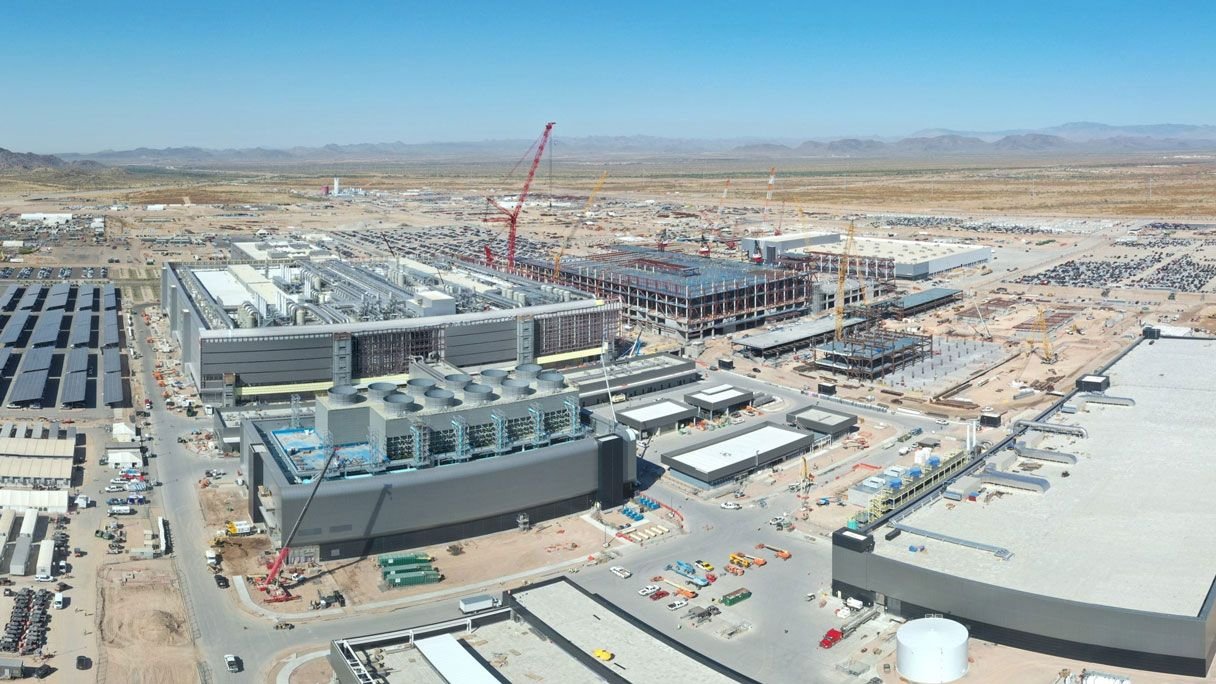
The approvals keep coming in bigger than the ones before. Taiwan’s Ministry of Economic Affairs said on September 28 that it has cleared $44 billion in Taiwanese investment into the United States by TSMC since December 2020, a running tally of one company’s westward migration, and it signaled that more applications are still awaiting review.
The figure measures only what Taiwan’s government has signed off on, not the full scope of TSMC’s American plans, which are larger still. The company has committed to build a string of fabs in Arizona and to package chips on U.S. soil, a shift driven as much by customers demanding a second source of supply as by geopolitics.
The demand side is now pulling harder. EDN reported on September 28 that Apple, Nvidia and AMD have added between 10% and 20% to their orders for TSMC’s most advanced process, a jump that has pushed the company to raise its target for 2-nanometer output to nearly 120,000 wafers a month before the end of the year.
The 2nm node is the next frontier in chipmaking, and the three customers driving the revision are among the most demanding buyers on the planet. Apple uses the leading edge for the chips in its iPhones and Macs, Nvidia for the accelerators at the center of the AI boom, and AMD for a mix of CPUs and GPUs. When all three raise their orders at once, the signal is that demand for the newest silicon has not cooled.
A wafer a month is a rough yardstick, but the number matters because leading-edge capacity is measured in exactly these units, and every wafer carries months of lead time. A target of nearly 120,000 wafers a month represents a meaningful step up from where TSMC’s most advanced lines have run, and it implies the company is confident enough in its customers’ forecasts to spend on the tooling to meet them.
Overseas, the company’s ambitions are also moving. TSMC is the largest shareholder of Vanguard International Semiconductor, known as VIS, which operates a joint venture with NXP called VisionPower Semiconductor Manufacturing Company in Singapore. That venture held a ceremony on September 28 to mark the completion of its first 12-inch fab, with production targeted for 2027.
The Singapore fab’s first phase is already fully booked, and the partners are evaluating whether to expand. That a fab years from first silicon is sold out speaks to how tight advanced and specialty capacity has become, even for chips that are not made on the very newest process.
TSMC’s American expansion has been the subject of intense political attention. The company announced in 2025 that it would raise its total U.S. investment to $165 billion, a figure that dwarfs the $44 billion Taiwan has so far approved and that reflects fabs, packaging plants and research facilities still to come.
The economics of the shift are not simple. Building in Arizona costs more than building in Taiwan, and moving the most advanced processes abroad raises questions about cost, yields and the supply of skilled workers. TSMC has answered those questions by signing up the very customers that give it pricing power, and by extracting incentives from a government eager to keep the industry’s crown jewel on American soil.
The company’s leadership has framed the American buildout as a hedge: a way to keep serving the world’s biggest market from inside it, whatever the politics. The approvals now accumulating in Taipei are the paper trail of that hedge, and the raised 2nm targets are the first hint of how much demand is waiting at the end of it.
The Arizona buildout is where the 2nm targets meet the politics. TSMC’s first Arizona fab began producing chips in late 2024, and the second is being fitted for the most advanced nodes, including 2nm. Moving the newest process to American soil, where it has never run at scale, is the hardest part of the company’s westward shift, and it is the part customers are watching most closely.
The Singapore venture is a different kind of bet. VIS has historically focused on specialty and mature processes rather than the leading edge, and the NXP partnership lets it add automotive and industrial capacity in a market close to the customers that need it. The fab’s full order book before it has produced a single wafer is a measure of that demand.
Taiwan’s tally of $44 billion, meanwhile, captures only part of the story. The figure rises every few months as new applications are filed, and the ministry’s notice that more are pending suggests the total will keep climbing. Each approval is a small formal step in a much larger reordering of where the world’s most advanced chips are made.
What remains open is whether the math holds. The 2nm ramp is just beginning, and the U.S. fabs have yet to prove they can match Taiwan on cost and speed. TSMC is placing the largest bet in its history on the proposition that they eventually will, and the customers now raising their orders are, in effect, betting on it too.