
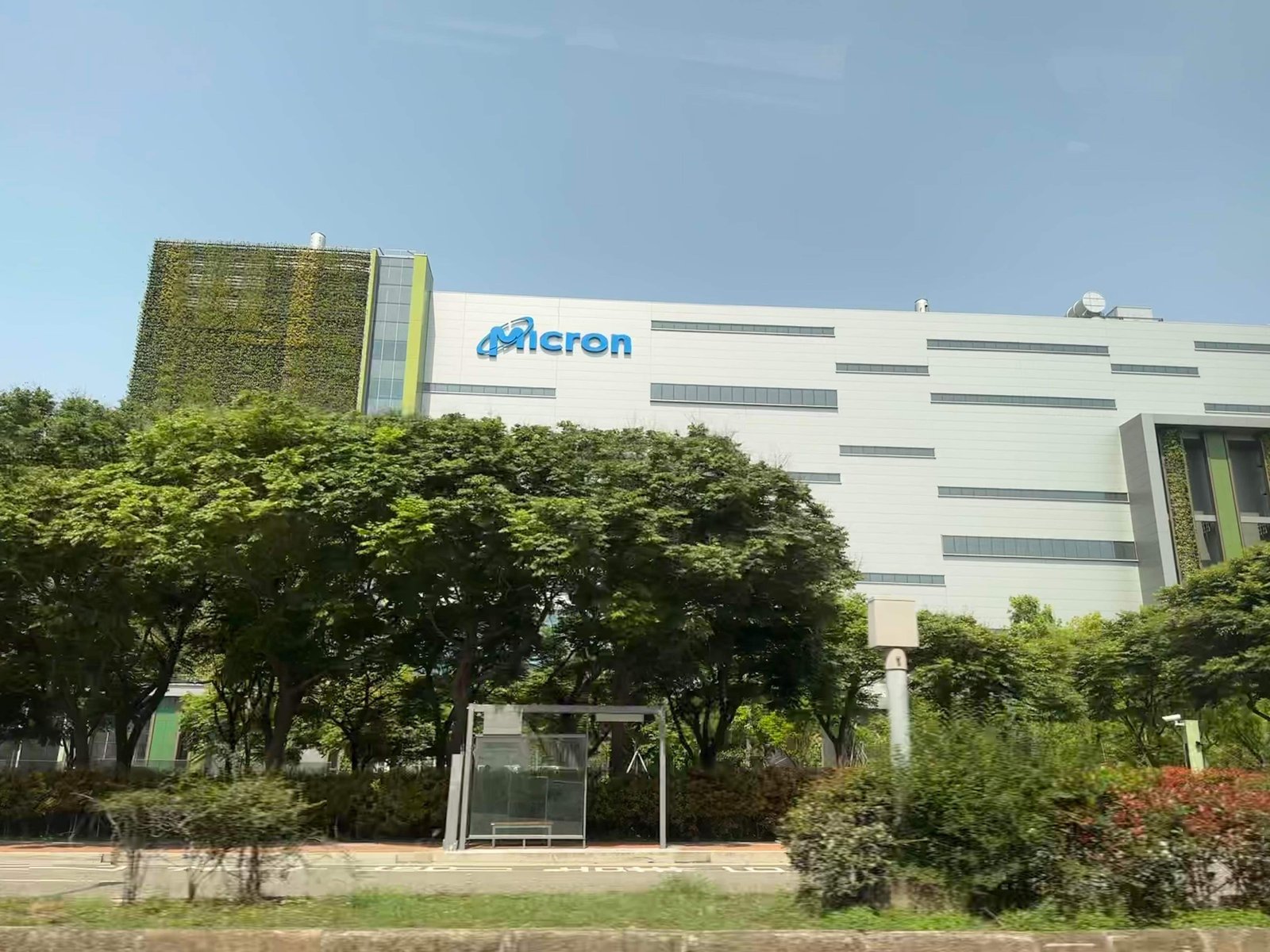
The vote was almost unanimous, and that is what gave it force. When the union representing workers at Micron Technology’s plant in Taoyuan, Taiwan, counted its ballots this week, 1,994 members — 99% of those who cast one — voted to authorize a strike over the company’s bonus scheme. No walkout has been called and no date has been set. Under Taiwanese labor law the vote does one thing: it hands the union the right to act when it chooses, and it told the memory-chip giant that its largest factory can stop at any moment.
The fight is not about base pay. It is about how Micron calculates bonuses, and the union wants that formula torn up and replaced. For fiscal 2026 the unions at Taoyuan and a sister plant in the central city of Taichung are seeking a one-time bonus worth roughly 83 months of salary. From fiscal 2027 they want Micron to scrap its incentive plan and set aside 15% of operating profit for workers, paid out quarterly instead of once a year. The demand is for a share written into the rules, not a gift handed down year by year.
Micron answered with what it called the largest bonus payout in company history: 35 to 68 months of pay for production workers in Taiwan, with a minimum cash payment of about NT$1.7 million, roughly $53,800. The union rejected it. Its objection was not the size of the number, it said, but that Micron announced the package while labor mediation was still under way and before reaching any agreement with the union. A one-time payout, however generous, leaves the underlying formula untouched.
The dispute has been building since at least September, when Micron announced fiscal 2026 rewards for more than 60,000 employees worldwide after what it described as an extraordinary year. Workers in Taiwan who joined before August 2025 received a T$1 million cash bonus, with later hires getting a prorated share. The unions called the package a one-off that dodged their core demand for a permanent formula.
The timing gives the vote its weight. Micron’s Taiwan operations sit at the center of the memory-chip boom. Artificial-intelligence systems depend on high-bandwidth memory, and Micron, alongside Samsung and SK Hynix, is one of a small handful of companies that can produce it. Analysts have warned for months that any disruption at a major memory plant could tighten a supply chain that is already stretched. A factory that halts for a day costs real money in a market where orders are being rushed through to meet AI demand.
The unions represent roughly two-thirds of Micron’s workforce in Taiwan, and the company has treated the island as a core manufacturing hub. Jerry Lin, the chairman of the Taoyuan union, has framed the demand as a matter of fairness: workers who produce record output, he has said, should share in record profit through a permanent, verifiable formula rather than a series of one-off rewards. Reuters reported the strike authorization on Wednesday, citing the union, which said 2,012 members cast ballots and 1,994 voted in favor.
Micron has kept its public response measured. A spokesperson said in late September that the company was committed to constructive dialogue with the Taoyuan union, and the company has declined to link its fiscal 2026 rewards to the labor dispute. Further mediation sessions are scheduled, including one with the Taichung union on October 22. The union has said details of any action, including its timing, remain under discussion and has not ruled out a sudden move.
The standoff reflects a tension running through the chip industry’s boom. AI demand has filled order books and lifted profits, and the workers who assemble and test the products are pressing for a cut guaranteed by contract rather than dependent on management’s goodwill. A bonus announced by the company is something workers receive; a profit-sharing formula is something they can rely on. That distinction is the entire argument.
Taiwan has become the flashpoint partly because it is where the boom meets the factory floor. The island houses the advanced fabs and packaging lines that turn Micron’s memory designs into the components feeding data centers across the world. A labor stoppage there does not stay local; it echoes up a supply chain that already has little slack.
For Micron, the risk is asymmetric. A strike would be costly at a moment when memory prices are firm and rivals are racing to add capacity, and even the threat of one is enough to make buyers watch Taoyuan closely. A settlement that locks in a profit-sharing mechanism would commit the company to paying out more in every good year that follows. The company is negotiating on a clock it does not control, and a vote of 99% was a clear statement that the clock is running.
Whether the authorization turns into a walkout depends on the mediation sessions in the weeks ahead. The union now holds the legal right it sought; what it does with it will be decided at the bargaining table. In a tight memory market, the cost of getting that decision wrong runs in both directions.



