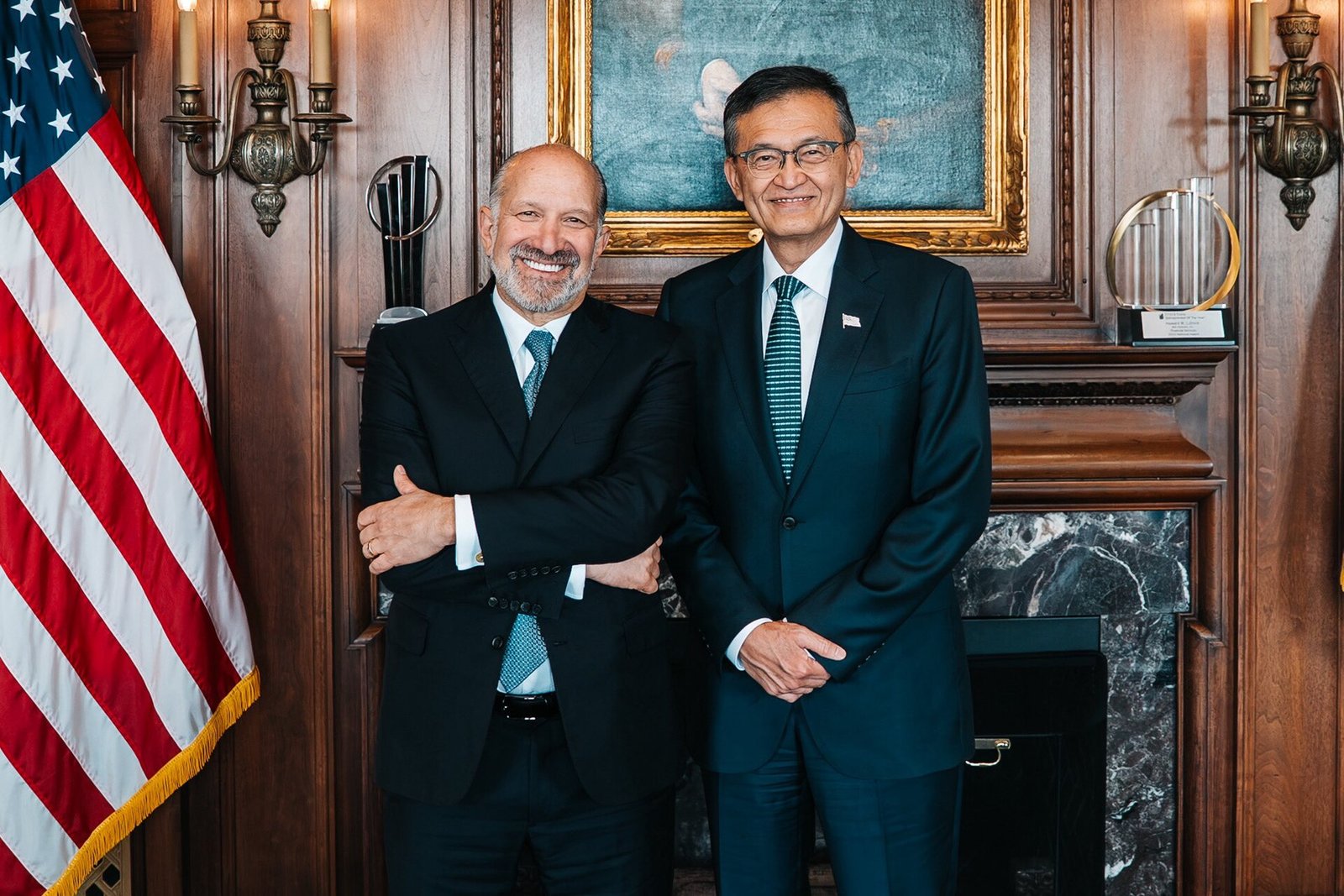
Intel Chief Executive Lip-Bu Tan said the U.S. government has not used its minority stake to shape company decisions, an assertion that answers a question Intel’s customers have been asking since Washington became its largest shareholder.
In an interview published by Nikkei Asia on October 17, Tan said the government has “no policy and no influence over corporate governance,” and described Intel as independent. The stake is about 8.2 percent after dilution from a share sale in August.
The position was created last year when the government converted $8.9 billion of federal grant money into equity. The initial holding was 9.9 percent. The government did not take a board seat, and Tan said it has not asked for one.
That combination — a large stake, no seat, no stated policy — is unusual enough that it has no close parallel among American companies of Intel’s strategic importance. The federal government has taken equity in banks and automakers during crises, usually with warrants, board observers and conditions attached to lending and pay. Intel’s arrangement carries none of the visible machinery.
The grant money came from the CHIPS and Science Act, and the conversion turned a payment the government had already promised into an ownership position it had not originally sought. Officials described the structure at the time as a way to share in the upside of an investment taxpayers were funding.
What it does carry is proximity. A shareholder with 8.2 percent can call the chief executive, ask for a briefing and make its view known without holding a vote. Whether that constitutes influence is a question that depends on the conversations, which are not public.
Tan’s answer is that the relationship runs the other way: the government’s money gives Intel the patience to fund advanced manufacturing, a business in which the gap between spending and revenue is measured in years. He noted that TSMC needed 10 to 20 years to become the world’s largest contract chipmaker, a comparison that sets expectations for how long Intel’s own turnaround should take.
The comparison is doing work in that sentence. Intel’s foundry business has lost money every quarter since the company began reporting it separately, and the losses are large. Its 18A process is entering production, with the next generation, 14A, dependent on whether enough external customers commit to it.
Customers are the part of the story the stake touches most directly. A foundry takes designs from companies that compete with one another, and those companies hand over masks, test data and production schedules. If the owner of the foundry is also the government that regulates them, licenses their exports and buys their products, the trust question becomes a procurement question.
That is the argument Intel’s salespeople have to answer in meetings, and it is the reason Tan’s phrasing matters. A statement that the government has no operational role is the kind of assurance a customer can put in a file.
Export controls cut the other way. Intel’s ability to sell advanced chips into China has been restricted by rules written in Washington, and the company has taken revenue hits as a result. A shareholder that writes the rules affecting its portfolio company is a different animal from a shareholder that merely owns shares.
Analysts who cover the company said the stake functions as a backstop rather than a control mechanism. It signals that the government will not let the company fail in the middle of a build-out it is paying for, which lowers the cost of capital and steadies suppliers who extend credit.
The terms also bind both sides. A government that sells would signal doubt at the worst moment, and a company that asks the government to sell would be telling customers that the arrangement had become a problem. Neither is likely soon.
Tan’s other theme in the interview was time. Advanced process technology improves through iteration, and iteration requires volume, which requires customers, which requires confidence that the roadmap will be delivered. That is a loop, and money can start it but cannot close it.
Intel has been trying to close it for three years. The company has cut capital spending, sold part of its stake in a programmable chip unit, taken money from Nvidia and SoftBank, and reorganized its manufacturing group. Each step bought time. None of them produced a customer list.
The test that matters is a commitment from a large designer to build a product on 14A. Without one, Intel’s foundry is a cost center with a national security rationale. With one, it is a business.
Tan’s remarks were addressed as much to that audience as to Nikkei’s readers. A chief executive who says the government stays out of the room is telling potential customers that their designs will be treated like anyone else’s, and telling Washington that the arrangement works because it is quiet.
Quiet arrangements can become loud quickly. A congressional hearing, a proposed condition on a future grant or a dispute over export licenses would put the stake back in the conversation, and Intel would have to answer the question again with less control over the timing.
For now the company’s position is that the ownership is passive, the money is patient and the roadmap is on schedule. Two of those three claims can be checked against results in the next eighteen months.