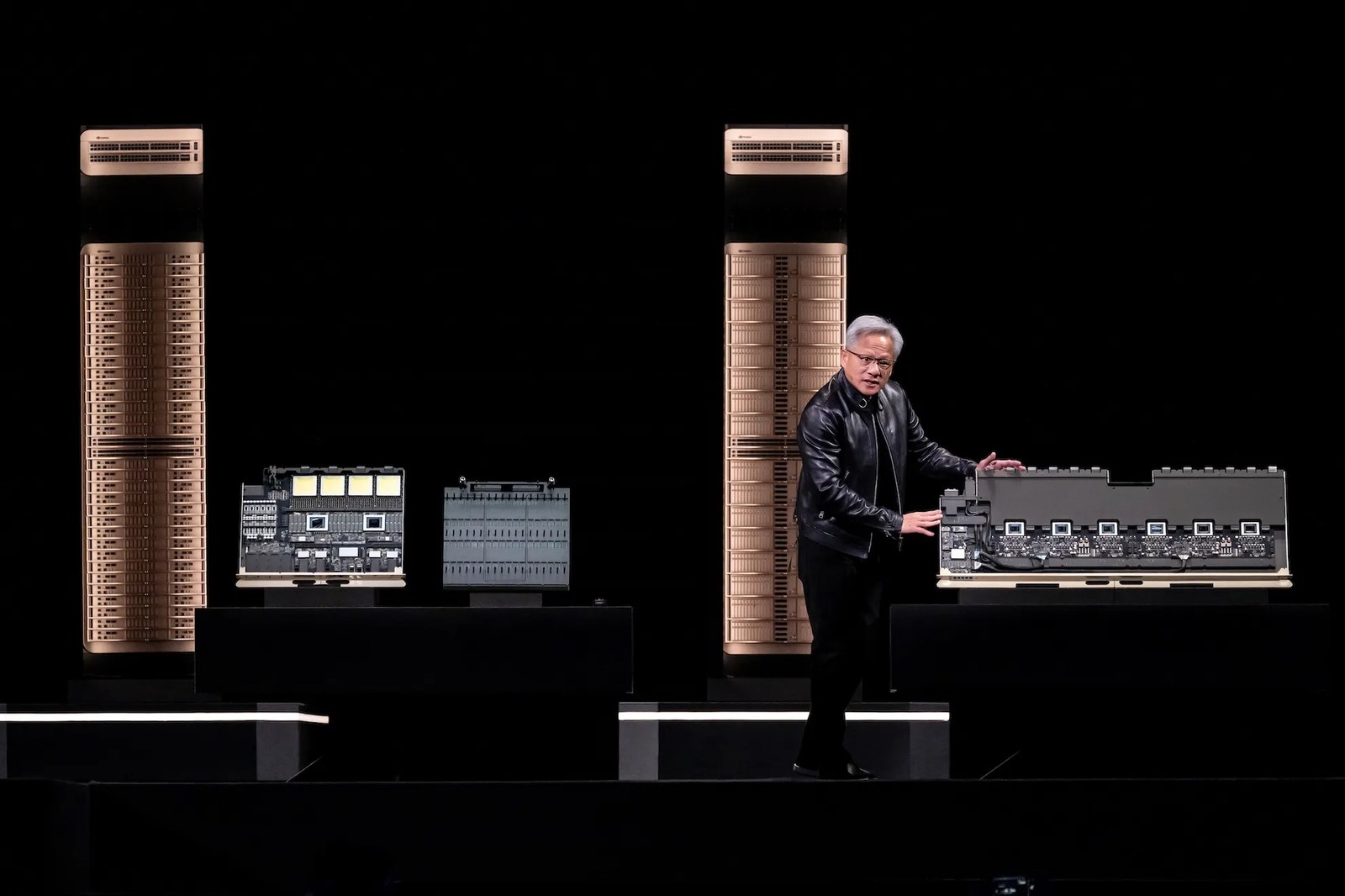
The venue was Kraftwerk, a former power station in Berlin whose turbine hall now holds conferences, and the two men on stage had spent a decade talking past each other’s industries. Friedrich Merz, the German chancellor, and Jensen Huang, Nvidia’s founder and chief executive, sat down on Monday morning to describe a partnership that both had reasons to want: German manufacturing expertise on one side, American accelerators on the other.
Earlier in the day, at the Invest in Germany summit, Merz, the Federal Ministry for Economic Affairs and Energy and the Federal Ministry for Research, Technology and Space signed a joint declaration of intent with Nvidia. The government put the investment at a nine-figure euro sum. Siemens, Audi and Black Forest Labs are named as participants. The declared targets are industrial models, robotics and autonomous driving.
The declaration is not a contract, and the number attached to it has not been broken down by site, by year or by who spends it. What it does is place the federal government inside Nvidia’s European sales effort, which is a different kind of asset. Germany’s Industry 4.0 platform, a standing body of politicians, companies, researchers and trade associations, becomes the channel through which the American company reaches the Mittelstand.
Huang used the stage to say plainly that Germany had fallen behind in artificial intelligence, and that saying so gave him no pleasure. He then argued that the gap is narrower than the rankings suggest, because the country’s advantage is not software but the knowledge embedded in machines, processes and the engineers who maintain them. That knowledge, he said, cannot be replaced by a model. It can only be amplified by one.
Merz answered in the same register. He told the room that Germany’s small and mid-sized companies are its real advantage, and then asked them directly to open their doors to AI and to the data already sitting in their factories. It was an unusual request from a chancellor to a business lobby: the pitch was not for subsidies but for permission.
The commercial logic behind the visit is straightforward. Nvidia has committed nearly 10 billion dollars to Europe across companies, universities and research institutions, and on Monday it announced plans to invest in four more German startups: Agile Robots, Avelios Medical, Mirelo and Reflex Aerospace. It had already backed n8n, Neura Robotics and Black Forest Labs. An accelerator company that invests in the applications built on its accelerators is buying demand with equity.
The event also opened GTC Berlin, which runs through October 22 with Huang’s keynote on Wednesday. The agenda is the one Nvidia has been carrying around the world this year: the Rubin platform, agentic software, and sovereign computing capacity that governments can point to as their own. Berlin is a natural stop. Germany is the largest economy in Europe, it has a hardware base that needs chips, and it has a government that has decided AI leadership is a political promise.
What Germany actually lacks is less obvious than the speeches suggest. The country has research institutes, a dense supplier network and customers with capital. It has spent two decades digitizing factories and has the operational data that follows. What it has not built is a software industry of the kind that turns a model into a product, and the gap shows in the number of German companies that buy their AI from California.
The obstacle that factory managers mention is not ambition. It is the cost of the first project and the risk of stopping a line to install one. A guarantee of performance is worth more to a 300-person toolmaker than a discount on hardware, and no declaration of intent supplies one. That is why the presence of Siemens and Audi matters more than the euro figure: they are the customers who can absorb a failed pilot and publish the results.
There is a tension in the arrangement that neither man addressed. Nvidia is the supplier of the compute, the investor in the startups that consume it, and now the partner of the government that is paying to build the ecosystem. Each role is defensible. Together they make the German industry’s route to AI run through a single American company at a moment when Berlin is also arguing, in Brussels, for European sovereignty over computing.
Huang’s answer to that, delivered in other rooms on other days, is that sovereignty in AI means owning the models and the data rather than the silicon, and that building a chip industry from scratch would cost a decade Germany does not have. It is a reasonable argument. It is also the argument a supplier would make.
For Merz, the political return is quicker than the industrial one. A photograph with the most valuable company in the world’s most talked-about chief executive, taken in a converted power station in his capital, on the same day his government is asking foreign investors to put money into the country, is worth more than a slow factory retrofit. He said he would like to see Huang at least once a year to review progress, and that he looked forward to a visitor who was happy about Germany as a place to invest.
Whether the partnership changes anything will be visible in deployments rather than in declarations: how many mid-sized manufacturers run an industrial model in production, how many robots leave a German line with an Nvidia brain, and whether the nine-figure sum turns into assets on German soil. The platform exists, the customer list exists, and the chancellor has asked for the doors to be opened. The rest is installation work, which is the part Germany has always been good at and the part that no keynote can schedule.