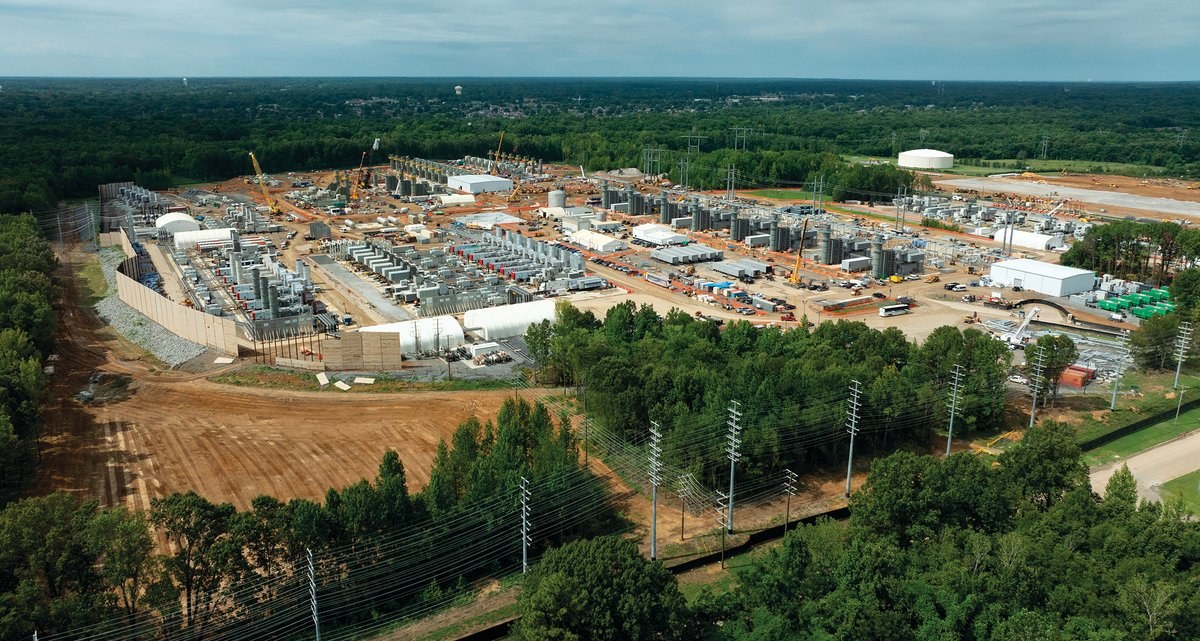
SOUTHAVEN, Miss. — The turbines stand in a field a few miles south of the Tennessee line: 27 of them, running on methane gas, supplying power to a data center on the other side of the state border. The lawsuit against them says they have never held an air permit.
On Tuesday, a federal judge in the Northern District of Mississippi refused the Justice Department’s request to throw that lawsuit out, leaving the NAACP and its Mississippi State Conference free to press claims that xAI Corp. and its subsidiary MZX Tech violated the Clean Air Act.
U.S. District Judge Debra M. Brown ruled that the government may join a citizen suit but cannot use that intervention to end it on its own, according to the Southern Environmental Law Center, which represents the plaintiffs with Earthjustice. The court rejected the department’s position that the case should be dismissed because the executive branch had decided it should not proceed.
The dispute began with a notice of intent to sue in February and became a complaint filed in federal court in September. The plaintiffs allege that xAI assembled what amounts to a power plant without permits, public notice or an opportunity for comment, and that the turbines release nitrogen oxides that form smog, along with soot and hazardous chemicals including formaldehyde. They asked the court for a preliminary injunction to stop the operation while the case proceeds.
The geography is central to the claim. The turbines sit in Southaven, Mississippi, but serve the Colossus 2 data center in South Memphis, and the neighborhoods nearest the site, including Boxtown, are predominantly Black and have carried a heavy industrial load for decades. The complaint argues that the burden of powering AI computing is being placed on a community that was not consulted and will not share the benefit.
The provision the plaintiffs used dates from the 1970 amendments to the Clean Air Act, which let citizens sue polluters directly when regulators do not act, on the condition that they give notice first. Congress wrote the clause after watching agencies decline enforcement, and it has been used against refineries, cement kilns and chemical plants ever since. It did not anticipate a case where the government would take the polluter’s side.
The order does not resolve whether the equipment broke the law. It resolves who gets to ask. That is a narrower question with wider consequences, because the Justice Department’s maneuver, intervening in a suit in order to dismiss it, would have given the federal government a way to shut down private enforcement of environmental statutes without repealing anything or issuing a rule.
The administration has made clear where it stands on the buildout. Data centers are treated as infrastructure of national importance, and the agencies that might slow them have been pushed to speed up. Permitting reform has been a recurring theme, and the government’s brief in this case argued that continued litigation conflicted with federal interests in the project.
The practical setting is familiar to anyone who has tried to power a large computing facility in the past two years. Utilities cannot deliver the load on the timeline the operators want, and the grid in the Memphis area has struggled to meet federal ozone limits without adding new demand. Companies have responded by bringing their own generation, and gas turbines can be ordered, delivered and running in far less time than a substation upgrade or a transmission line.
That workaround now faces its first serious legal test. A ruling for the plaintiffs would establish that on-site generation is subject to the same permitting regime as a merchant power plant, which is what environmental lawyers have argued all along and what several operators have effectively bet against. A ruling for xAI would make the citizen suit a weaker instrument than Congress intended.
Other cases are watching this one. Data center operators in Texas, Virginia and Indiana have signed deals for on-site gas generation, and state regulators have begun asking whether the air permits cover what is actually being installed. The answers will depend on how courts read a statute written for a different era of power plants.
For the NAACP, the ruling keeps alive a claim that has as much to do with process as with emissions. The organization’s Mississippi chapter argued that the community learned about the turbines after they were running, and that the absence of a permit meant the absence of the health assessment and public hearing that would normally accompany a plant of that size.
A spokesperson for xAI did not respond to a request for comment on the ruling. The company has described the turbines as a temporary source of power while permanent generation is built.
The case now moves to the merits, where the questions are technical: which turbines ran, for how long, at what capacity, and whether any permit covered them. Sulfur and nitrogen readings, stack tests, and the permitting record will matter more than the briefs.
A trial date has not been set. In the meantime, the turbines are running, the data center is drawing power, and the community that challenged them has a court date it did not have a week earlier.