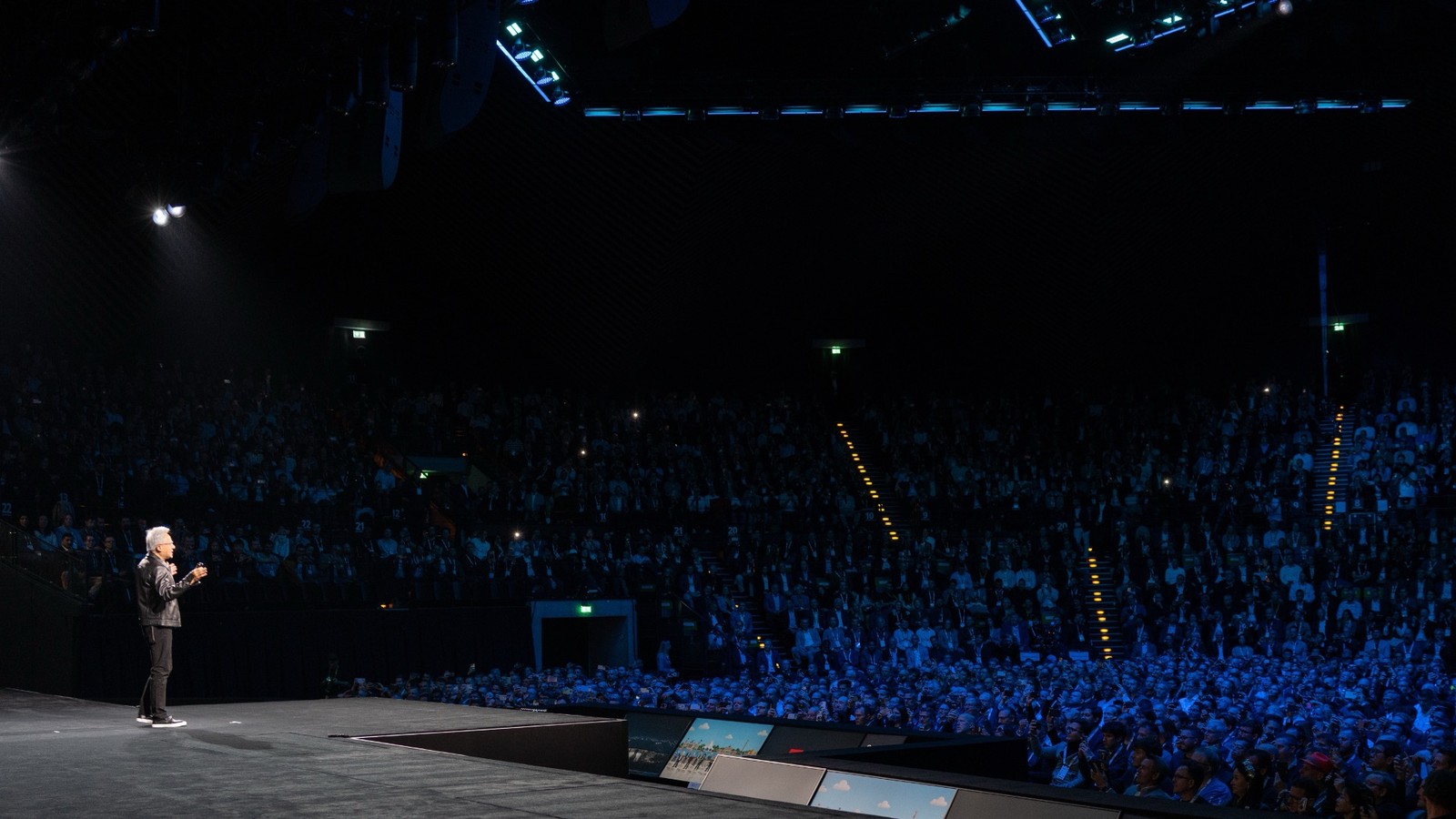
Jensen Huang walked onto the stage at the Tempodrom in Berlin on Wednesday in the middle of a selloff. The Philadelphia Semiconductor Index was extending its longest losing streak since 2008, and the companies that buy his chips had spent the month being marked down on doubts about how the buildout gets financed. His answer was a container.
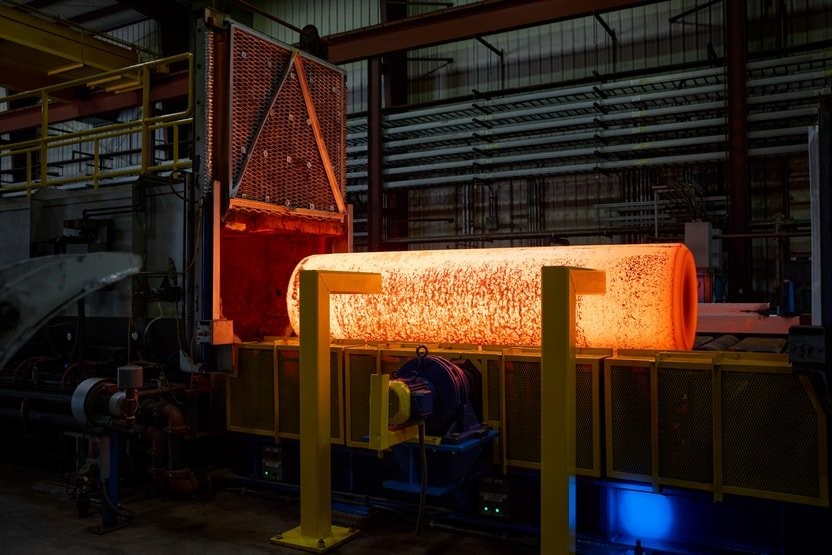
Nvidia used the Berlin stop of its GTC conference to introduce DSX POD, a reference design for complete Vera Rubin systems assembled inside modular containers by manufacturing partners, wired, piped and tested before they ship. At a site where power, cooling and network connections are ready, the company says deployment falls from about six months to as little as fourteen days.
The partner list is the substance of the announcement: Bull, Dell Technologies, Hewlett Packard Enterprise, Lenovo, Schneider Electric and Vertiv, with the first units promised in early 2027. Those are the companies that integrate racks, cabling, liquid cooling loops and power distribution. Moving their work into a factory removes the part of a data center project that depends on scarce electricians and commissioning crews at the destination.
“An AI factory creates value when it starts producing tokens, not when construction is complete,” Huang said in the statement accompanying the launch. The sentence describes the arithmetic his customers are living with. A shell of a building with no compute inside is a capitalized cost with no revenue, and at current interest rates the gap between construction and first token is expensive.
The efficiency claims attached to the broader DSX platform are the company’s own. At two gigawatts of capacity, Nvidia says the design saves 54 million liters of water a day, roughly what 180,000 households use, and up to 30 percent of the power needed to generate the same number of tokens. Both figures depend on the comparison being made, which in Nvidia’s presentations is a conventional air-cooled hall built with the previous generation of equipment. Operators who have already moved to liquid cooling will see smaller gains.
Huang’s message to the European audience was broader than the product. He told the hall that automakers, banks and hospital groups have to become artificial intelligence companies, not buyers of artificial intelligence tools. That claim has been his refrain for two years, and it lands differently in a country where the industrial base is the customer. Germany’s carmakers, machine builders and insurers are exactly the mid-sized enterprises that have been slowest to buy compute at scale.
The other announcements filled out the software side of the same pitch. Nvidia introduced OpenShell, an architecture for securing agents that act on their own inside corporate systems, and upgraded its Isaac framework for robotics. It also said it is working with Nokia and several telecom operators on rebuilding radio networks around accelerated computing, a long-running effort to put general-purpose hardware inside the base station.
The supply chain moves are the ones that will determine whether any of this ships on schedule. Amkor Technology plans to quadruple its advanced packaging capacity by 2028, and King Yuan Electronics is expanding test capacity in Taiwan. Packaging has been the tightest link in the chain for two years, and the fact that Nvidia’s partners are publishing capacity plans three years out is a signal about how long the company expects demand to run.
The Berlin setting was not incidental. Europe has committed public money to sovereign computing capacity and has very little of the construction labor required to install it quickly. A factory-built module addresses a real constraint on the continent: an operator can order a validated unit, connect it to a grid connection it may have queued years earlier, and begin selling inference in weeks. Whether the electricity is there is a separate question, and one that no reference design answers.
There is a simpler reading of the day. Nvidia’s customers are being asked to spend tens of billions of dollars on equipment that depreciates in a handful of years, financed largely with debt, in a market where the end demand for tokens is still being discovered. Anything that shortens the interval between the cheque and the first invoice improves the economics of that bet. A container that arrives integrated is worth more to a lender than a building site.
The skeptics have a point that the announcement does not address. Fourteen days assumes a prepared site, and preparing a site is where the years go. A two-gigawatt campus needs substations, water rights, permits and a community that will tolerate it, and none of those arrive in a container. If the bottleneck has moved from construction to interconnection, as operators in Virginia and Ireland report, then compressing the installation phase solves the smaller half of the problem.
Still, the direction of travel is clear. The unit of sale in this industry used to be a chip, then a rack, then a cluster. It is now a building that arrives by truck, with the integration done by someone else and the risk of a botched commissioning transferred to a factory floor. The part of the project that a customer can control has shrunk, which is precisely what a customer waiting five years for power wants.
The robot ducks that shared the stage with Huang got more coverage in some quarters than the container did. That is the nature of a keynote in a year when the audience is looking for reasons to feel good about the sector. The number that matters will be published in 2027, when the first units arrive and someone measures the interval between delivery and the first paid token.