For years, the first detailed look a county commissioner got at a proposed hyperscale data center often came with a condition attached: sign here, and do not discuss it with your constituents. Google says it will no longer ask.
The company confirmed the change this week and pointed to a document published on its website describing how it approaches data center construction, which now states the policy. Amazon and Microsoft have already ended the practice of requiring nondisclosure agreements from local officials. Amazon went further this month with a “Data Center Commitment” that includes pledges to disclose more about its facilities’ energy and water use and to improve the environmental rating of its backup diesel generators.
The shift follows pressure from Washington. Rep. Jamie Raskin, the ranking Democrat on the House Judiciary Committee, opened an investigation on Sept. 30 into Amazon, Google, Meta and Oracle over agreements that prevent state and local officials from discussing projects with the people they represent. His letters asked why the companies required the signatures and which projects the agreements covered.
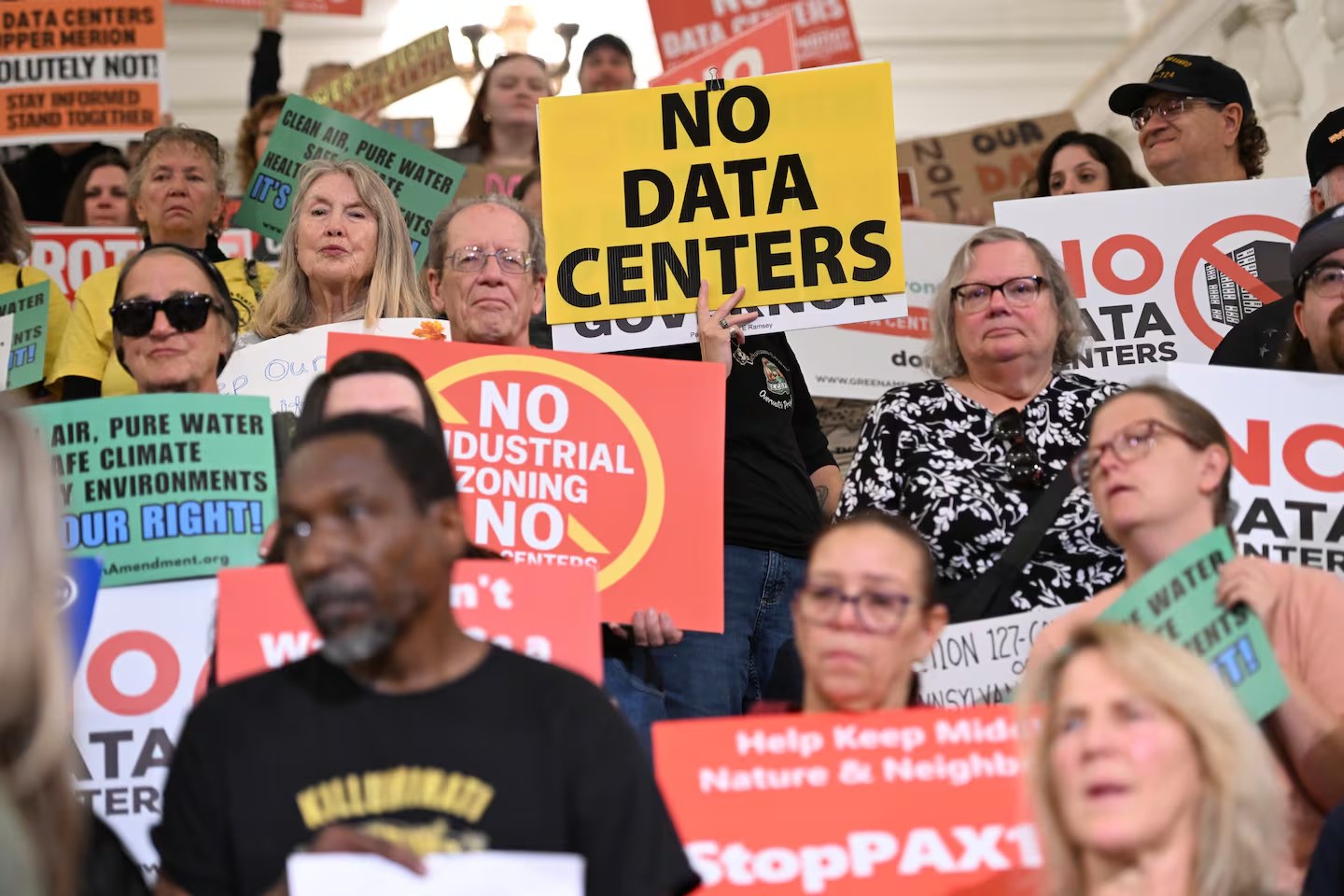
Critics have argued that the practice kept residents from learning about a project’s power demand, water consumption, tax abatements and generator emissions until a vote appeared on a municipal agenda. Developers often fronted projects under code names, so that even officials who knew something could not say who was behind it.
“It raises people’s suspicion as to what’s truly happening,” Anita Verma-Lallian, a developer with data center projects in Arizona, told the Associated Press.
Google’s framing is softer than a retreat. Devi Thomas, the company’s global head of community development and engagement, told the AP that she would not describe local resistance as a backlash, but that “there are often community questions to be addressed,” and that early public consultation “is increasingly a very important part of the process.”
The timing is not subtle. Data center construction has become an election issue. Control of Congress and 36 governorships are on the ballot next month, and local boards from Indiana to Ireland have rejected or restricted projects over electricity bills, water use and noise. Officials who once competed for the property tax revenue of a server warehouse now campaign against the warehouse.
For the companies, the agreement was a way to control the sequence of a project: option the land, secure the power, arrange the incentives, then present a finished package to a board that had little choice but to approve it. That sequence works when the benefits are obvious and the costs are diffuse. It fails when ratepayers can see their bills and neighbors can hear the generators.
Disclosure changes the sequence, not the underlying arithmetic. A project that draws hundreds of megawatts still needs a substation, a transmission upgrade and a decision about who pays for it. In most states that decision belongs to a utility commission rather than a county board, and no amount of transparency at the zoning stage changes the cost allocation. The same is true of water contracts and air permits, which sit with separate agencies on separate calendars.
What transparency can change is the price of opposition. A project disclosed eighteen months before a vote gives neighbors time to organize, hire lawyers and elect a different board. For a company with a multiyear pipeline, that is not obviously worse than a surprise rejection at the end of a two-year process. An early no is cheaper than a stranded asset, and a negotiated set of conditions — noise limits, a community fund, money for grid upgrades — is cheaper than litigation.
There is a competitive logic too. Google, Microsoft and Amazon face the same constraint, and any one of them can gain goodwill by being the most open. That advantage lasts only until a rival matches it, which appears to have happened within a few weeks. What is left is a baseline that all three now share, and no one can retreat from it without inviting the comparison.
The agreements had a defensible purpose, which the companies rarely articulated. A data center developer negotiates with dozens of landowners, several utilities and a handful of local governments, and any one of them can hold the project up once the site becomes public. Secrecy compresses that window and keeps land prices from rising the moment a buyer’s identity is known. It also moves the argument to the end, where a company has more bargaining power and the community has less time.
Skeptics will note that a published policy is not an audited commitment. Nothing in it prevents a company from using a shell developer to option land, and nothing requires disclosure of the price paid for power or the size of an abatement. The change addresses the agreement officials sign, not the information gap that made the agreement attractive in the first place.
State regulators are already moving into that gap. Public utility commissions have opened proceedings on special tariffs for very large loads, which decide how much of a data center’s power bill is paid by the developer rather than spread across other customers. Those cases matter more to a project’s economics than anything said at a zoning hearing, and they are decided in rooms where the public rarely appears. For the companies, a patchwork of state rules is a worse outcome than a single voluntary standard.
The test will arrive at a specific hearing, in a specific county, where a project is fully disclosed and the board votes no anyway. Executives say they want an informed conversation with host communities. Whether they still want one when the answer is negative will decide whether this is a change in practice or a change in presentation. Google’s next contested site will answer that.