Tesla sold about as many cars as it did a year ago and made little more than half as much money on them, a squeeze its executives describe as the price of becoming something other than a carmaker.
The company reported third-quarter revenue of $28.05 billion, essentially flat against $28.10 billion a year earlier, and net income of $787 million, down 43% from $1.37 billion, according to results published Wednesday after the close. Operating income fell 56% to $718 million, a 2.6% operating margin, less than half the level of a year earlier. Diluted earnings per share came to $0.22, down from $0.39.
The cost side tells the story. Operating expenses rose 39% to $4.78 billion, with research and development climbing to $2.76 billion from $1.63 billion. Capital spending more than doubled to $4.73 billion, and Chief Financial Officer Vaibhav Taneja put the full-year figure at about $20 billion. Tesla has arranged the ability to borrow up to $30 billion but does not intend to draw on it this year, he said.
Every operating unit moved in a different direction. Automotive revenue slipped 3% to $20.56 billion. Energy revenue fell 16% to $2.88 billion, which Tesla partly attributed to tariff-related customer refunds. Services and other revenue, a line that includes Supercharging, insurance and the robotaxi operation, rose 33% to $4.61 billion.
Deliveries declined 2% to 486,532 vehicles, and the company said battery availability, not demand, capped output. Income from the regulatory credits other carmakers buy fell to $113 million from $417 million. It finished the quarter with its largest passenger-vehicle order backlog in four years and built its ten-millionth car. Gross profit nonetheless rose to $5.49 billion from $5.05 billion, helped by a quarter in which restructuring charges fell to zero from $238 million.
Two supply projects advanced in the quarter. Megafactory Texas began production, with planned capacity of 50 GWh, and Megapacks assembled with LFP cells made in Nevada started shipping. Both address the battery constraint management cited, though neither adds enough capacity to change this year’s volumes, and the company said orders and backlog for storage reached their highest levels.
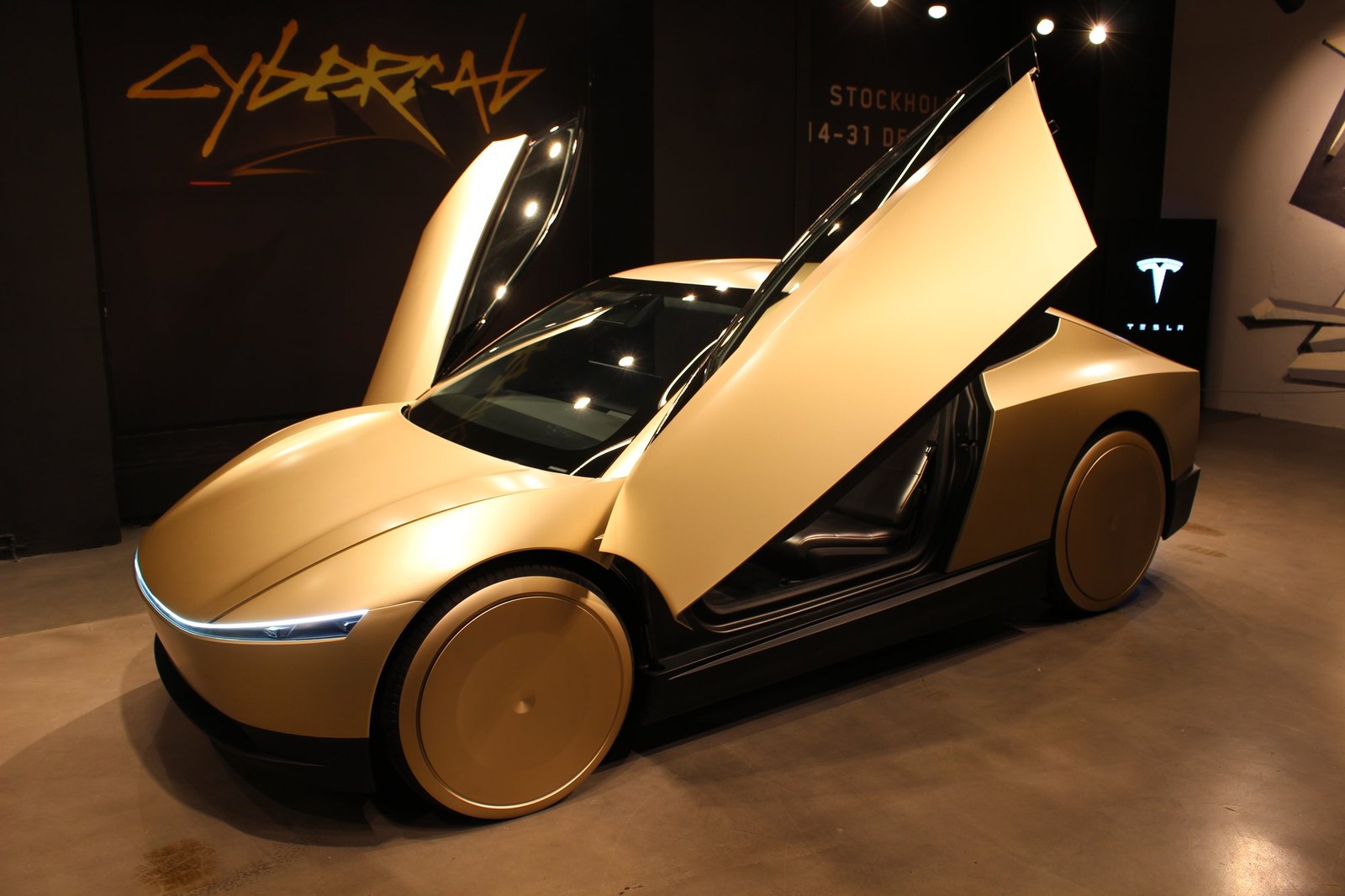
The forward-looking claims are where the earnings call became interesting. Lars Moravy, the engineering vice president, said Tesla is trying to begin selling the Cybercab to customers by the end of 2026, starting small. Every unit built so far has gone into Tesla’s own robotaxi fleet, which began carrying paying riders in Austin on Sept. 3. Ashok Elluswamy, who runs the AI software effort, said Cybercab rides would start in Dallas next month.
The vehicle itself is the problem. The Cybercab has two seats and no steering wheel, and the National Highway Traffic Safety Administration is investigating how Tesla certified it against federal safety standards, a case that remains open. Musk told investors that “the vast majority of the Cybercab stuff will be essentially Tesla-owned and transport as a service,” which is a different business from the one where owners buy cars and rent them out.
Optimus, the humanoid robot, has reached what Musk called early production on high-volume lines in Fremont, California. He said the ramp would be “somewhat bumpy,” that most of the remaining design work is in the hands, and that reaching 20,000 units a week would probably take at least a year, perhaps longer, with deliveries to other companies beginning around the end of 2027.
Full self-driving for customer-owned cars slipped again. Musk said in April that unsupervised operation would probably arrive in the fourth quarter of this year; on Wednesday Elluswamy put the first customer vehicles joining the robotaxi fleet at around the second quarter of 2027. Subscriptions to the supervised version rose 67% to 1.74 million, and more than 75% of new North American deliveries came with one attached, a statistic that measures adoption more than autonomy.
The quarter also carried two marks from Musk’s other ventures. Tesla booked a $142 million paper loss on the SpaceX shares it bought for $2 billion earlier this year, offset by a gain of about $290 million on its bitcoin. Cash and investments rose $1.9 billion to $45.4 billion, and free cash flow came to $1.53 billion after a negative $1.09 billion in the second quarter.
Investors focused on the margin. Shares fell more than 3% in after-hours trading, and analysts said the quarter offered little evidence that the AI and robotics spending is close to earning a return. The bull case now rests on a robotaxi network Tesla operates itself, a robot it has not yet sold to anyone, and a software product whose unsupervised version has been delayed twice.
Musk has never run Tesla as a car company, and for most of its history the market has indulged him for it. The difference this quarter is that the car business is no longer generating the cash to fund the story, which leaves the story paying for itself.
If the Cybercab cannot be sold until a regulator closes its investigation, and the robot cannot be sold until its hands work, what exactly is generating the $20 billion of capital spending this year?