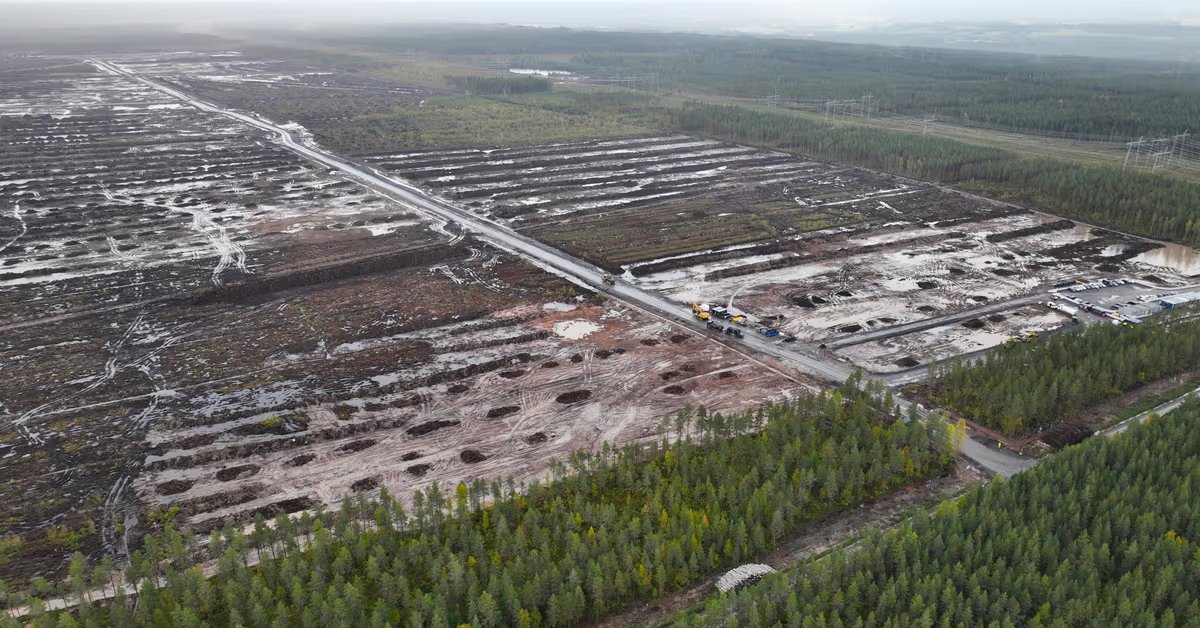
MUHOS, Finland—The clearing runs to the edge of the Oulujoki river and stops about 400 metres short of the water. Machinery tracks, exposed roots and standing puddles mark where spruce forest stood until late summer, on land Google bought for a data centre it says will serve its artificial intelligence business for decades.
That work is now the subject of a police referral, an apology from Google’s Finnish management, and a political argument in Helsinki about what the country gets in exchange for hosting the infrastructure of AI.
Finland’s Licensing and Supervision Agency, known by its Finnish initials LVV, ordered Google’s project company, Tuike Finland Oy, on Oct. 6 to suspend preparatory work at two northern sites, Muhos and Otanmäki near Kajaani, until environmental impact assessments are finished. The order gave the company until Oct. 23 to stop anything that alters the land.
The agency went further on Oct. 22, asking Oulu police to investigate the Muhos project. LVV has declined to discuss the referral, saying Finnish publicity law requires it to keep the matter confidential. A police communications official in Oulu said no preliminary inquiry has begun and that officers are waiting for the agency’s own assessment. If the case proceeds, it would go to the economic crimes unit. A private individual has filed a second referral over the same site.
Google’s subsidiary felled roughly 250,000 trees at Muhos and about 150,000 at Otanmäki, according to estimates reported by Yle and the Guardian, for a total above 400,000. The clearing covered 330 hectares at Muhos and almost 200 at Otanmäki. Work began in March and continued through September.
LVV says it learned what had happened at Muhos only in late August, after the local environmental office flagged possible effects on nearby waterways. By then most of the felling was done.
The company’s defence is procedural. In a Sept. 25 submission, Tuike Finland told the regulator that the work needed no permit, citing a clause in Finland’s building law that allows felling and excavation before construction starts. Google has said trees on land it owns were removed in compliance with the Forest Act. It told the BBC that it understood the concerns and had “fallen short of our own high standards in this instance.”
That position ran into the agency’s water specialists. LVV has demanded a fuller water management plan for Muhos, including the structures to be built, where they go, a construction timetable and monitoring by an independent party, with a deadline of Nov. 5. Janne Kärkkäinen, who heads the agency’s water environment unit, said the material submitted so far did not show with sufficient certainty that effects on waterways could be prevented.
Antti Järvinen, Google’s Finland country manager, apologised on Oct. 13. LVV’s unit head Sari Myllyoja told Yle that “failure is too strong a word” for the agency’s handling, saying it acted within its powers.
The two sites belong to a €13 billion, two-year Finnish programme Google announced in September. It covers new data centres at Muhos, Vaala and Kajaani and an expansion of the company’s existing campus at Hamina, near the Russian border, which has run since 2009 and was built around seawater cooling.
Politics moved faster than the paperwork. Prime Minister Petteri Orpo called the Muhos clearing a “cold shower.” A citizens’ initiative demanding tighter rules for data centres and a fee to compensate host municipalities passed 96,000 signatures within days of the Guardian’s report. Sofia Virta, leader of the Green League, called for an immediate investigation and said Finland needed stronger oversight as foreign companies expand.
The complaint from the Finnish Association for Nature Conservation is technical: it argues that converting more than 200 hectares of land permanently should have triggered an assessment before the trees came down, not after. Hanna Halmeenpää, the group’s chair, told the national news agency STT that the case was either a failure of expertise by the project company or disregard for Finnish law.
Finland has become one of Europe’s most attractive places to build AI capacity. Power is comparatively cheap and low-carbon, the climate cuts cooling costs, land is available and the grid in the north has capacity that the south lacks. The Guardian counted 145 data centre projects at various stages of planning, including a €10 billion campus at Jämsä announced this month.
The same conditions have produced conflicts elsewhere. Ireland’s regulator restricted new data centre connections around Dublin after the power system filled up. The Netherlands imposed a moratorium on large new campuses in 2022 and lifted it the following year with tighter rules. Germany’s grid operators now queue projects by how quickly they can bring their own generation. What changes when a country reaches this stage is not the appetite for investment but the price of a permit.
For Google, the exposure is schedule rather than money. A €13 billion programme announced with political fanfare is now waiting on an assessment it should have completed first, a water plan due in November and a police decision that could take months. Data centre construction schedules are measured in quarters; Finnish appeals can run for years.
The broader industry reads the case as a warning about diligence. Hyperscalers have learned to lock in power, land and equipment years ahead, and increasingly to promise local benefits. What they have not solved is the paperwork that sits between a purchase agreement and a foundation pour, in countries where the environmental review is the only real veto.
LVV has not asked police to look at Otanmäki. The agency says the suspension at both sites holds until the assessments are complete, and Google says it will comply fully with regulators. The next date that matters is Nov. 5, when the company has to show how it will keep silt out of a river that flows into the Gulf of Bothnia.