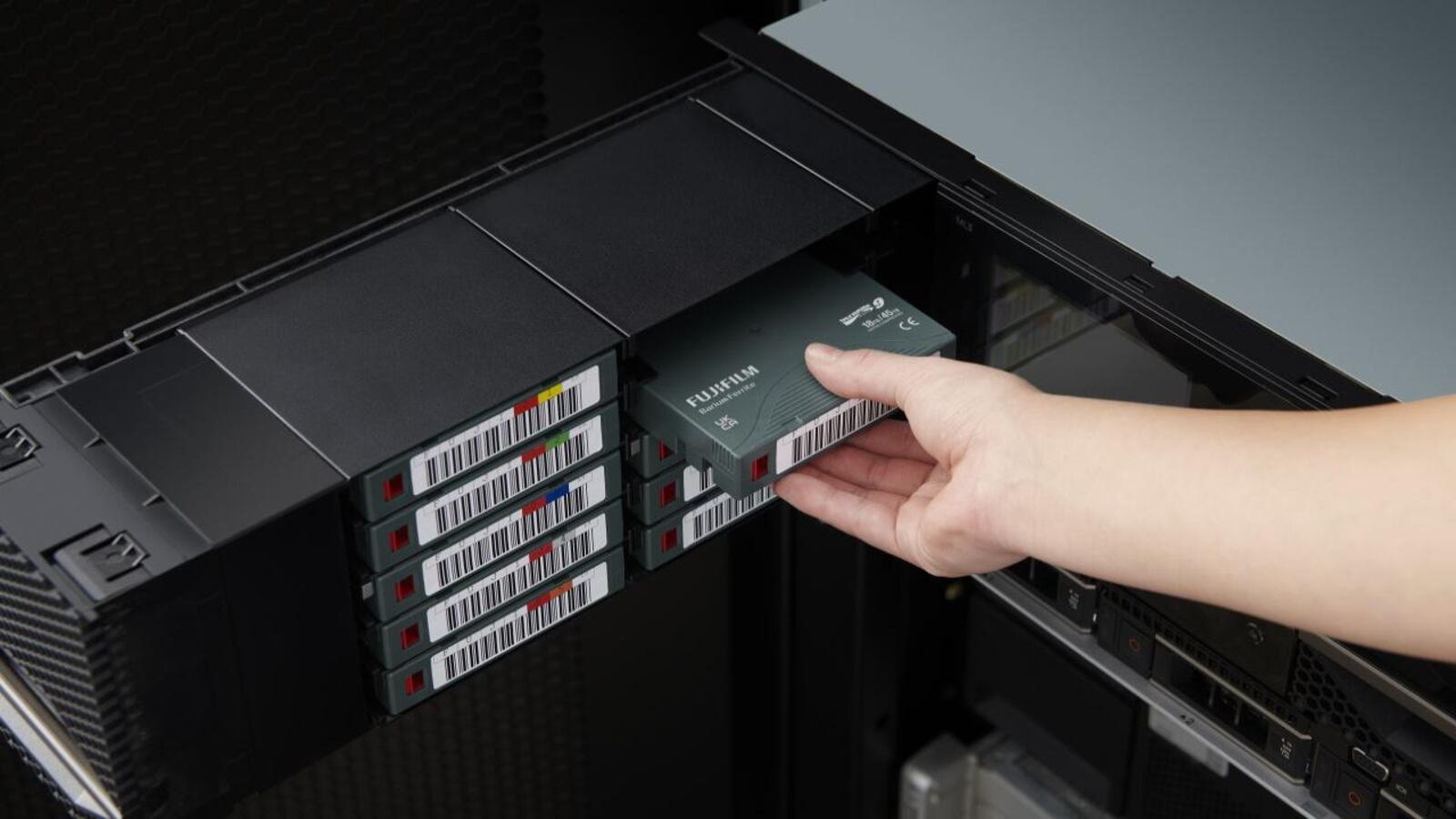
The fastest-growing storage medium in the AI buildout is a ribbon of plastic coated with magnetic particles, wound on a hub the size of a coffee cup.
Fujifilm intends to spend about 10 billion yen to raise its tape capacity fivefold, according to a report in Nikkei, the largest expansion of that business in roughly twenty years. The company targets completion in the fiscal year ending March 2028 and will concentrate on high-capacity LTO cartridges, the format that now holds something around 100 terabytes on a single reel.
The economics are strange enough to explain the decision. A cartridge on a shelf consumes nothing. No platter spins, no controller draws idle power, no cooling is required, and a library of ten thousand tapes uses electricity only when a robot arm fetches one and threads it into a drive. In a data centre where the power bill is the constraint that decides how many accelerators a site can hold, that matters more than read speed.
The trade is latency. A disk answers in milliseconds and a tape in seconds or minutes, because the drive has to locate a position on a long, thin piece of media and wind to it. Sequential access rules out anything a person waits for. It does not rule out archives, and archives are what AI systems produce in volume: training corpora, checkpoints written through the night, logs, and frozen copies of old model weights that nobody expects to open again.
Cloud operators have run tape at the bottom of their storage tiers for years, mostly without discussing it. It is the cheapest place to put a byte that has to be kept and almost never read, and regulators in finance and healthcare have spent a decade requiring exactly that kind of retention. What changed is the volume. A company training models against a corpus measured in petabytes generates copies of that corpus for every experiment, and the copies outlive the experiment.
Media supply is thin. Fujifilm is one of only two companies still coating LTO tape at scale, and the format’s roadmap has stretched as generations took longer to qualify. With disk prices rising and flash diverted toward AI accelerators, the archive tier has become the one part of the storage stack where a buyer can still find relief, which is precisely when that relief runs short.
Capacity takes time to build. Coating lines are specialised equipment with long lead times, and a fivefold increase is not something a company does in a year even with the money committed. Announcing completion by fiscal 2028 is therefore a statement about expected demand three years out, made by a company that can see the order book of its customers.
The investment is also a bet against substitution. Flash can be pushed into the archive tier, and some operators have done it for data they expect to read again. Disk can hold nearline data at a cost that is close enough to matter for small libraries. Tape wins where the volume is large, the retention is long and the access pattern is rare, and AI has produced more of that data than any prior workload.
The libraries that read the tapes are a constraint of their own. A robotic archive holds thousands of cartridges and a handful of drives, and the ratio is set by how often the data is requested. For an AI archive the answer is rarely, which is what allows the cost per stored terabyte to fall so far below disk.
What the expansion does not fix is the speed of retrieval. A tape that takes two minutes to locate is useless for a service answering queries, so the tier structure stays: flash for the working set, disk for the near line, tape for everything that must be kept. Each layer is now under price pressure at the same time, and the cost of an archive is being repriced upward for the first time in a decade.
Fujifilm has been here before in another sense. The company spent years converting film-coating expertise into products for electronics and healthcare after photographic film collapsed, and the tape business is one of the places where that know-how survived. A magnetic coating line is closer to a film line than to a chip fab, which is why a chemical company holds a position that semiconductor firms do not contest.
For the buyers, the practical consequence is a planning assumption that has to change. Storage was the line item that fell every year and could be deferred; it is now the line item that rises and cannot be deferred, because the data arrives whether or not the budget does. The hardware that writes it, the software that inventories it and the buildings that hold the libraries all get more expensive together.
Nikkei’s report did not say how much of the new capacity is already spoken for, and Fujifilm has not discussed pricing. The direction is not in doubt. A company that has not expanded tape output in twenty years is committing capital to a fivefold increase in the same month that disk makers report record margins and memory prices climb, which is a statement about where the AI industry’s data ends up.