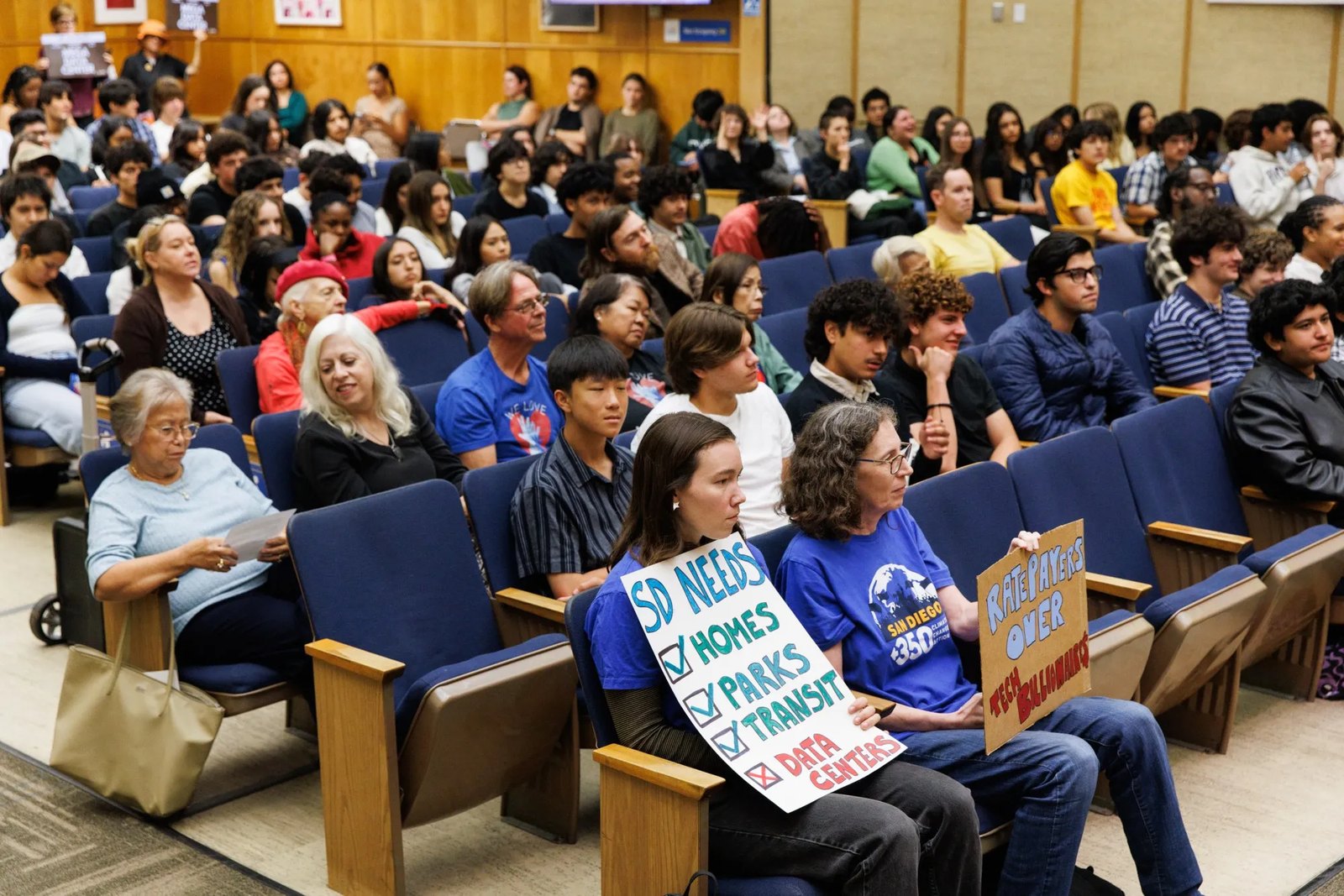
The San Diego City Council settled the question in a single evening. On Tuesday it voted 9-0 for an emergency ordinance suspending new data-centre development across the city, without dissent and without the amendments developers had spent the previous fortnight drafting.
The measure converts an executive order Mayor Todd Gloria signed days earlier into law, which matters because an order binds city staff while an ordinance binds everyone. Council President Joe LaCava said residents’ objections to where the buildings were going and to the electricity and water they would consume had been “clear and strong.”
Neither the length of the pause nor the rules that will replace it has been settled. That work now sits with a planning process that has published no timetable, and with an industry that had come to regard San Diego County as one of the easier places in California to site a large computing campus.
The objections are concrete. A large AI hall draws power on the scale of a factory, and the substations serving the coastal neighbourhoods where several projects were proposed were built for houses and light retail, not for a load that never drops. Water is the older argument: evaporative cooling consumes millions of gallons in a county that imports most of its supply, and even air-cooled designs need water for humidity control.
Both complaints land in the same room. Land use, power and water are decided by different bodies on different schedules, but the council is the only one where a resident can appear and be heard inside three minutes, so it absorbs pressure from all three.
What San Diego did fits a widening pattern. Commissioners in Martin County, Florida, have passed a one-year pause. The council in Denton, Texas, is advancing a six-month one. Aurora, Colorado, went the other way, its council rejecting a ban for the second time. The split is not regional and does not track party politics. It tracks whether a specific site has already been named.
That is the practical difficulty for developers. A moratorium announced in general terms is survivable, because land can be optioned elsewhere. A moratorium that follows a named project, a rezoning application and a packed neighbourhood meeting is harder, because the opposition arrives organised and the local record is already built.
Utilities read the vote differently. A data centre is a twenty-year customer with a flat load profile, and the wires and generation built to serve it are paid for by every other ratepayer if the project is abandoned halfway. Several states have begun writing rules that require large loads to fund their own interconnection, and regulators will take a unanimous council vote as evidence that demand forecasts are not firm enough to build against.
For the companies, the arithmetic of delay is unforgiving. A shell and a substation take two to three years; an order book does not wait that long. Capacity booked for 2028 in Virginia or Texas cannot be moved to a California site that will not hold a permit until 2029, so a pause removes the site rather than deferring it.
Some developers will take the other road and build outside the city limits, on unincorporated county land where the board of supervisors writes the rules and the neighbours are fewer. That has been the pattern in northern Virginia and in parts of Arizona, and it usually produces the same fight one jurisdiction later, with a bigger hall and a longer commute for the staff who run it.
The industry’s case to councils has been fiscal: property tax, construction jobs, a customer for the local utility. That case weakens where the tax base is already healthy and housing is short. A data centre employs few people for the land it occupies, and it does nothing for a city trying to house the workers it already has.
LaCava’s phrasing is worth reading closely for what it concedes. He called the objections clear and strong, not correct. A council that says residents are loudly opposed is a council reserving the right to approve something later, once the questions about power and water have answers it can defend in public.
There is also a question of definition. An ordinance that suspends data centres has to say what one is, and the drafting will decide whether a hall of two hundred megawatts and a twelve-rack closet in an office park are treated the same way. Lawyers for both sides will spend the pause arguing about the threshold, which is one reason the pause may outlast its nominal term.
State legislatures have been circling the same ground. Bills that would strip municipalities of the power to refuse large computing loads have been introduced in several states, usually framed as a question of grid planning rather than land use. None has passed in a form that would settle a case like this one, and the industry’s lobbyists now have a fresh example to cite.
Until then, San Diego joins the list of places where the constraint on AI capacity is not silicon. The chips are allocated, the racks are being assembled, the capital is raised. What is missing is a vote nobody has scheduled.