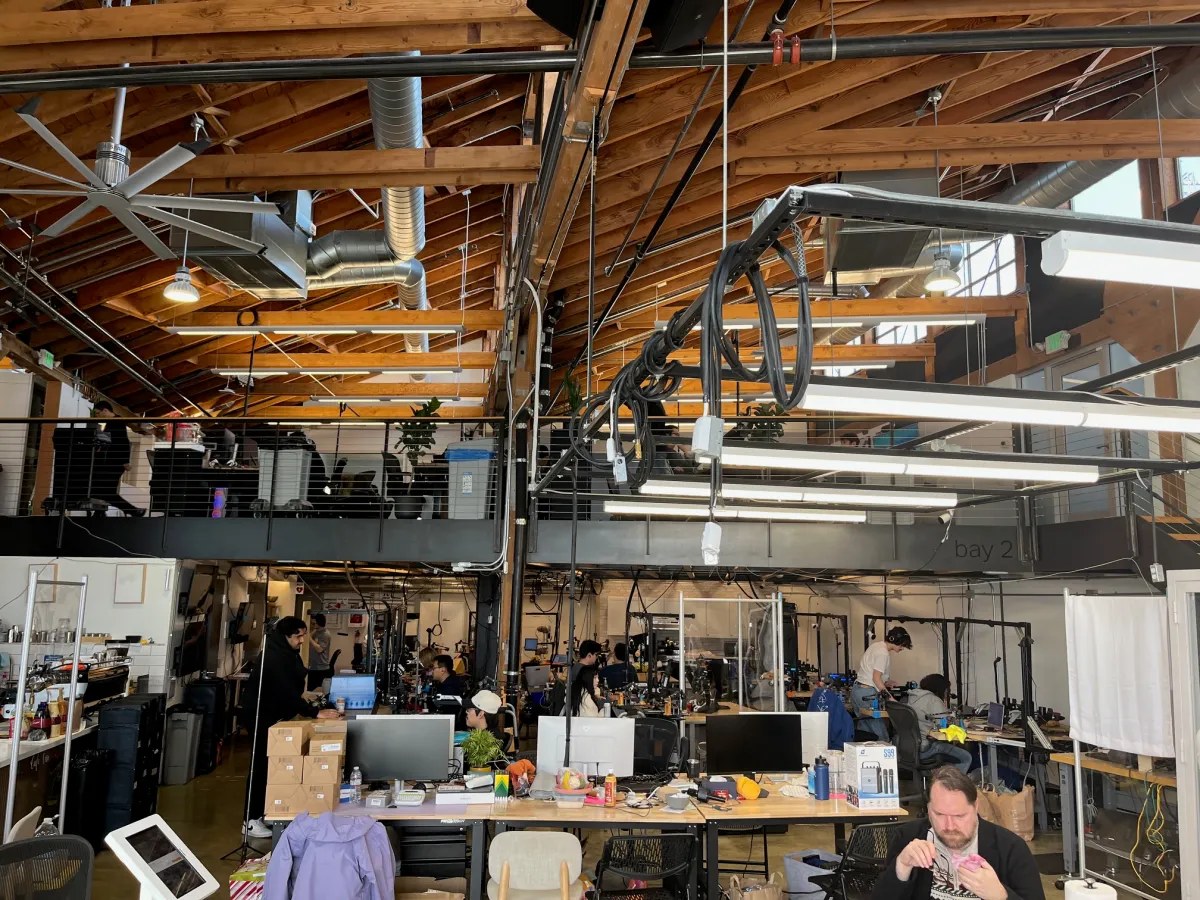
The company selling the software has no product on the market and no revenue to report. Physical Intelligence, which writes general-purpose software for robots, is nonetheless in talks to raise at least $1 billion at a valuation of about $20 billion, according to people familiar with the matter, nearly double the $11.5 billion it carried earlier this year.
Avenir and Lux Capital, both existing investors, are negotiating to lead the round. The company’s backers already include CapitalG, the growth fund tied to Alphabet, Thrive Capital and Jeff Bezos. Physical Intelligence was founded in 2024 by former researchers at Google DeepMind and academics from Stanford and Berkeley.
The catalyst for the talks appears to be a product decision rather than a financial one. This month the company began letting outside developers fine-tune its newest robot model in a beta release, which gives researchers and hardware makers a way to test the software on their own machines for the first time.
That access matters because the hardest problem in robotics is not building an arm. It is teaching a machine to handle objects it has never seen, in rooms it has never entered, without an engineer writing a program for each task. Manipulation is where the field has stalled for decades, and where the recent generation of large models has made its first credible progress.
The bet investors are making is that a single model, trained on enough demonstrations, can generalize across hardware. If that works, the software becomes the layer that every robot maker licenses, and the market is measured in the millions of machines that factories, warehouses and hospitals might eventually deploy.
Fine-tuning access is the commercial test of that thesis. A developer who takes the beta and builds something useful is a future customer. A developer who finds the model brittle on a different gripper or a cheaper camera is a reason to wait. The company is asking investors to price the first outcome before the second has been ruled out.
What the round does not have is a way to check the price against a business. There are no contracts, no bookings and no unit economics, because there is nothing being sold yet. The valuation is a statement about capability, made by investors who have seen the model and believe the remaining gap is engineering rather than research.
That is a different kind of wager than the ones being made a few miles away in the data center business, where capital is being committed against signed leases and power contracts. Physical Intelligence is raising against a demonstration. The two are both large numbers, and only one of them can be audited.
The company is not alone in attracting this kind of money. Robot software has become one of the few areas of AI where investors will accept pre-revenue pricing, in part because the alternative — waiting for a proven market — has historically meant missing the companies that created one. The firms that backed the first generation of foundation model developers made the same argument, and the returns have been uneven.
There is also a hardware problem the software cannot solve alone. Robot arms differ in their joints, their sensors, their control interfaces and their cost. A model trained on one platform may need retraining for another, which limits how quickly a software layer can spread across the industry. The beta program is a way of finding out how much of that variation the model absorbs and how much has to be handled by the integrator.
For the investors, the timing question is whether to pay $20 billion now or wait for evidence. The case for now is that the best robotics teams are small, scarce and already funded, and that the price of entry rises with each demonstration. The case for waiting is that pre-revenue valuations in this cycle have a way of resetting when the next funding environment arrives.
Neither side has to decide immediately. A round of this size takes months to assemble, and the terms being discussed are not final, according to the people familiar with the talks. What is being priced today is a research result that the company believes it has already achieved and that the market will only be able to judge once developers outside the company have had the software in their hands for a year.
The founders’ backgrounds explain part of the confidence. DeepMind alumni have produced a series of results in control and simulation, and the academic groups at Stanford and Berkeley have trained much of the field’s workforce. A team assembled from those sources is, in the judgment of venture investors, the most likely group to convert a demonstration into a product.
The larger question is what happens to the robotics industry if the model works. A general-purpose controller would compress the value of the software stack and shift margin toward whoever owns the data and the deployment relationships. That is a familiar outcome in other parts of computing, and it is why the hardware makers have been building their own teams rather than waiting for a vendor.
For now the company is raising money to hire researchers and buy computing, and it is doing so at a price that assumes the hard part is nearly finished. The developers who received the beta this month will produce the first independent evidence of whether that is true.