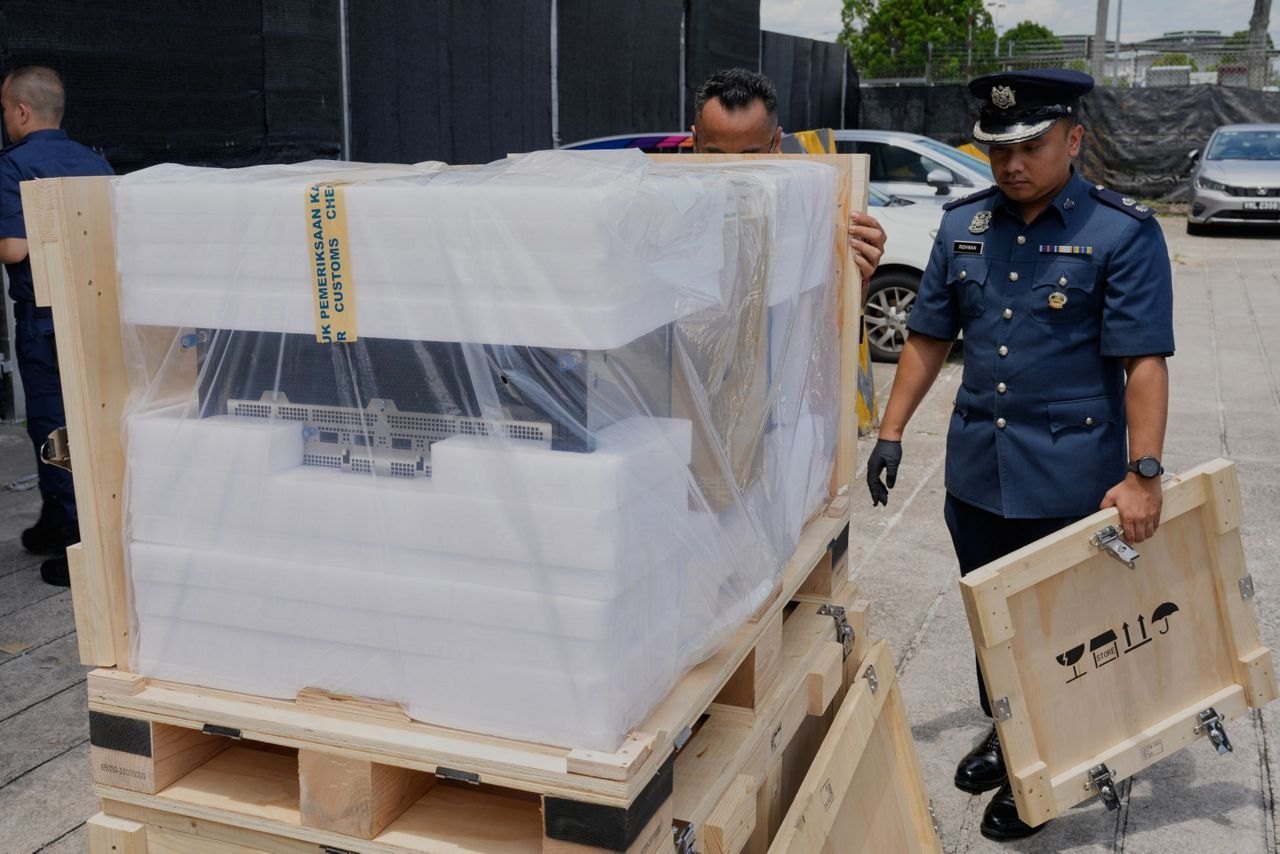
The shipment looked like ordinary hardware. Thirty server chassis arrived at Kuala Lumpur International Airport this month, and when officers opened them they found advanced AI chips inside, according to Malaysia’s customs department, which put the value at about 49.5 million ringgit, or $12.1 million.
The department said at a news conference Tuesday that the goods are suspected of violating export controls and that investigators are pursuing a smuggling syndicate behind the shipment. No arrests were announced, and the agency did not say where the equipment was headed or where it had come from.
It is the second such case Malaysia has disclosed this year. In June, authorities intercepted AI chips worth nearly $13 million in a separate operation. The two seizures together suggest that the route through Southeast Asia is being used repeatedly, and that the volume moving along it is large enough to support specialized logistics.
The economics explain the traffic. A single high-end accelerator can cost more than a car, and a pallet of them is worth more per kilogram than almost any legal cargo. Server chassis make convenient packaging: the units look like standard enterprise equipment on a manifest, and the chips inside are not visible without opening the case.
Malaysia has become a transit point for a reason. The country has a large electronics manufacturing base, established air cargo links and a customs regime built for legitimate trade volume. A container that enters as computer equipment and leaves as computer equipment does not draw attention unless someone inspects it.
The seizures come as Washington has been tightening its review of AI chips that pass through third countries. The concern is not the destination on the manifest but the one after it, and enforcement has shifted toward tracking components through intermediaries rather than relying on end-user declarations. Countries in the region have been asked to strengthen their own controls, and several have begun requiring permits for advanced chip transshipment.
That pressure puts governments in an awkward position. Malaysia wants the data center investment that comes with the AI buildout, and it also wants to remain a trusted link in global supply chains. A customs service that finds contraband is demonstrating both competence and the scale of the problem at the same time.
The chips themselves are the hard part of any investigation. Accelerators are not serialized in a way that makes tracing simple across borders, and the parties arranging a shipment are usually several intermediaries removed from the buyer. Prosecutions in cases like this tend to focus on the freight forwarder and the shell company that booked the cargo, not on the end user.
For the companies that make the equipment, the seizures are a reputational issue as much as a legal one. Export rules bind the seller, but once a unit is in the channel, the manufacturer’s visibility ends at the distributor. Several have responded by tightening their own dealer agreements and by requiring end-use certificates that are difficult to verify.
The broader pattern is one of arbitrage against regulation. Every tightening of a control list creates a price gap between jurisdictions where a chip can be sold legally and those where it cannot, and a gap that large attracts people willing to move boxes through airports. Enforcement reduces the volume and raises the cost, but it does not close the gap.
Malaysian officials framed the case as a warning to the networks rather than a resolution. The department said it is still working to identify the syndicate, which implies the shipment was one part of a series rather than an isolated attempt. That is consistent with what customs services in the region have reported: the same routes, the same packaging methods, different cargo.
What happens next depends partly on how much the destination governments cooperate. A seizure at the origin airport is a case about export paperwork. A seizure that leads to an arrest at the destination is a case about a criminal organization. The first is easier to produce and more common.
The hardware will be held while the investigation proceeds, and the value cited by customs reflects what the chips would sell for, not what the shipper declared. That gap is often the first thing investigators use to build a case, because a manifest that undervalues a shipment by an order of magnitude is evidence of intent.
For the industry, the practical effect is a slower and more expensive path through the region. Freight forwarders are being asked for documentation they did not previously collect, and legitimate buyers of server equipment are being delayed while customs inspects consignments that used to clear in hours.
Malaysia’s customs department said it would continue inspections at the airport and at sea ports. Thirty chassis is a small fraction of the cargo that moves through Kuala Lumpur in a month. The fact that officers found this one suggests they are looking.