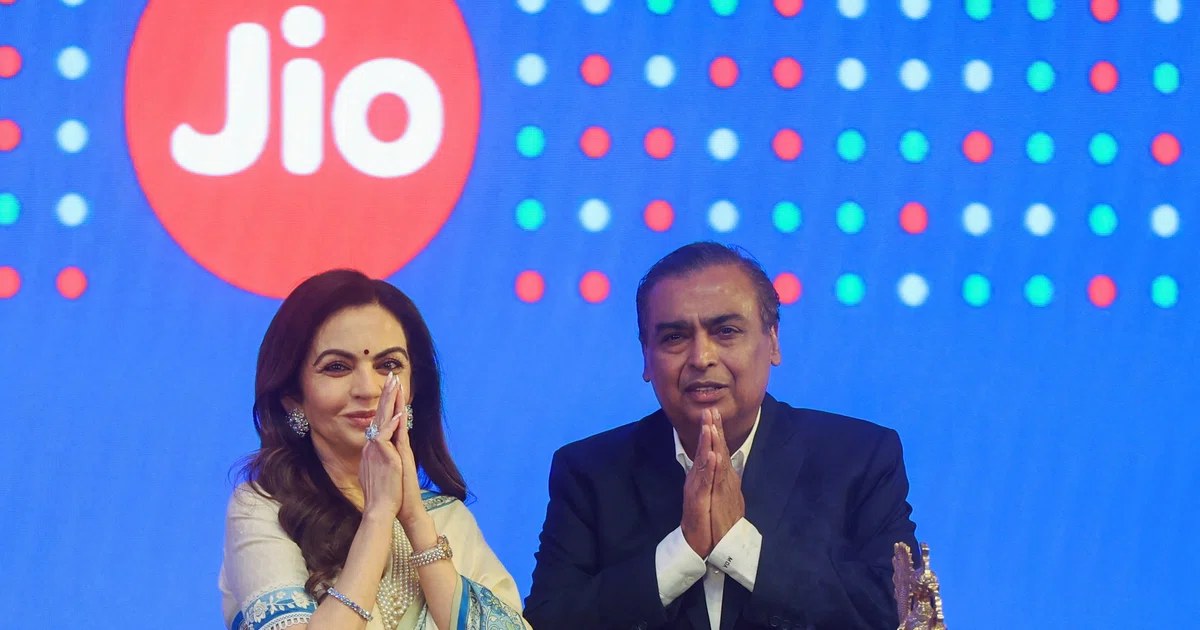
More than 13.8 million people applied for shares in Jio Platforms. On Oct. 28 the company gave them a listing, and the scale of that queue turned out to be the story.
Jio Platforms, the telecom and digital arm of Reliance Industries, began trading in Mumbai at 1,358 rupees against an issue price of 1,119 rupees and closed at 1,419 rupees, a gain of 26.8%. The offering of 270 million shares raised 302 billion rupees, about $3.2 billion, and was subscribed 22.19 times. By the count of applications it was the most heavily bid initial public offering in Indian market history.
The closing price puts the company’s market value at roughly 13.05 trillion rupees, or about $131.5 billion, making it the second-largest listed company in the country behind its own parent. Reliance Industries sold a minority of a business it built from a standing start in 2016, and the market marked the newly listed shares up by more than $25 billion in a single session.
The financials behind the sale are those of a mature operator rather than a growth story. In the last fiscal year Jio Platforms reported net profit of 300.5 billion rupees on revenue of 1.47 trillion rupees, both up about 15%. That is the profile of a company with a very large subscriber base, a settled tariff structure and a capital-spending program that has already been paid for once.
Where the money goes matters more than where it came from. Up to 275 billion rupees of the proceeds will repay debt at Reliance Jio Infocomm, the operating subsidiary that carries the network. Deleting that liability before the next spending cycle is the reason the offering exists in the form it does: the company is not raising money to survive a buildout, it is clearing its balance sheet ahead of one.
That next cycle is artificial intelligence. Jio has been assembling data-center capacity and computing power, and the arithmetic of that business is different from telecom in every respect that investors care about. A wireless network spends capital once and collects rent for a decade. A computing business spends capital continuously, because the hardware depreciates at the speed of the model release schedule rather than the speed of the tower.
The 26.8% first-day gain is a retail number more than an institutional one. An offering subscribed 22 times, with an application base in the tens of millions, is a bet by small investors on the parent’s reputation as much as on the subsidiary’s earnings. Indian listings have a long history of opening strong and drifting back toward the issue price over the following months, and a debut that adds a third to the valuation of the country’s second-largest company is the kind of move that invites profit-taking.
For Reliance the transaction does something a bond sale could not. It creates a public currency for the digital business, which can now be used to pay for acquisitions, to compensate employees and to raise further capital without adding to the parent’s debt in the eyes of lenders. The group has spent a decade arguing that the telecom network was the foundation of something larger. A listed subsidiary with its own share price is how that argument gets marked to market every day.
The comparison Indian bankers will be making this week is with the last large domestic listing cycle, when newly floated companies were absorbed into index funds within a quarter and then traded on their earnings rather than their story. Jio is different in one respect that matters: it is now among the largest companies in the index that is still opening a market it did not have, because the business it is entering, computing and data centers, barely existed in the country five years ago.
Risks are not hard to list. Indian telecom is a three-player market with a history of destructive price competition, and price competition has destroyed returns in the sector before. Average revenue per user has improved, but it improved because tariffs were raised, not because costs fell. A company that has to fund a computing buildout from the cash flow of a mature wireless business has less room to absorb a price war than its valuation implies.
Then there is the question every large Indian listing faces eventually: what the float does to governance. A subsidiary that answers to public shareholders as well as to a controlling parent will be asked, at some point, why a contract was awarded to a group company or why a related party got the terms it did. Reliance has managed those questions at the parent level for decades. It will now have to manage them twice.
For the market, the signal is simpler. A $3.2 billion offering that drew 13.8 million applicants and closed 26.8% higher says domestic capital is abundant, that investors will pay for infrastructure assets with predictable cash flow, and that the queue for a Reliance security is not a thing of the past. The next test is whether the shares hold above the issue price once the first-month buyers are gone.