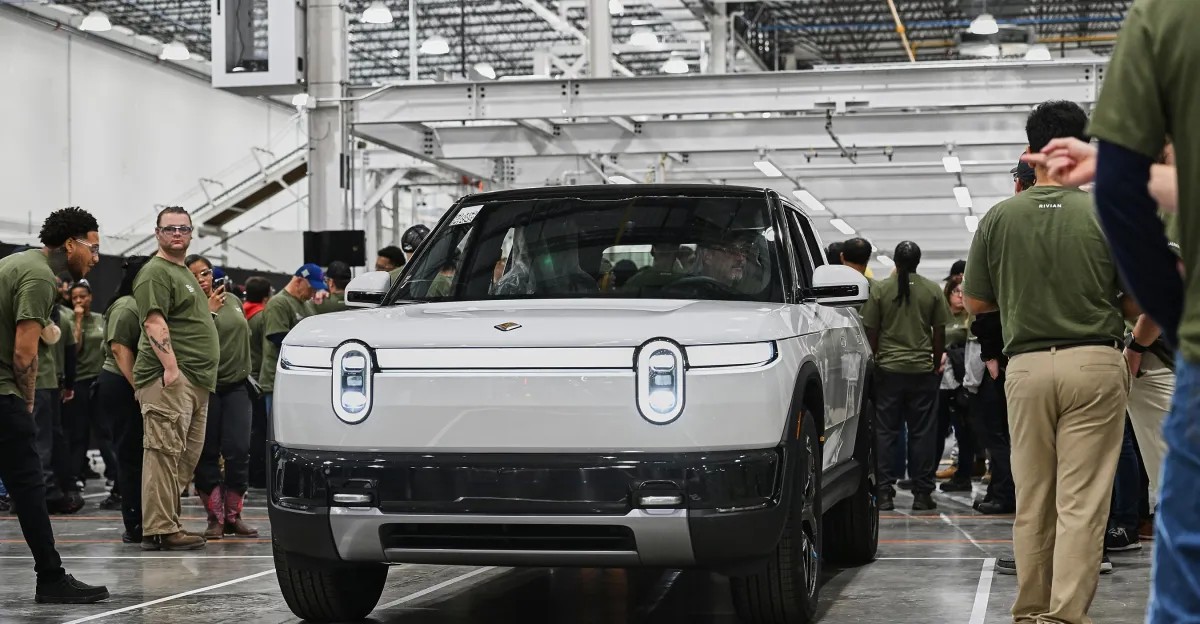
The R2 reached showrooms this year, and it is already the best-selling vehicle Rivian makes. The company said Thursday that the smaller SUV outsold both the R1 line and its commercial delivery vans in the third quarter, a shift in the product mix that took less time than the company’s own guidance implied.
Revenue for the quarter came to $2.155 billion, up 38% from a year earlier, with deliveries up 46%. The adjusted loss was 48 cents a share, narrower than the 62 cents analysts had forecast. The stock has been volatile all year on questions about cash, and a quarter that beat on both revenue and loss per share does not settle those questions so much as push them out.
The mix is the story. Rivian built its reputation on the R1T and R1S, vehicles priced near and above $80,000 that established the brand with buyers who wanted an electric truck before there was a credible one. Those vehicles cannot carry a company. The R2, starting around $45,000 before incentives, is the first Rivian designed to be built at volume, and it is being assembled at the company’s existing plant in Normal, Illinois, rather than at the Georgia factory Rivian paused to conserve capital.
That decision looks better with each quarter. Ramping a new vehicle at an existing site avoids the cost and delay of a greenfield build, and it lets Rivian reuse a workforce that has already learned to assemble its platforms. The company said R2 output is still climbing, which is the phrase to hold onto: the vehicle is selling faster than it is being built, and the margin on each unit depends on how quickly the line reaches its rate.
The other number in the release is the one that has quietly become the most interesting part of the business. Software and services generated $354 million, about 60% of that segment’s revenue, from the joint venture with Volkswagen. The arrangement, in which Volkswagen agreed to fund up to $5.8 billion, licenses Rivian’s electrical architecture and software stack for use in the German group’s own vehicles. It is, in effect, a supplier business attached to a carmaker, and it carries none of the capital intensity of building vehicles.
Rivian and Volkswagen said the same day that the venture’s scope is expanding to include an AI assistant, with the vehicle software stack packaged as something that can be licensed to outside manufacturers. The logic is straightforward. Rivian spent years and a great deal of money developing a zonal electrical architecture and the software that runs on it, and the marginal cost of letting another manufacturer use it is close to zero. The marginal revenue is not.
For Volkswagen, the appeal is speed. Its own software unit has been the source of repeated delays, and buying a working stack from a smaller partner is faster than fixing an internal one. For Rivian, the appeal is a revenue line that does not depend on how many vehicles it sells, which matters for a company that has consumed cash at a rate its vehicle margins have not covered.
Competition in the R2’s price band is about to become the most crowded in the industry. Every major manufacturer has announced a mid-size electric SUV in the $40,000 to $50,000 range, several of them with production starting in the next eighteen months. Rivian’s advantage is that it got there first with a vehicle that has been reviewed well and a brand that carries some of the premium associations of the R1. Its disadvantage is scale: the incumbents can lose money on a vehicle line for longer than Rivian can.
Cash remains the constraint that governs everything else. The company has been spending on the R2 ramp while carrying the fixed costs of a plant built for a larger product line, and the Georgia site sits idle pending a decision about when to restart it. Every quarter that the R2 sells well pulls that decision forward and pushes the funding need out.
The demand side looks less fragile than it did a year ago. Electric vehicle sales in the United States have grown more slowly than forecasts, and the expiration of federal purchase incentives has made the entry price of a new EV more visible to buyers. A $45,000 SUV is a different proposition in that market than an $80,000 truck, and Rivian’s order book suggests the difference is real.
What the quarter does not answer is whether Rivian can make money on the R2 at volume. Gross margin per vehicle depends on battery costs, on how much of the bill of materials the company sources itself, and on how quickly the line absorbs overhead. The R2 was designed around a smaller bill of materials than the R1, and whether that design holds once the line is running at rate will be tested over the next four quarters rather than in this one.
The Volkswagen relationship is the hedge. If vehicle margins stay thin, the licensing revenue becomes the difference between a company that needs to raise money again and one that does not. If the venture’s AI assistant work produces contracts with other manufacturers, Rivian starts to look less like a carmaker with a software hobby and more like a supplier that also builds cars.
That is a strange identity for a company that began by selling a truck to people who wanted one badly. It is also the identity that the capital markets have been pricing all year, in a stock that moves on delivery counts and cash balances rather than on product reviews. The R2 gave Rivian the volume story it needed. The joint venture is being asked to supply the margin.