
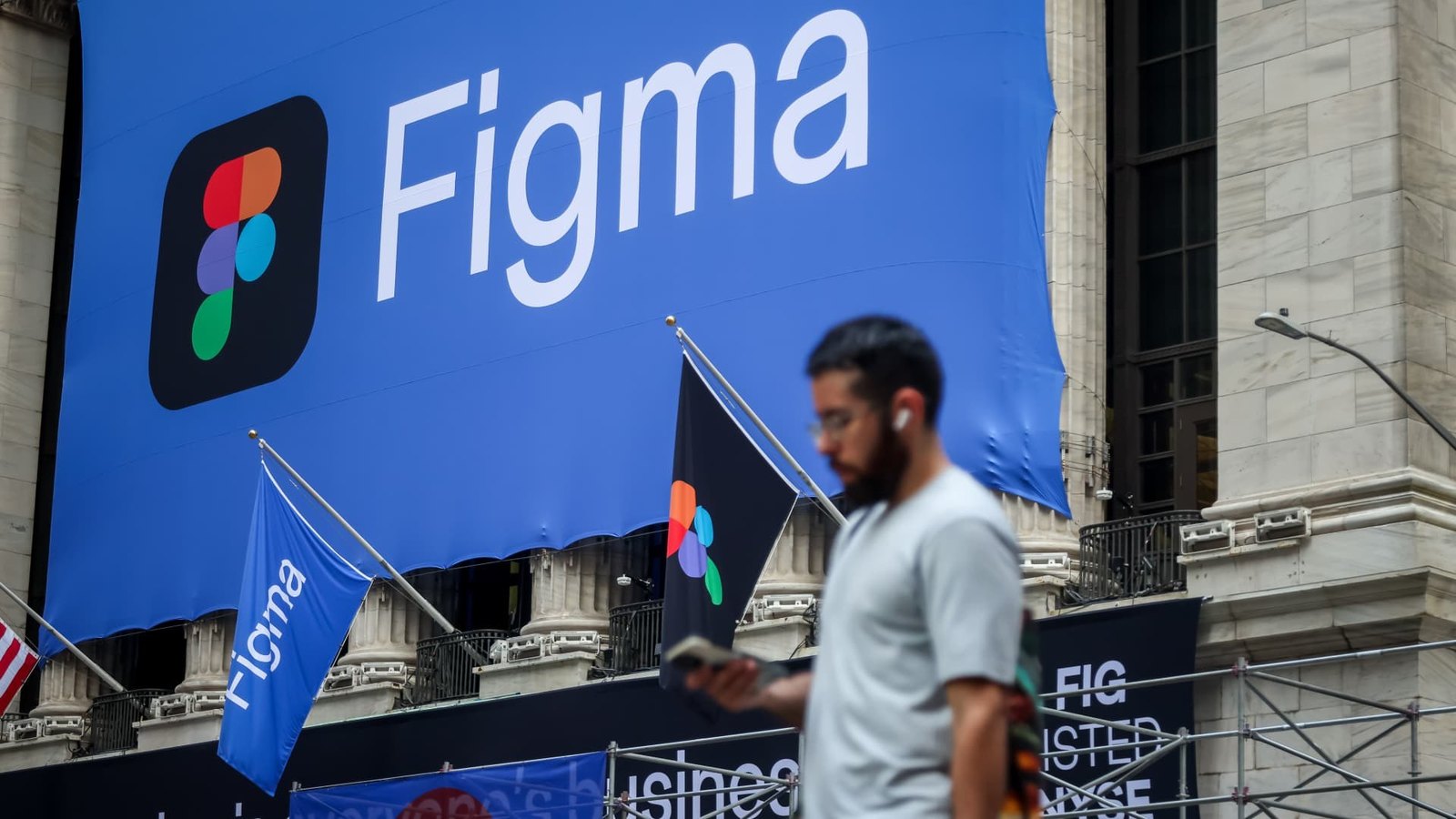
A company that grew 43%, beat on revenue, beat on profit, and narrowed its loss by more than 90% lost 7% of its market value after the numbers came out. The market was not reading the quarter. It was reading the bill for the next one.
Figma reported third-quarter revenue of $391.4 million on November 4 after the close, up 43% from a year earlier. Adjusted earnings per share came to $0.10, and the adjusted operating margin was 12%, both above what analysts had expected. The net loss narrowed to $81.3 million from $1.1 billion in the same quarter a year earlier, a reduction of roughly 93%.
The loss figure needs context, because a swing of that size rarely comes from operations alone. A $1.1 billion loss in a single quarter for a company with $391 million of revenue is the signature of charges that do not repeat, most often stock-based compensation and the accounting treatment of earlier funding rounds. The $81.3 million loss in the latest quarter is closer to the underlying economics of the business, and at 12% adjusted operating margin the company is now producing something close to $47 million of adjusted operating profit.
Figma also guided fourth-quarter revenue to $402 million to $404 million, a midpoint above the consensus estimate. That implies sequential growth of 2.7% to 3.2%, which is a modest step for a company that just grew 43% year over year. The difference between those two numbers is the whole story: the year-over-year rate reflects how small the base was a year ago, and the sequential rate reflects how much the business is adding now.
The market’s concern is not growth. It is what growth costs. Figma has been building artificial intelligence features into its design tools, and those features run on inference, which is to say on rented computing that is billed by the token. Every prompt a designer types into a Figma canvas has a marginal cost that a seat license does not. A company that has charged per editor for years now has to decide whether the new capabilities are part of the seat or a separate meter.
Both choices carry a penalty. If the AI features are included in the existing price, the cost of goods sold rises with usage and the 12% margin becomes a ceiling rather than a floor. If they are metered, adoption depends on customers deciding that a generated layout or an auto-completed component is worth a per-use charge, and design teams are famously resistant to tools that bill by the click. The reaction after the close suggests investors think the first path is more likely than the second.
There is a second, quieter problem. Design software is priced by seat, and the number of seats a customer buys tracks the number of people who do the work. If AI tools let a team of five produce what a team of eight produced before, the customer’s renewal conversation starts with a smaller number, whatever the product does. Growth in seats has been the engine of the subscription model for a decade. A tool that makes each seat more productive eventually tests the model that prices the seat.
Figma is not alone in this. Every software company that has added generative features to a per-seat product is running the same experiment, and the ones with the most usage-heavy features are the most exposed. The difference is that Figma’s customers are designers, a group that adopts new tools quickly and abandons them just as quickly, so the company cannot rely on switching costs to hold a price increase in place.
The company’s defenders point to the breadth of the platform. Figma is no longer only a tool for drawing screens; it is where product teams review work, where prototypes get tested, and where a design system lives. That breadth increases the cost of leaving and gives the company room to sell more seats to the same account. It also increases the surface area that has to be supported, and support costs do not scale down when usage does.
The 43% growth rate also deserves a closer look. It is measured against a base that was small relative to the business Figma now runs, and beating a small base is easier than beating a large one. The fourth-quarter guide, which implies a sharp step down in the annual growth rate, is management’s own acknowledgment that the comparison gets harder from here.
What happens next depends on a number the company has not yet disclosed: the gross margin on AI features. If inference costs fall as model providers compete on price, Figma can keep the features bundled and let the margin recover on its own. If they do not, the company faces a choice between a slower product roadmap and a lower operating margin, and neither is popular with investors who bought the growth story.
The stock’s 7% decline after a beat is not a verdict on the quarter. It is a verdict on the arithmetic that follows the quarter. A business growing 43% with a 12% adjusted operating margin has room to absorb a new cost line for a few quarters. It does not have room to absorb one that grows faster than revenue indefinitely.
The question for the next earnings call is therefore simple enough to state and hard to answer: when a customer’s bill arrives, is the AI work priced as a feature that raises the subscription, or as a cost that the subscription has to cover? Figma’s margin will answer before management does.



