
SK AX reported third-quarter revenue of 805.2 billion won, up 21.0% from a year earlier, and operating profit of 80.4 billion won, up 28.9%. The margin that falls out of those two figures is 10.0%, a level systems integrators rarely reach, and the reason the Korean company now describes itself as an AI business.
The results are reported on a standalone basis, which matters. SK AX books its own contracts rather than consolidating the group, so the numbers reflect what the company bills for building and running systems, not the turnover of the SK affiliates that own those systems.
SK AX began as SK C&C, the information-technology arm of SK Group, and its historic work was unglamorous: building and operating the systems that SK Telecom, SK Hynix and SK Energy run on. That work is contract-based, low-margin and renewable, and it is the base the AI business is being built on.
The repositioning has two halves. One is enterprise software, where AI is being folded into office tools and internal workflows. The other is manufacturing, where the same models are pointed at semiconductor lines, and where the payoff is measured in yield rather than in hours saved.
In May the company signed an enterprise AI collaboration agreement with OpenAI, which gives it access to frontier models and a role integrating them for Korean customers. For an integrator, that is a distribution position. The model is the product and the integration is the contract.
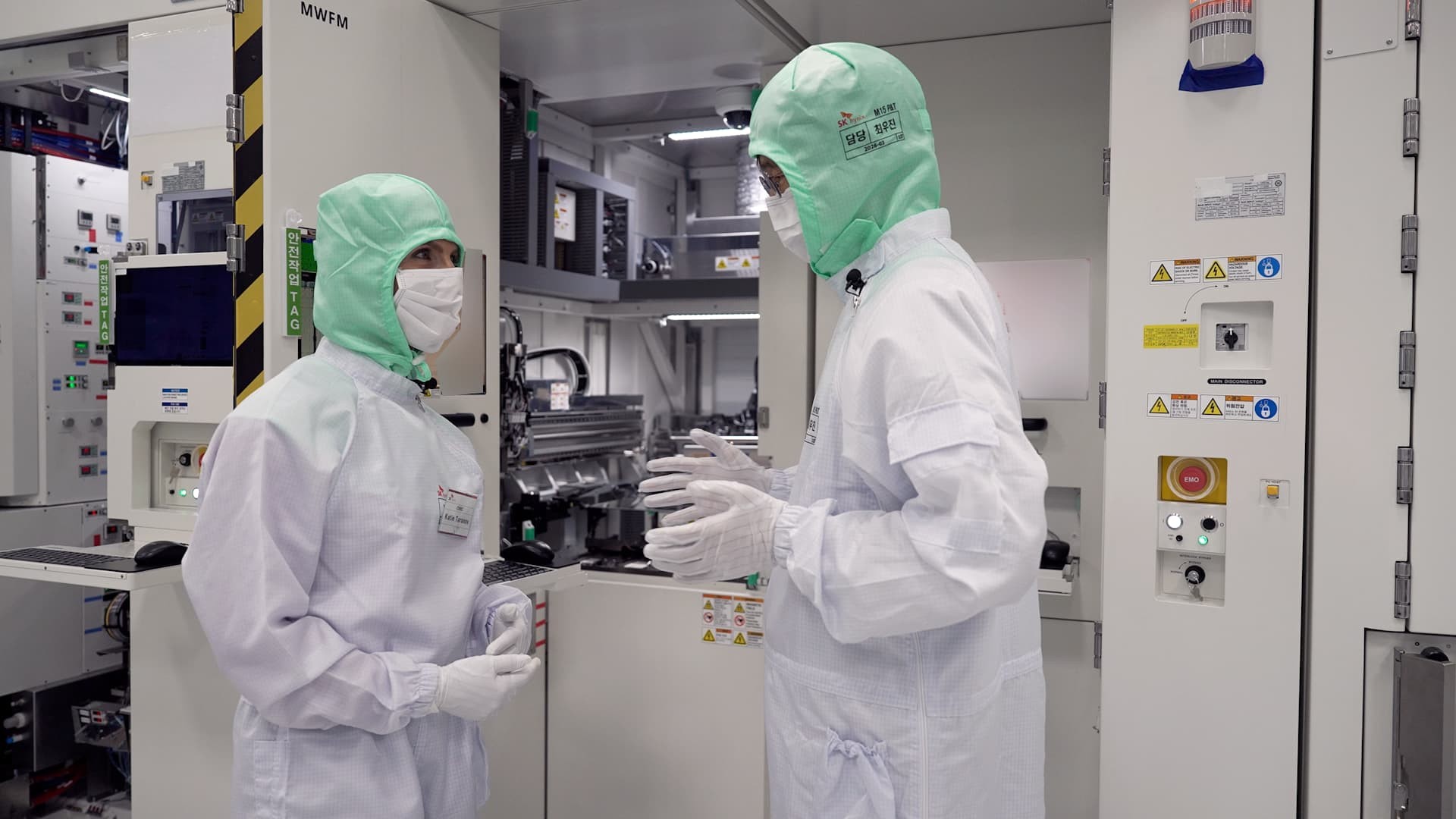
The manufacturing half runs through SK Hynix. The two companies are building a digital twin of memory production and pushing toward what they call an autonomous factory, where the line adjusts itself with AI instead of waiting for an engineer to notice a drift. Yield is the target, because yield is where memory profit is made.
A digital twin is a working model of the fab, fed by the same sensor and metrology data the real line produces. Run it alongside production and it can test a setpoint change without spending wafers. The saving is not the simulation. It is the experiments that no longer have to be run on product.
Memory manufacturing is already among the most automated work in the world, so the gain has to come from narrow places: scheduling between tools, responding to an excursion before it becomes a scrap event, and holding a process window while equipment ages. None of that lands in a headline until yield moves.
That is why the margin looks the way it does. Project work is priced against headcount. Software and digital-twin work is priced against the value of the outcome, and a 10.0% operating margin on 805.2 billion won suggests the second kind of work is now large enough to move the average.
The Korean market gives the company a specific opening. The country’s conglomerates are converting their captive IT units into AI companies at the same time, so each one competes for the same enterprise contracts while defending the affiliate business that funds it.
The affiliate relationship cuts both ways. It supplies revenue that does not have to be won in open competition, and it caps the multiple, because investors price captive sales at a discount to sales that could walk away. SK AX has not disclosed how much of its revenue comes from outside the group.
Compute and power are the constraint. Serving models at manufacturing scale needs processors and electricity, and Korea’s data-center buildout has run into the same siting and grid problems as everywhere else. An integrator does not carry that cost, but its customers do, and their budgets set the ceiling.
The OpenAI agreement carries a dependency too. If the models improve quickly, integration work gets easier and value shifts back toward whoever owns the model. If they stall, the integrator keeps the contract and the customer keeps the problem.
What the quarter shows is that AI revenue is arriving at a Korean IT services company in measurable amounts rather than as a pilot programme. Profit growth of 28.9% against revenue growth of 21.0% is almost eight points of spread, and that spread is what a mix shift looks like when it works.
The next test is disclosure. SK AX does not break out AI revenue, so the market is inferring the mix from margin. A company that wants an AI multiple will eventually have to publish the number that justifies it, and management has not yet made that choice.
The risk sits in the memory cycle. SK Hynix is a cousin company and a customer at once, and fab construction and equipment spending move with DRAM prices. A downturn would cut the projects that feed the digital-twin work at the moment the fixed costs of the AI build are highest.
For now the arithmetic favors the company: revenue up a fifth, profit up more than a quarter, margin in double digits. Whether it holds depends on whether a factory that runs itself can be sold to customers outside the group that built it.



