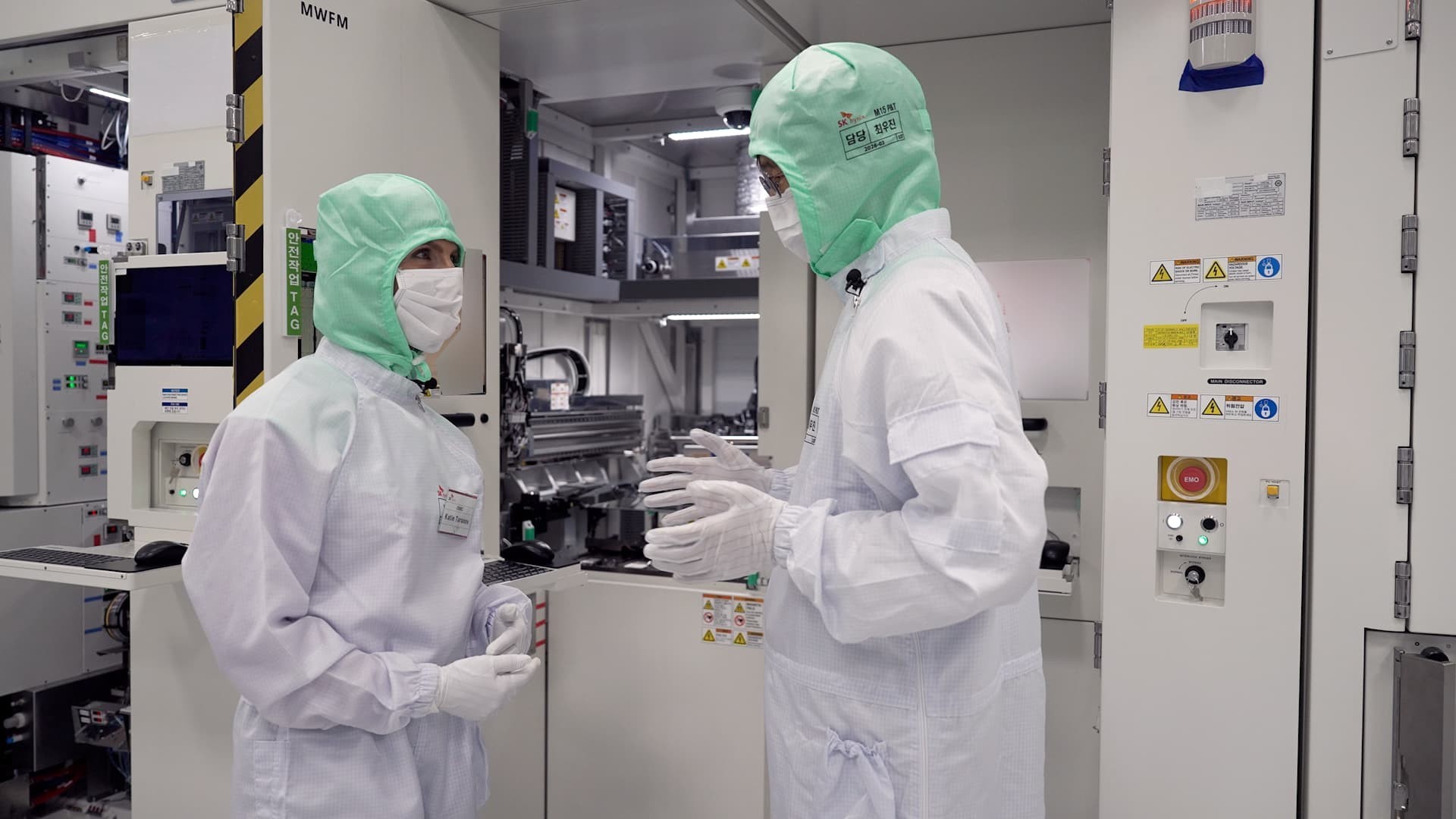
A gas line, a valve, a pump that moves corrosive fluid without seizing. None of those items appear in a memory chip’s specifications, and any of them can stop a fab. The companies that make them have historically proved their products by persuading a chipmaker to risk a production line on an untested part.
SK Hynix said on Nov. 16 that it will spend ₩1.4 trillion, about $1.05 billion, over five years to support South Korean suppliers of materials, components and equipment. Roughly $655 million of that goes to a test wafer fab called Trinity Fab, where smaller suppliers can validate their products under real process conditions.
The test line is the part that changes the arithmetic. Validation inside a working fab has always been the bottleneck, because a supplier with a new coating or a new seal needs a customer willing to interrupt output to try it. Trinity Fab gives those suppliers a place to run wafers that are not for sale, on tools that mimic the ones in production.
For a small company, the cost of that validation can consume an entire development budget before the first order arrives. A facility that absorbs the trial runs, and the wafers they ruin, moves a supplier from a proposal to a purchase order. It also gives the customer a look at how the part behaves over months rather than an afternoon.
SK Hynix is the second Korean memory maker to take this route. Samsung has run comparable programs with domestic suppliers, and both companies now describe the local supply chain as part of the expansion plan rather than a detail of procurement. The shift is recent enough that suppliers still describe it as a change in tone.
The motive is partly history. When Japan restricted exports of three materials used in chipmaking in 2019, Korean manufacturers discovered how much of a production line sat behind a single supplier in a single country. That episode reshaped purchasing: second sources, local sources, and stockpiles held against an interruption nobody had modelled.
The motive is also arithmetic. A memory fab is a machine for turning capital into wafers at a fixed rate, and every day a line sits idle for want of a part is a day of depreciation with no output. Anything that shortens downtime pays for itself at a scale where a single tool can cost more than a mid-sized company is worth.
There is a national argument as well. Seoul has spent years trying to keep the equipment and materials layer of the chip business inside the country, on the theory that the margin sits with the tools and the chemistry rather than with the wafers. A supplier that grows up on SK Hynix’s test line can later sell to fabs in other countries, which turns a domestic subsidy into an export.
The counterargument is that a captive test fab can shelter weak suppliers. When the customer owns the validation facility, the standard becomes whatever that customer wants, and a supplier tuned to one company’s process may not travel well to another’s. Test lines also age: a facility built around today’s design rules is less useful when the industry moves on.
The money is modest next to the cost of building memory capacity, and five years is a long commitment for a program whose output is measured in qualification reports rather than revenue. SK Hynix has framed the spending as support for its suppliers, which is also a way of saying that the benefit arrives through its own yields.
What the plan does not address is the staff who run a test line. Trinity Fab needs process engineers who understand both the supplier’s part and the fab’s recipe, and those are among the scarcest people in the Korean chip business, courted by the same conglomerates funding the facility. A test bed without them is a cleanroom with equipment in it.
The plan fits a broader pattern. The United States, Japan and the European Union are all paying suppliers to build near the customer, through subsidies and tax credits aimed at shortening supply chains. Trinity Fab is a private company’s version of the same policy, paid for out of a capital budget instead of a ministry’s.
What the arrangement cannot fix is the part of the problem that lives outside Korea. A supplier can prove a pump on a test line and still lose the order to a rival with a lower price and a longer warranty. Validation shortens the queue. It does not settle the sale.
The wafer that comes out of Trinity Fab is not sold. It is measured, sliced and inspected, and then the supplier takes the result back to its own floor and tries again, on the tool it hopes will end up inside a fab that runs around the clock.