
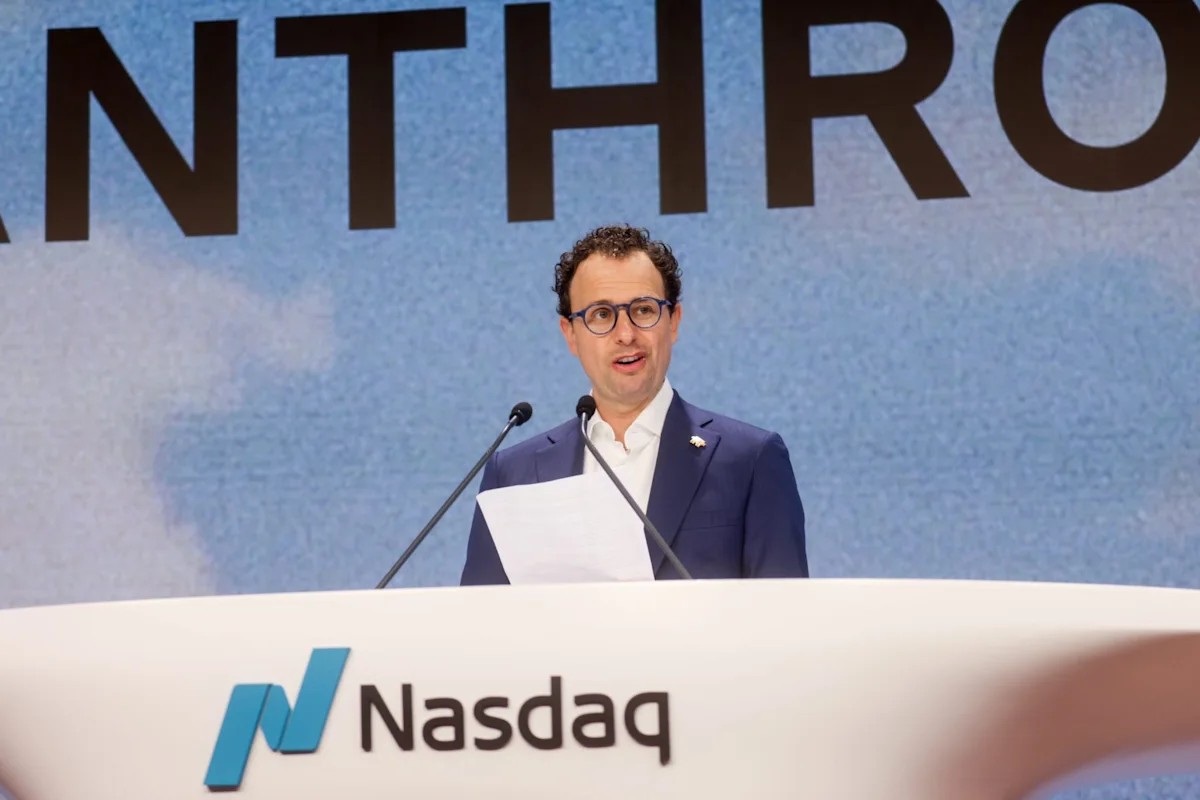
Two cloud providers wrote cheques to a start-up, and the start-up became a $1.7 trillion public company. Fortune’s estimate on Nov. 19 puts the combined paper gain for Amazon and Google at about $260 billion, on a stake of nearly 30% built largely from computing contracts rather than cash.
Amazon’s numbers are the cleaner set. It committed roughly $18 billion across several rounds; at Anthropic’s first-day close of $97.17 that holding was worth about $216 billion, a multiple of 12 times. The gap between those two figures is what the market is now being asked to believe.
Google’s position has been smaller in cash and larger in infrastructure. It signed a cloud agreement in 2023 that made Google Cloud the lab’s preferred provider, and its stake reflects equity plus the compute commitments that came with the contract. Neither company breaks out the holding separately, so the combined figure rests on estimates of each side.
The raise behind the mark was the largest on record: $81.3 billion in the IPO plus $26 billion in a concurrent private placement, $107.3 billion in total, ahead of SpaceX’s June listing. Anthropic priced at $83, opened at $111.50, traded as high as $115.10 and closed 17% above the offer.
Why should an investor in either parent care, beyond the headline multiple? Because the treatment of the stake decides where the gain lands. A position marked to market shows up in other income, not in cloud revenue, and cloud revenue is the line the market uses to value the operating business. Two very different earnings streams sit in the same income statement.
That sets up the expectation gap. Cloud growth is what the sell side models, quarter by quarter, with a target multiple attached. A stake worth a fifth of a trillion dollars is not in most discounted cash flow models, cannot be spent on data centres and does not appear in operating cash flow. When the mark rises, earnings beat; when it falls, they miss, and neither result says anything about the cloud business that produced the revenue.
Anthropic’s own trading will drive both companies’ reported results for the next several quarters. The stock gave back about 5% after hours on day one, which on a combined stake near $500 billion of value is roughly $13 billion of book value in an evening, without a single operating decision being made.
The bull case is straightforward. The positions were bought cheap and carry strategic weight beyond the mark. Amazon gets a customer whose computing bill flows through AWS; Google gets one whose models train on its tensor processors. If Anthropic’s revenue compounds at the rate its backlog implies, the equity becomes a claim on one of the most valuable software businesses ever built, and the entry price stops mattering.
Microsoft already ran this play. It put about $13 billion into OpenAI over several years and converted that into a stake of roughly 27%, which the restructuring completed in 2025 valued near $135 billion. Investors who held Microsoft through that period were paid twice, once for Azure’s AI revenue and once for the equity, and the second payment was the larger of the two.
The bear case starts with liquidity. Lockups mean the gain cannot be realised on demand, and selling a 15% position in a company of this size would take months and move the price against the seller. Taxes fall due on sale. Until then the number is an opinion about a single stock, marked by other people’s trading, and it can be right in December and wrong in January.
Correlation is the part that deserves more attention than the multiple. Anthropic pays Amazon and Google for computing out of capital that those companies and their peers helped supply. If the lab’s economics weaken, cloud revenue and the equity mark fall in the same quarter, and the diversification investors think they own turns out to be one bet with two line items.
Dilution runs against the holders. Anthropic will keep issuing equity to fund computing commitments, and every new sale shrinks the percentage held. Amazon and Google can protect their share by writing more cheques, which converts a paper gain into a capital commitment at exactly the moment the shares are dearest.
Our read is that the market is treating these stakes as free options while the companies are treating them as strategic assets, and both sides are partly right. What is not defensible is adding $216 billion of Amazon equity value to a sum-of-the-parts calculation and then applying a cloud multiple to the revenue the same customer generates.
There is also a simpler question for anyone building a position today. Anthropic is now a public company. An investor who wants exposure to the lab can buy the lab, rather than buying a 15% proxy wrapped inside a cloud business whose capital spending is the thing most likely to compress its multiple.
Three things will test the view. Watch whether the next annual report discloses the fair value of each stake as a separate line, whether either company sells shares once lockups expire, and whether Anthropic’s disclosed computing commitments grow faster than its revenue. The first tells you how seriously management takes the mark, the second tells you what management thinks the mark is worth, and the third tells you whether the customer can pay for it.



