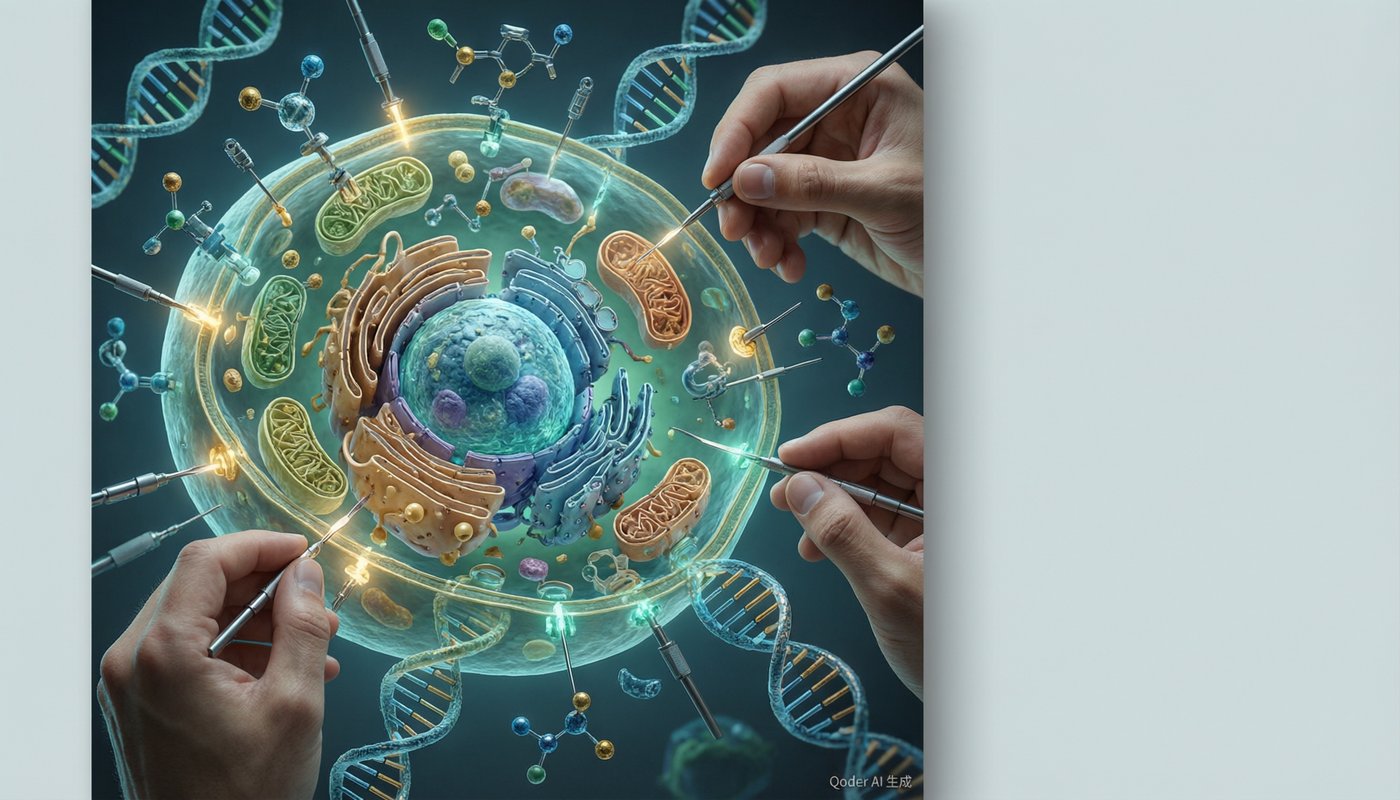
The announcement came not from a biology conference but from a university press release, and it described something no lab had demonstrated before: a cell built entirely from non-living chemical components, assembled from the bottom up rather than modified from an existing organism. Researchers at the University of Minnesota said they have constructed a synthetic cell they call SpudCell, which can acquire resources, grow, replicate its genome, divide, and compete across generations — behaviors that, taken together, amount to most of the defining features of life.
The achievement, reported by The Guardian and the university, represents a different approach to synthetic biology than the field’s better-known work. Earlier advances in the field involved taking a living organism and editing its genome — replacing the DNA of a bacterium with a synthetic copy, or adding new functions to an existing cell. SpudCell, by contrast, was assembled from molecular parts, more like building a machine from components than modifying an existing one. The researchers’ description is blunt: this is not the conventional “modified bacteria,” but a small system of molecular parts that mimics the behavior of living things.
The details of the construction are technical, but the implications are not. The Minnesota team took chemical building blocks and organized them into a structure that carries out the core functions of life — taking in resources, converting them into growth, copying its genetic material, and splitting into new cells. In the researchers’ account, successive generations of SpudCell exhibit selection and competition, meaning the populations change over time in ways that echo natural selection. The line between chemistry and biology, the field’s fundamental question, is the subject being tested. The researchers’ announcement was careful in its claims, describing what the cell can do rather than declaring a new form of life, a restraint that reflects the discipline’s hard lessons about overstatement.
The work has been years in the making. Building a cell from scratch requires solving problems that living systems solved billions of years ago: how to keep the components inside a boundary, how to fuel the chemistry of growth, how to duplicate the information-carrying molecules, and how to do it all reliably enough that the result can reproduce. The Minnesota team’s contribution, according to researchers familiar with the work, is a system that manages all of these functions together, rather than demonstrating them in isolation.
The scientific significance goes beyond the achievement itself. A synthetic cell that can grow and divide offers a platform for studying the origins of life — a window into how chemistry became biology. It also offers a practical tool: cells engineered from scratch could be designed to produce chemicals, clean up waste, or manufacture materials, with fewer of the constraints that come with modifying natural organisms. The researchers said the technology could eventually allow scientists to build cells with functions that no natural organism possesses.
There are reasons for caution, and the researchers are careful to state them. SpudCell exhibits many of life’s characteristics, but it is not, by most definitions, alive in the full sense — it does not carry the full complexity of a natural cell, and the researchers described it as possessing most of the key features of life rather than all of them. The work also raises questions that go beyond science: if scientists can assemble cells from scratch, where is the line between chemistry and biology, and what rules should govern the creation of synthetic organisms?
The regulatory questions are not hypothetical. The field of synthetic biology has operated for years under guidelines designed for genetically modified organisms, and a cell built from non-living components may not fit those frameworks. Governments and funding agencies will need to decide how to classify such work, and the researchers said they have been engaging with the questions of governance as part of the project. The scientific community, meanwhile, is treating the result with the combination of excitement and skepticism that major claims usually attract.
The practical timeline is long. Even if the technique works reliably in the Minnesota lab, moving from a demonstration to something useful — a cell that produces a chemical at industrial scale, for instance — will take years and substantial investment. The field’s history is full of demonstrations that worked in the lab and struggled in production. What the SpudCell work changes is the sense of what is possible: the assembly of a cell from parts is no longer a thought experiment.
The deeper meaning of the announcement is the progress of a scientific program that began with the question of whether life can be created in a lab. The University of Minnesota team has now shown that the answer is closer than it was a year ago. The cell they built is primitive, and its capabilities are limited, but it reproduces, it competes, and it evolves. Those are not small things. They are, in fact, most of what life is.