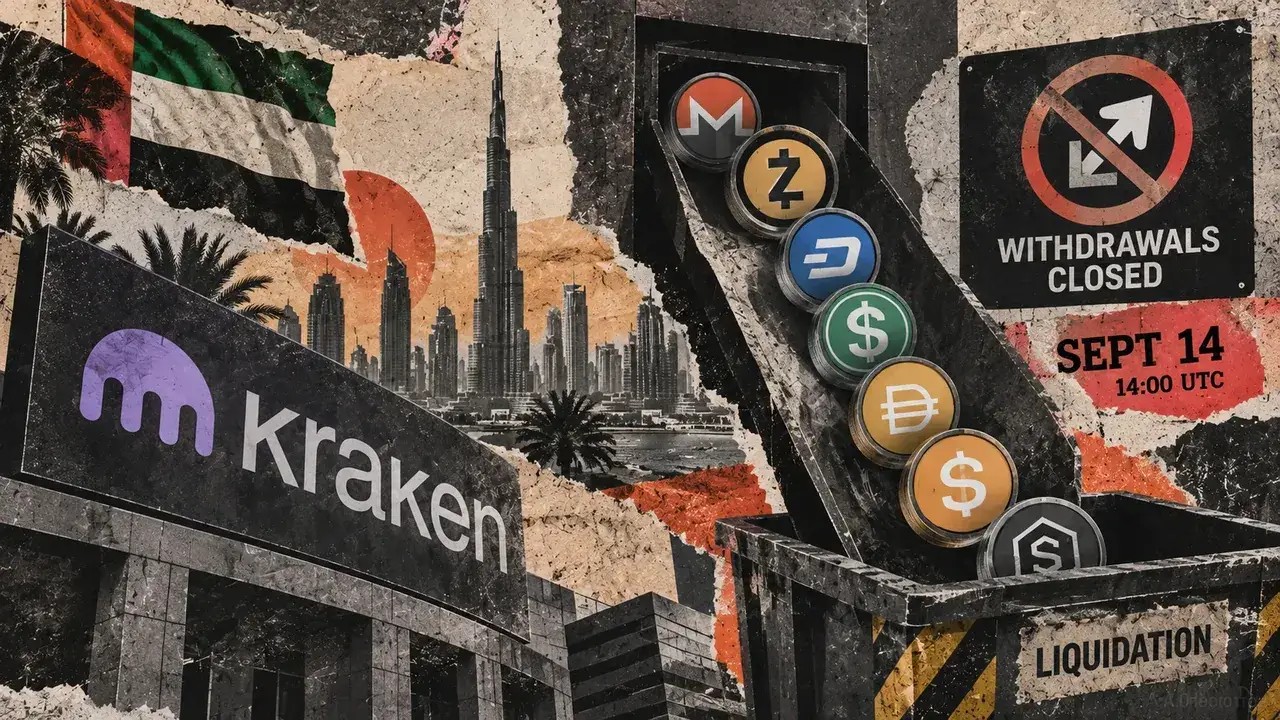
Payward, the parent company of the crypto exchange Kraken, filed an application on September 12 to offer perpetual futures contracts to eligible U.S. traders under Commodity Futures Trading Commission oversight. The filing came through Bitnomial, a designated contract market that Payward acquired this year, and the first batch of products would cover bitcoin, ether, solana, XRP, and cardano.
The products would have to clear a 30-day self-certification period before they could launch. Under that process, the exchange certifies that the contracts comply with CFTC rules, and the regulator has a window to review the filing before trading begins.
The move is the payoff from an acquisition Payward closed to buy a regulated U.S. derivatives venue. Payward agreed to acquire Bitnomial in a deal worth up to $550 million, a price that bought a license rather than scale, since Bitnomial was a small player compared with larger U.S. futures exchanges.
Perpetual futures, which never expire and settle continuously against a funding rate, are the most heavily traded instrument in global crypto. Unlike dated contracts, they roll over constantly and keep their price aligned with spot markets. Offshore exchanges built their businesses on the product, and it remains the most popular way for traders to express leveraged views on digital assets.
They have been largely confined to offshore venues for U.S. customers, because domestic exchanges and regulators have been cautious about a product whose leverage can wipe out traders quickly. The CFTC has watched the instrument warily, and no major domestic exchange offers it at scale.
A CFTC-regulated perpetual contract would give U.S. traders access to the product through a domestic venue, with the disclosure and oversight that entails. Payward’s filing is a bet that the self-certification route will clear and that the agency’s posture is softening as the industry matures.
Bitnomial, the Chicago-based venue Payward bought, held the legal status of a designated contract market, which is what makes the filing possible. The up to $550 million Payward agreed to pay for the company was widely read as the price of that license, since the venue itself was far smaller than its domestic rivals.
The announcement sat alongside another sign of capital moving into crypto infrastructure. On September 14, Kaiko, a Paris-based digital asset data provider, said it had expanded a funding round to $110 million, with S&P Global leading the investment.
The round drew a roster of financial incumbents: BNP Paribas, Nasdaq, Royal Bank of Canada, the French state investment bank Bpifrance, and the trading firm Susquehanna all participated. Kaiko said the money would go toward round-the-clock market data services and infrastructure for asset tokenization.
The investor list is the story. S&P Global, a ratings and index giant, leading a round in a crypto data firm signals that the traditional financial industry is building the plumbing it will need if tokenized assets become standard.
Kaiko’s business is unglamorous by crypto standards. It has spent a decade collecting and selling market data across exchanges, the kind of utility that becomes essential when banks, asset managers, and exchanges need reliable pricing to trade or value digital assets.
The two announcements point in the same direction. One is about a U.S. exchange moving a popular product into a regulated channel; the other is about the data and tokenization rails that institutional adoption will require.
Analysts said the current cycle differs from earlier crypto booms in one respect: the money is flowing into infrastructure and compliance rather than speculation. A regulated derivatives filing and a data provider’s funding round are quieter than a token rally, but they describe an industry trying to build itself into the financial system rather than around it.
The push for U.S. perpetual futures is part of a broader race among domestic exchanges to expand their product lines. Rivals have been rolling out crypto derivatives and seeking approval for new instruments, betting that a regulated market can pull volume away from offshore venues that operate with fewer constraints.
Payward’s bet rests on the assumption that U.S. traders want the product badly enough to accept domestic oversight. The offshore perpetual market has long been the industry’s engine of volume, and capturing even a fraction of it through a compliant venue would be a meaningful business.
Kaiko’s trajectory tells a parallel story about data. As traditional institutions have moved into digital assets, they have discovered how hard it is to get clean, consolidated pricing across hundreds of venues. A firm that can supply that data reliably becomes infrastructure, and the round’s investors are betting that tokenization will only increase the demand.
Neither announcement guarantees success. The CFTC could block or delay the perpetual contracts, and Kaiko still has to turn a data business into a durable revenue engine. But both moves show that crypto’s most ambitious players are now courting regulators and institutions as customers rather than as adversaries.