The building sits at 1175 Collins Road in Greenwood, Indiana, just across the street from an Amazon fulfillment center off Interstate 65. Amazon bought it to make the machines that move packages through warehouses like the one next door. On Sept. 24 the company said it would pour more than $100 million into the site and turn it into a factory.
The roughly 585,000-square-foot facility will employ about 300 people in skilled manufacturing and engineering roles paying close to $100,000 a year on average, Amazon said, with operations expected to begin by 2028. The plant will produce equipment for the company’s fulfillment and robotics network across North America.
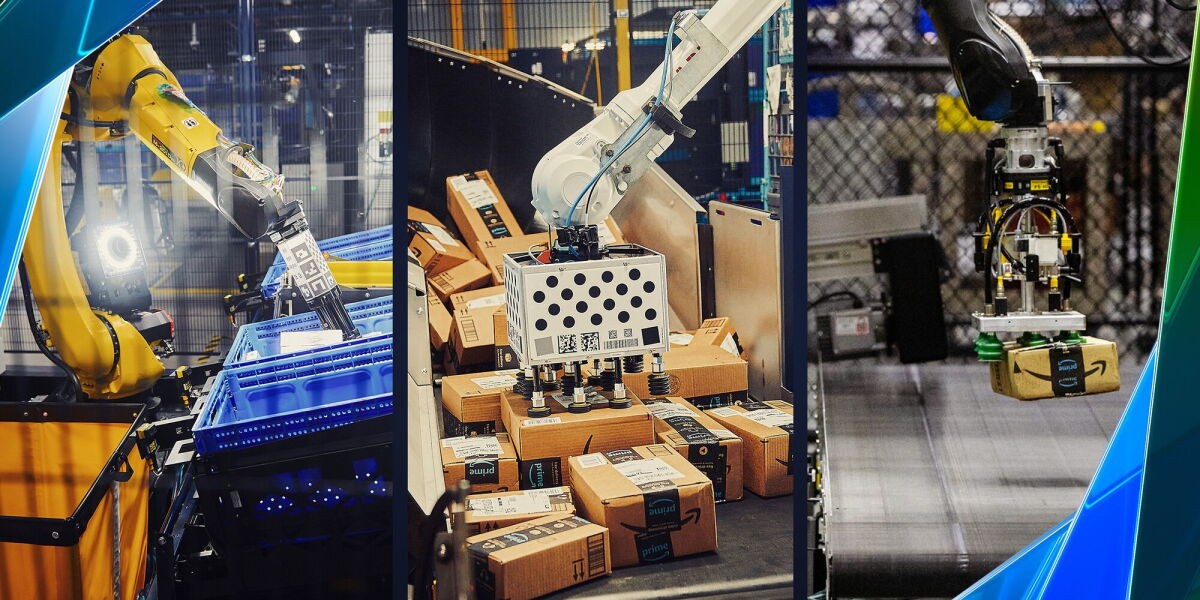
Under one roof, Amazon plans to run advanced fabrication, robotic welding, automated powder coating and assembly, supported by AWS and AI-powered manufacturing systems. The jobs range from CNC operators and welders to powder coating technicians, controls engineers and program managers.
Amazon’s robotics business traces back to its 2012 purchase of Kiva Systems, the warehouse-robot maker, for $775 million, a deal that reshaped how the company moved goods through its fulfillment centers. Since then it has turned robots from a curiosity into the spine of its logistics network.
The Greenwood plant is the fourth self-built robotics manufacturing site Amazon has opened, adding to operations anchored in Massachusetts and a robotics investment in Texas announced in August. Amazon has said it has built more than one million robots in the United States, deployed across more than 300 facilities worldwide, and that those robots now assist with roughly 75 percent of the customer orders it delivers. Its Massachusetts operation, the company says, ranks among the largest industrial-robotics plants in the world.
Indiana was not a hard sell. Amazon pointed to the state’s manufacturing workforce, its cost structure and its logistics network, ranked 13th nationally for transportation, along with a talent pipeline of more than 2,500 industrial engineering graduates a year from Purdue, Rose-Hulman and Ivy Tech. The site’s position on I-65 puts it directly on the route to fulfillment centers across the country.
Governor Mike Braun called the investment a testament to Indiana’s manufacturing base. Holly Sullivan, Amazon’s vice president of economic development, said the roles carry a median salary “well above the regional average.” The company has a long history in the state: more than $40 billion invested and more than 27,000 jobs created since it first opened a facility there in 2008.
The plant is part of a larger American-manufacturing push at Amazon. The company says it has spent more than $230 billion on goods and equipment from U.S. manufacturing since 2010, supporting more than 100,000 manufacturing-related jobs this year. Bringing robotics production in-house gives the company more control over a supply chain it has spent two decades scaling.
Amazon’s expansion of its own robotics production comes as the company looks to keep fulfillment costs in check while delivery volumes keep climbing. Analysts have long viewed the warehouse-automation program as the main lever Amazon can pull on the labor and speed side of its cost equation, and building its own machines gives it a degree of control it did not have when it bought robots from outside suppliers.
Greenwood’s mayor, Mark W. Myers, framed the deal as the kind of development that builds careers, and Indiana’s secretary of commerce, Chuck Goodrich, noted the state’s advanced-manufacturing sector already supports more than 518,000 jobs. Amazon has leaned on Indiana’s training programs as well: more than 4,200 employees there have used its Career Choice program since 2019, with tuition prepaid across 32 education partners. The company also runs programs across the state under its Future Ready 2030 initiative, which aims to train 50 million people for technical work, from K-12 courses to AWS training for early-career workers.
The same week, Amazon made a different kind of move aimed at its sellers. The company opened its seller-back-office data to outside AI agents, with Anthropic’s Claude as the first external integration, and released a cross-platform tool to help merchants manage inventory across Walmart, Shopify and other channels. Amazon has signaled that more outside agents will follow, aimed at the merchants who sell on several storefronts at once.
The two announcements point in the same direction. On the warehouse floor, Amazon is building the robots that sort and move packages; in the seller dashboard, it is handing more of the work to software agents. Both are efforts to strip labor and time out of the two halves of its retail business.
The Greenwood plant will not be operational for years, and its 300 jobs are a small fraction of Amazon’s workforce. But the factory’s real product is a hedge: a steady supply of purpose-built machinery for the day when Amazon’s fulfillment network runs, more than ever, on its own robots.