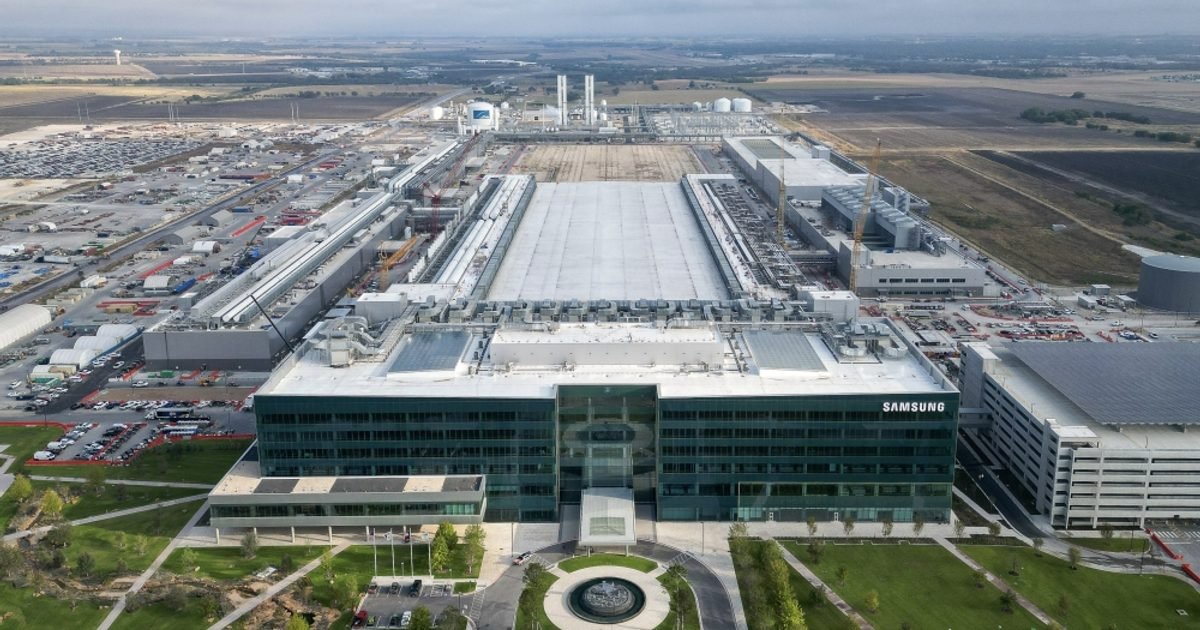
The road into Taylor, Texas, runs past a school district, a row of grain silos and, since 2022, a construction site large enough to see from the county highway. On Oct. 15, Samsung Austin Semiconductor said it would spend $22.84 million next year on the people who live along that road.
The money, announced at a company event promoting Texas manufacturing, goes to workforce training and community programs across central Texas, including schools in the Taylor district, where Samsung is building a fabrication plant. The Korea Herald reported the figure on Oct. 18.
For a company that has committed tens of billions of dollars to Texas fabs, $22.8 million is a rounding error. It is also the part of the budget that determines whether the plants can be staffed.
A leading-edge fab needs two kinds of labor. Construction crews build it, and they leave when the cleanroom is finished. Technicians run it for twenty years, and they have to come from somewhere within driving distance, because the shifts are long and the pay, while good, does not move families across the country.
That distinction shapes how the money is spent. Much of it goes to programs at community colleges and technical schools that award two-year degrees in semiconductor manufacturing, a credential that did not exist in most of central Texas a decade ago. The rest goes to school districts, which benefit twice: directly from the grants, and indirectly from the property tax base that a working fab creates.
School funding in Texas is tied to local property values, a structure that makes a large industrial employer valuable to a district before it writes a check. Districts near the new plants have seen enrollment grow as employees move in, and construction timelines give them only a few years to build classrooms.
The workforce question has become the competitive one in central Texas. Samsung’s campus in Austin, which has fabricated chips since the 1990s, sits about 40 miles south of Taylor. Texas Instruments is building fabs of its own in Sherman, north of Dallas. Each project draws from the same pool of electrical technicians, process engineers and equipment maintenance staff.
The Korea Herald report added a name to that list. TSMC, the Taiwanese foundry that has built a plant in Arizona, is weighing a Texas site, according to the newspaper. TSMC has not announced such a plan, and companies in its position routinely study locations they never build in. The report nonetheless described recruiting pressure that local officials have acknowledged for two years.
Poaching is the visible form of that pressure. A technician who can run an etch tool is worth more to a rival that needs one next quarter than to an employer that trained him last year, and fabs trade staff in small numbers that matter enormously at the margin. Training grants enlarge the pool rather than redistribute it.
State and local governments have folded the labor supply into their incentive packages. Texas has no state income tax and a light regulatory posture, which is why the fabs came. What it lacks is a deep bench of people who have worked in cleanrooms, and that gap is expensive to close.
The federal government entered the same territory with the CHIPS Act, which set aside money for workforce development alongside factory subsidies. The amounts have been small next to the capital grants, and industry groups have said the training money arrives on a different clock than the construction.
Analysts who follow the industry said the announcement should be read as a cost of doing business rather than as charity. A fab that runs below capacity because it cannot hire loses more in a quarter than Samsung is spending on the region in a year. Community grants are cheaper than idle tools.
The comparison with Arizona is instructive. TSMC’s Phoenix plant has pushed back production schedules partly because it brought workers from Taiwan and found that the local supply of qualified technicians developed more slowly than the buildings went up. Samsung has reasons to avoid repeating that.
Residents have their own accounting. A plant brings payroll, contractors and traffic, and the housing that follows payroll. Taylor’s population has grown quickly enough that the school district has added portable classrooms, and the county has argued over water lines and road capacity. The company’s community money does not settle those fights, though it changes who shows up to argue them.
There is a limit to what a check can do. Two-year programs take two years, and the first cohorts graduate after the first tools are installed. Companies have filled the gap with experienced hires from other fabs, from the military and from abroad, and each of those channels is finite.
Samsung has not said how many people the Taylor plant will employ at full production. Published estimates for plants of its size run into the thousands, and the company has described hiring in phases tied to equipment installation rather than to a single opening date.
What the Oct. 15 announcement does establish is a timeline. The money is budgeted for 2026, which suggests the company expects to be staffing in earnest that year. A grant to a school district is also a statement about how long the company intends to be there.
For the district, the calculation is simpler. A semiconductor company that needs its graduates has an interest in the schools being good, and that interest outlasts a single budget cycle. Whether it survives the next downturn in chip demand is the question every plant town learns to ask.