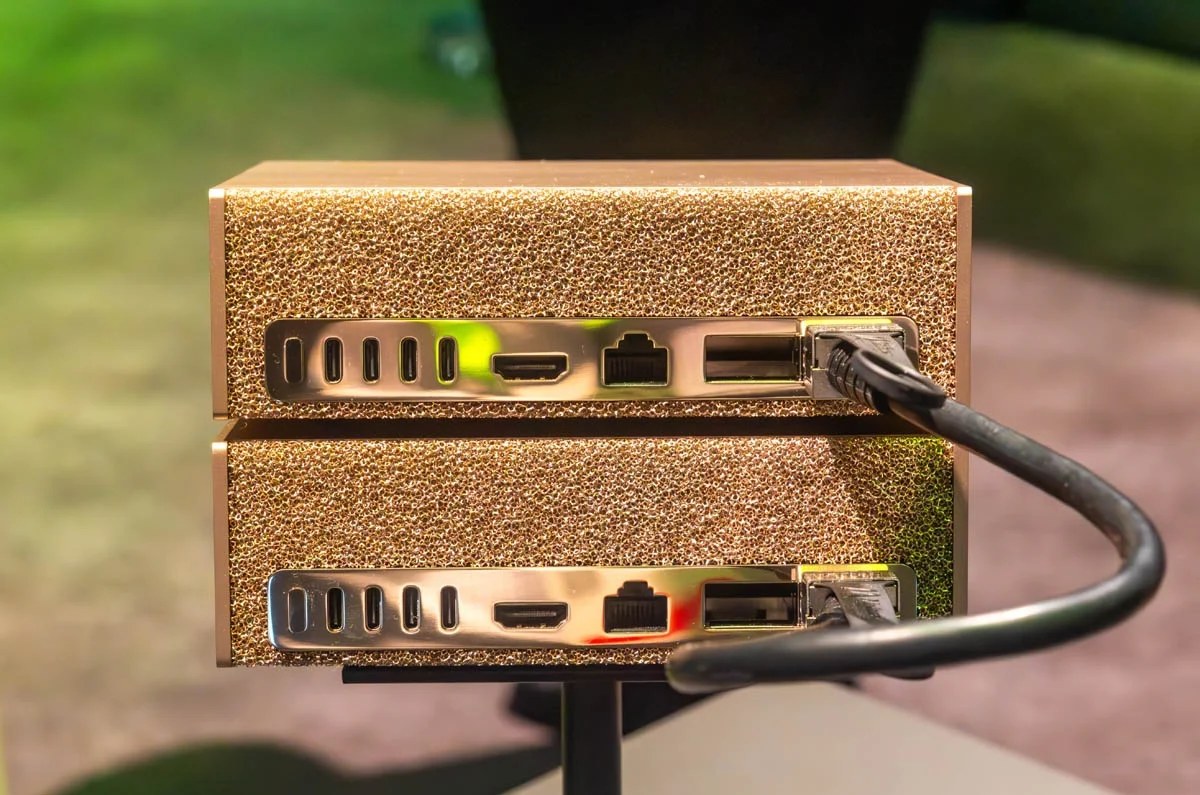
The case for running a large language model on your own desk has always run into the same wall, and it is not compute. It is memory. A model with tens of billions of parameters has to fit somewhere before it can answer a question, and the graphics cards most developers own were designed for images, not for holding a model resident. Nvidia’s answer goes on sale Friday for $4,999.
The company said the 64-gigabyte configuration of DGX Spark, its small desktop AI computer, will be sold from Oct. 23 by Acer, Asustek Computer, Dell Technologies, Gigabyte Technology, HP and MSI. Each unit carries the GB10 Grace Blackwell superchip, a package that pairs an Arm-based Grace processor with a Blackwell graphics component and a single pool of unified memory that both can address without copying data back and forth.
On its own, Nvidia says, one unit runs models of up to 100 billion parameters entirely on the device. Two units joined by a cable pool their memory into 128 gigabytes and support models of up to 200 billion parameters. Nvidia’s Sync Cluster Assistant handles discovery and network setup over a 200-gigabit link, so that adding a second box does not require a networking engineer.
The performance claim attached to clustering is narrow but telling. In a test running Qwen3.8 27B, Nvidia said, a two-unit cluster reached up to 1.7 times the performance of a single unit. That is not double, and the gap is the honest part of the disclosure: splitting a model across two machines adds communication overhead that a single larger machine would not pay.
Four-unit configurations extend to 256 gigabytes through a qualified switch, which turns a desk accessory into a small rack. Nvidia also said a Model Launcher due at the end of October will deploy local models across connected systems and set up a browser-based coding environment, the kind of plumbing that decides whether buyers actually use the hardware or leave it on a shelf.
What the machine is not is a substitute for a data center. A 100-billion-parameter ceiling is a ceiling, and the practical targets Nvidia names sit far below it, in the 30-billion to 35-billion range where agents and coding assistants live. The box is for teams that want a model on the premises, not for teams training one.
That distinction defines the buyers. Hospitals, law firms, defense contractors and banks have workloads they will not send to a public API, and the cost of a compliance review often exceeds the cost of the hardware. Media companies with unreleased footage and manufacturers with proprietary process data fall into the same category. For them, $4,999 is a rounding error against a legal opinion, and a machine that never leaves the building settles the argument.
The economics work differently for everyone else. Cloud inference is priced per token and falls steadily, so a team with spiky usage is usually better off renting. A desktop unit wins when utilization is high and predictable, when latency matters, or when the work involves iterating on prompts and fine-tunes all day. Nvidia is effectively selling the option to stop metering.
There is a strategic motive underneath the price. Every DGX Spark ships with the same software stack as Nvidia’s data-center systems, including its CUDA libraries and support for common serving frameworks. A developer who learns that stack on a desk is a developer who specifies it in a purchase order for a cluster three years later. Nvidia has defended its margins by making the programming model portable across everything it sells, and a cheap entry point widens the funnel.
The competitive threat comes from personal computers with large unified memory pools, which can run the same class of model without a specialized appliance. Those machines are general-purpose, cheaper per unit and already on the desks of the people who would buy a Spark. Nvidia’s counter is software maturity and support, not raw specifications.
Analysts at Futurum Group flagged two gaps buyers should press on. Nvidia has not detailed the storage included at the $4,999 price, and the single-system baseline behind the 1.7-times cluster result needs clarification before anyone uses it to choose between two small boxes and one larger machine. Those are the numbers that decide a purchase, and they are the numbers the announcement left loose.
Nvidia is also asking buyers to think in increments. A second unit is another $4,999, a switch is another capital line, and the four-node configuration needs networking that a two-person team may not want to run. The entry price is the beginning of a bill, not the end of one.
For the AI hardware market, the significance is that inference is spreading outward from rented data centers into offices, and the constraint everyone is pricing against is memory capacity rather than raw arithmetic. That favors vendors who can put a lot of memory next to a modest amount of compute at a low price. It also means the model sizes that matter commercially are the ones that fit, which is why the interesting number in Nvidia’s announcement is 128 gigabytes, not the price.
The comparison every buyer will eventually make is against a mid-range workstation with two consumer graphics cards, a configuration that costs less and runs smaller models faster. Nvidia’s answer is that unified memory lets a single model exceed the memory of any card a customer can install, and that no driver work is required.
Whether that argument holds will be settled by support tickets rather than benchmarks.
If a $4,999 box can hold a 200-billion-parameter model, what happens to the market for the rented tokens that used to be the only way to reach one?