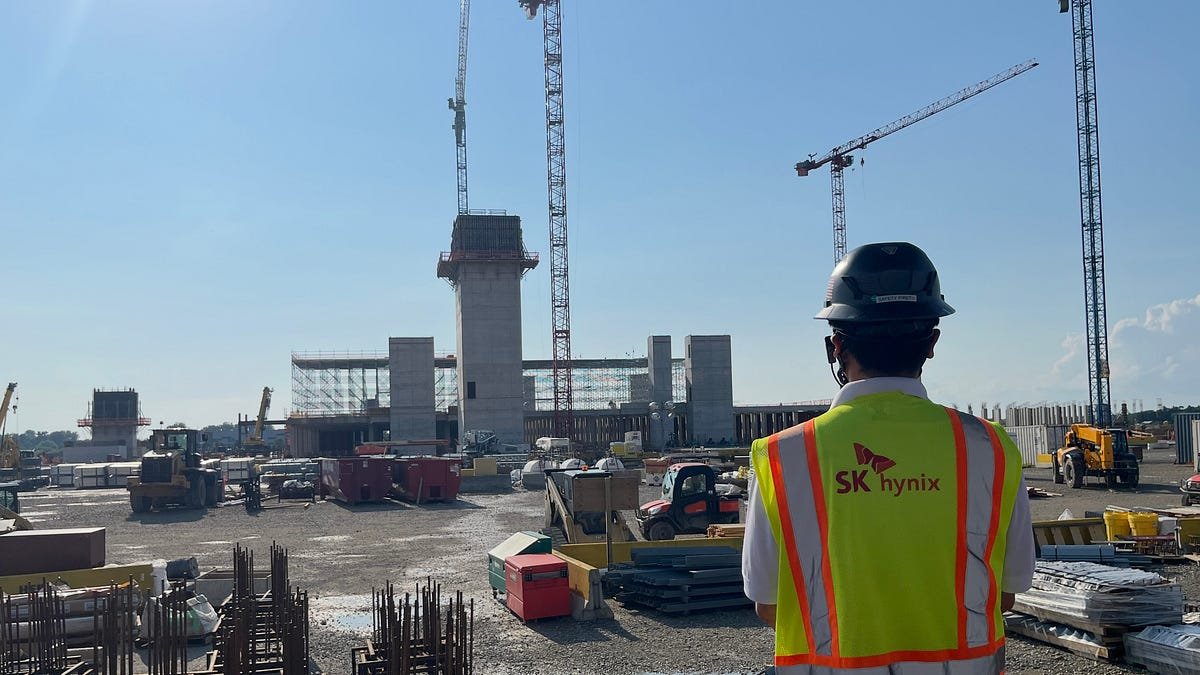
Earth movers have been working the site north of Purdue University since April. What is still unsettled is the zoning that let them onto the land.
Judge Sean Persin of Tippecanoe Circuit Court this week refused to dismiss a lawsuit seeking to block SK hynix’s $3.87 billion advanced packaging plant in West Lafayette, Indiana, and set trial for Dec. 1. The ruling followed a pre-trial conference on Oct. 26 and rejected the argument, made by the city, the Purdue Research Foundation and the company, that the challenge could be decided without a trial.
The plant is the largest single investment SK hynix has made outside Korea and one of the largest ever announced in Indiana. It is designed to package high-bandwidth memory, the stacked DRAM that sits beside an AI accelerator and feeds it data, along with research space. The company has said production is targeted for 2028. The project is in line for $458 million in federal grants and up to $570 million in loans under the 2022 CHIPS and Science Act, money that arrives against construction and hiring schedules.
The dispute dates to the spring of last year. The parcel, owned by the Purdue Research Foundation, had been zoned for residential use and is surrounded by housing on the northern edge of the city. In May 2025 the city council voted 6-3 to rezone it for heavy industry, six weeks after the Tippecanoe Area Plan Commission had recommended denial by 9-5.
Three local residents sued the city, the foundation, the company and the commission. The commission was later dismissed from the case. The residents argue that the city ignored evidence that should have led the council to refuse the rezoning, and that the location would hurt property values and pose safety and environmental risks. They have said they are not opposed to semiconductor manufacturing in West Lafayette, only to this site.
SK hynix has argued the opposite in court filings: that the parcel is better suited to its needs and farther from homes than a site across the road that was already zoned for industry. Purdue has an interest of its own, since the foundation owns the land and the university has built a semiconductor programme around the plant’s presence.
The company and the foundation asked Persin in November for summary judgment, arguing that the residents lacked standing to challenge a zoning decision and had not shown enough evidence of harm. The city joined them. In late May the judge declined to end the case on those grounds, though he struck one claim about notice of the plan commission meeting. This week’s ruling dealt with the remaining issues from that motion.
Construction has not stopped. Site preparation began in the spring and the company has continued to describe the Indiana facility as central to its American expansion. A trial in December means a decision within weeks of the hearing, though either side could appeal, and an appeal would push a final answer into the following year.
The stakes go beyond one plant. High-bandwidth memory is packaged as well as fabricated: the DRAM dies are thinned, stacked, connected with through-silicon vias and bonded to a base die, and that step has become a bottleneck as AI accelerators consume more stacks per system. Almost all of that work happens in Asia. A packaging plant in Indiana would be the first of its size in the United States, and it would sit within a day’s freight of the customers designing the accelerators.
That is why the federal money is attached to it. The CHIPS programme has directed most of its awards to fabrication, which is capital-intensive and slow to build. Packaging is cheaper per wafer and employs fewer people, but it is the part of the supply chain that a war or a blockade would interrupt first, and Washington has been trying to move some of it onshore since 2022.
Local politics cut the other way. Rezoning fights have become a standard feature of the American chip buildout: Micron’s plant in upstate New York, TSMC’s site in Arizona and a string of supplier facilities have all met objections over water, traffic and land use. Most have ended with the project approved and the objections compensated or exhausted. The Indiana case is unusual in reaching a trial date rather than a settlement.
For SK hynix, the practical question is not whether the plant gets built but on what schedule, and how much the delay costs. Equipment orders for a 2028 start have to be placed well ahead, and the company’s Korean packaging lines are already committed to customers who need the capacity sooner. A court that takes a year to rule would put the Indiana plant behind the Korean expansion rather than alongside it.
The judge’s decision this week does not stop a single truck. It does mean that a project announced two years ago, subsidised by the federal government and half-built on the edge of a college town, will have its permits examined in open court before it ships a wafer. For the residents who brought the case, that is the point. For the company, it is a date on a calendar it does not control.