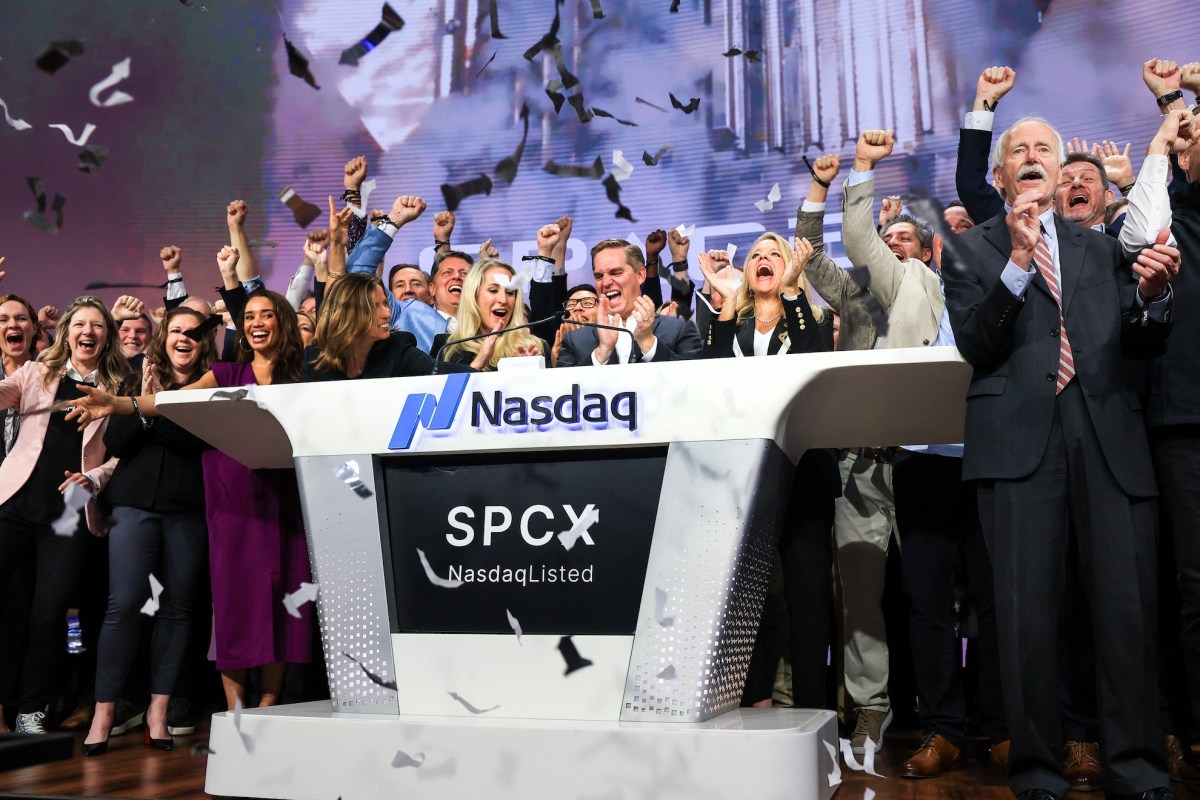
The first trades crossed at 9:30 a.m., and by the closing bell the tape told a story four years in the making. SpaceX, the rocket company Elon Musk built from a small factory in Hawthorne, California, finished its first day on the public exchange at $160.95 a share, up 19% from its $135 offering price and close to a peak market value of $2.3 trillion.
The offering raised $75 billion, the largest in history, with roughly 4% of the company’s shares floated. Mr. Musk’s stake in SpaceX is now worth more than $860 billion, according to people familiar with the matter. Combined with his holdings in Tesla, his net worth has crossed $1 trillion, a figure no individual has reached before, wealth trackers said.
The trading day carried the energy of a secondary event as much as a listing. Robinhood reported record order flow, and brokers said retail demand that had built through the private-market wait spilled into the open market within minutes. The stock opened above the offer price, climbed through the session and settled at $160.95, giving early investors a gain they had carried through years of delayed listing plans.
Gwynne Shotwell, SpaceX’s president and chief operating officer, used the day to raise a question that has hovered over the company for a decade: what happens between SpaceX and Tesla? In an interview on listing day, she hinted at a merger, saying a combination “would make Elon’s life a bit easier.” The remark was short on detail, but it was the closest any SpaceX executive has come to confirming that the two Musk-controlled companies have discussed joining forces. Tesla shares rose on the comment before giving back part of the move.
The listing also paid off for Alphabet, which holds 4.9% of SpaceX. The stake is now worth roughly $105 billion more than Alphabet paid for it, according to analysts’ estimates, a paper gain that came without any change to Alphabet’s core business.
The scale of the debut has reset how investors think about the rocket industry. SpaceX now ranks among the most valuable listed companies in the world, above Tesla at about $1.8 trillion and Meta. The company dominates commercial launch, carrying a majority of global payloads, and its Starlink satellite-broadband unit has grown into a cash engine that supports the capital-heavy work of building reusable rockets and a lunar lander for NASA.
Analysts cautioned that the first-day pop reflects a float so thin that buying pressure can move the price more than fundamentals. With only about 4% of shares available, index funds and large institutions that need to own the stock have few ways in, a dynamic that can inflate prices until supply arrives through secondary offerings or insider sales.
The debut also forces a reckoning with valuation. SpaceX’s $2.3 trillion market value puts it ahead of every company in the world except a handful, and it rests on a business whose revenue, while growing, remains a fraction of the largest technology firms. The company said little about its financial projections beyond the prospectus, and the float is too small for the market to establish deep price discovery. People familiar with the matter said SpaceX weighed delaying the listing when markets wobbled in May, then pressed ahead once demand proved resilient. The first day’s gain suggests the decision was right; the coming quarters will show whether the price holds.
The bigger question is what the listing means for the rest of the market. The $75 billion raised will fund Starship development, Starlink expansion and the company’s contract backlog, executives said in the prospectus. The debut also opens a door for other closely held giants. OpenAI and Anthropic are preparing their own listings, and fund managers said the appetite shown for SpaceX suggests those offerings will be met with similar demand.
For Mr. Musk, the day capped a stretch in which his fortune has swung with the fortunes of two companies. Tesla remains his largest single holding, and its shares have recovered from a weak 2025. The SpaceX stake, once hard to value and harder to sell, is now priced by the market every trading day.
Ms. Shotwell, asked what comes next, pointed to the flight manifest rather than the balance sheet. The company plans dozens of Starship launches this year and a first crewed mission aboard the capsule that carries NASA astronauts. “The stock price is a vote of confidence,” she said in the interview. “The work is the same as it was yesterday.”
By the close, the day had produced a set of numbers without precedent in market history: the largest IPO, the first trillionaire, and a new member of the top tier of American stocks. Whether the valuation holds will be tested in the coming weeks as the quiet period lifts and insiders can speak, and as the market weighs a $2.3 trillion price tag against a company whose revenue, while growing quickly, remains a fraction of the largest technology firms.