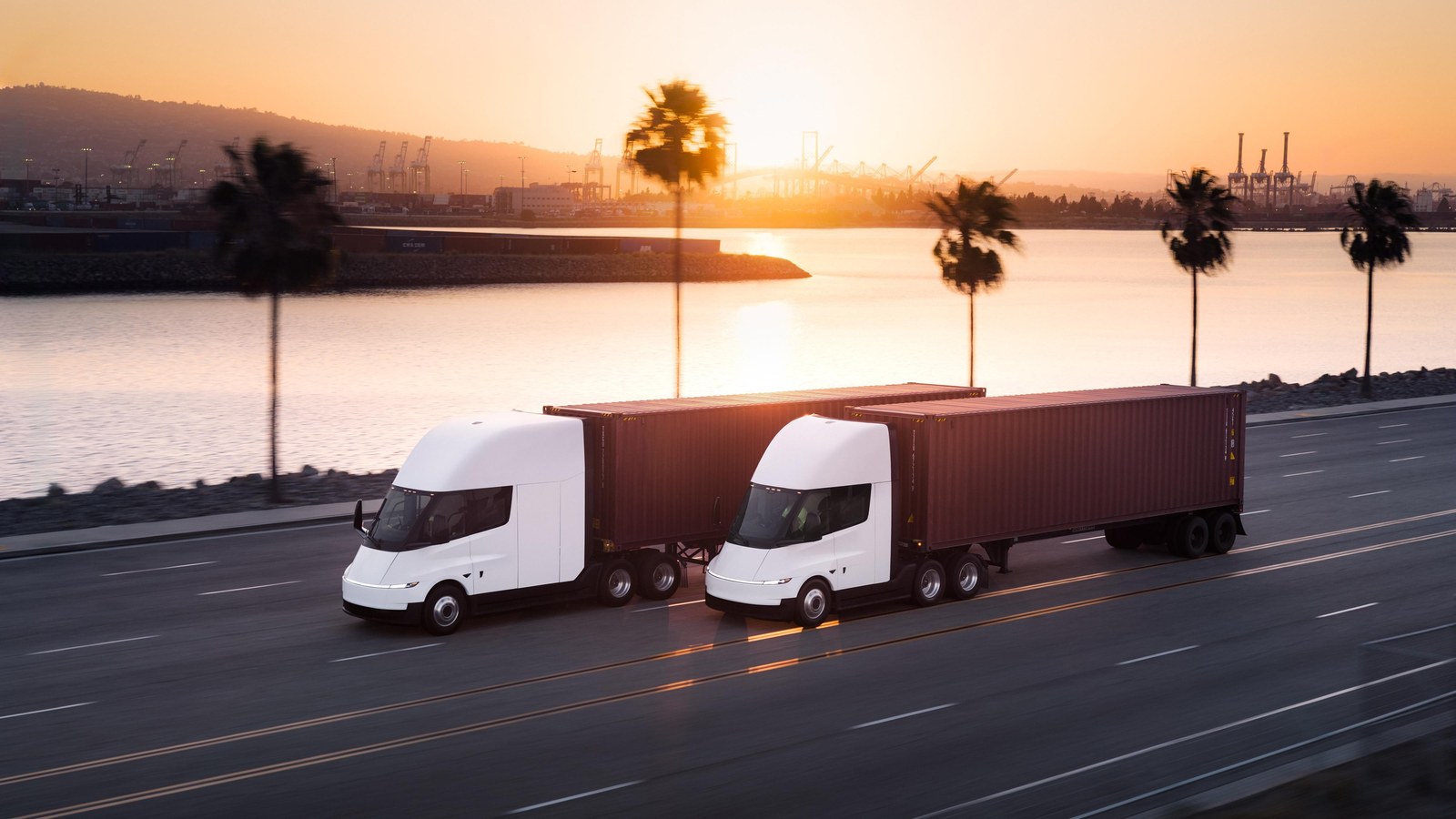
The trucks sat in a row on the Nevada desert, their doors already bearing the names of customers. On Sept. 24, Elon Musk stood before them at a factory east of Reno and declared that the Tesla Semi, a truck he first showed the world in 2017, had finally entered high-volume production.
The plant, adjacent to Tesla’s Gigafactory Nevada in Storey County, is planned to build 50,000 Semis a year. Aerial footage from the event showed eleven trucks already carrying customer markings, including PepsiCo, DHL, US Foods and WattEV. Musk called the Semi a game changer and said the waiting list had grown long.
The gap between the announcement and the assembly line is the real story. Tesla unveiled the Semi in November 2017 at its design studio near Los Angeles, promising a truck that could travel 500 miles on a charge and accelerate from zero to sixty miles an hour in twenty seconds while pulling an 80,000-pound load. Production, Musk said then, would begin in 2019. It did not.
Battery supply, always the constraint, was diverted to the Model 3 and Model Y. The Semi spent years in pilot form. Tesla delivered its first units to PepsiCo in December 2022, more than three years after the original target, and the trucks that followed went to a small circle of partners rather than to the open market.
The delay gave Tesla time to rework the truck around its 4680 battery cells, which are now manufactured at the same Nevada complex. Building cells and trucks on one campus removes the long-distance shipping of heavy, sensitive batteries, and Tesla has argued that this vertical integration is what finally makes the Semi economical to build at scale.
The truck’s design has not changed much since 2017. It runs on four independent motors, positions the driver in the center of the cab rather than behind a conventional steering wheel, and promises roughly half the energy cost per mile of a diesel. What has changed is everything around it: the cells, the factory, and a charger network that did not exist when the Semi was announced.
The customers now attached to the project give a sense of the bet. PepsiCo has run a fleet of Semis out of its Frito-Lay plants, using the trucks on the short-haul and regional routes where electric range holds up best. DHL and US Foods bring freight and food-distribution routes to the mix. WattEV, a startup that sells electric trucking as a service, points to a different customer: fleets that would rather rent the transition to battery power than own it.
Analysts said the 50,000-unit target matters less for what it says about Tesla than for what it says about the market. North American sales of heavy-duty Class 8 trucks run around 250,000 a year, so a full ramp would give Tesla roughly a fifth of the segment, a share no electric rival has come close to claiming. Daimler’s Freightliner eCascadia and Volvo’s electric VNR are on the road, but both trail the Semi in range and in the attention they command.
A Semi needs charging far beyond what a passenger car uses, and Tesla’s answer is a network of high-power Megachargers along freight corridors. That network is still thin relative to the diesel fuelling stations it would replace, and analysts said it, more than the factory, will decide how far the Semi travels beyond early adopters.
The shift is also being pushed by regulation rather than appetite alone. California’s Advanced Clean Trucks rule requires manufacturers to sell a rising share of zero-emission trucks in the state, and a dozen other states have adopted the same framework. Fleets that once treated electric trucks as an experiment now face a timetable, which gives the Semi a customer base that did not exist when it was first announced.
The debut carried a second message the same day: Tesla released a fresh teaser for the Roadster, the sports car it showed alongside the Semi in 2017, with a full reveal planned for Oct. 1. The pairing was deliberate, a nod that the long-promised vehicles Tesla designed years ago are now, one by one, turning into metal on a line.
For the Semi, nearly a decade passed between the concept and the high-volume line. The company that once promised 2019 deliveries is now promising 50,000 trucks a year, and the customers standing in the Nevada sun are the first proof that this time the timeline has some hardware behind it.
Musk has described the truck as a product that will change the freight industry, and the economics of fuel and maintenance give the claim a foundation. Whether the Semi becomes a mainstay of American trucking now depends less on Tesla’s engineering, which has largely been settled, and more on the chargers, the cells and the patience of fleet buyers who have been waiting years to write the check.