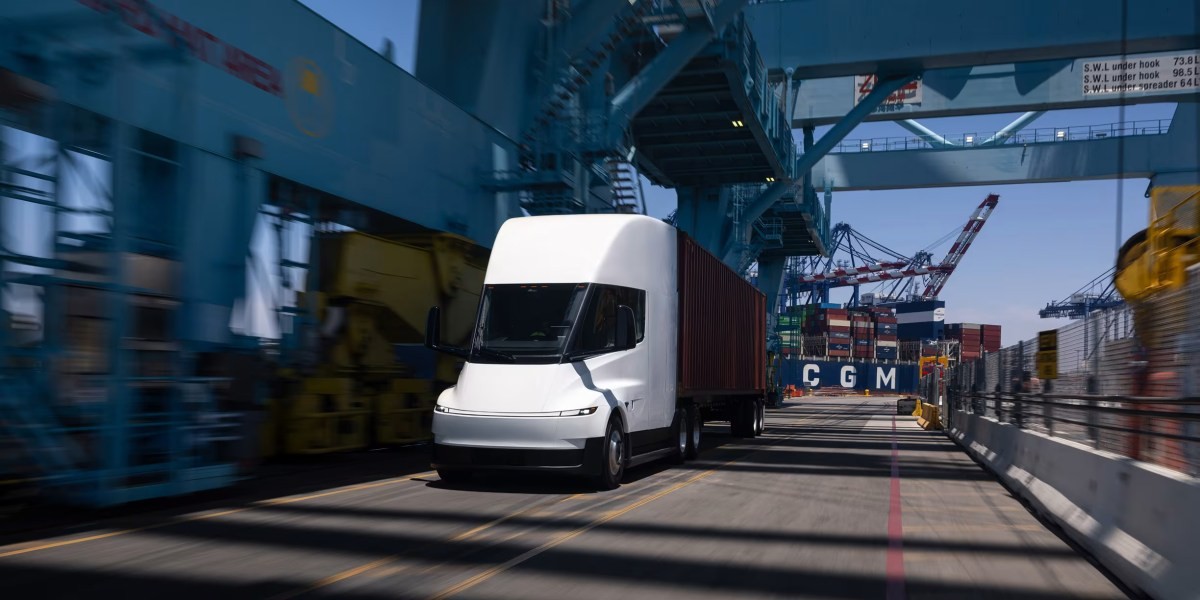
The trucks parked outside the new factory in Sparks, Nevada, on the evening of September 24 carried the logos of PepsiCo, DHL and US Foods, and their presence was the news. Nearly nine years after Elon Musk showed a prototype of an electric Class 8 truck to a crowd in Hawthorne, California, Tesla handed the first Semi tractors to paying customers.
The specifications were the ones Tesla had been promising. The long-range version can travel 500 miles on a full load; a standard version covers 325 miles. Both use a three-motor powertrain rated at 800 kilowatts.
Executives did not announce a final price. A figure of about $290,000 for the 500-mile version has circulated among customers, and Tesla has not confirmed or corrected it.
The factory itself is the larger bet. Tesla says the plant can eventually build up to 50,000 Semis a year, roughly 1,000 a week, and will employ about 3,000 people. The company also plans to have more than 30 Semi charging stations and over 200 megawatt-class chargers in place before the end of the year, infrastructure that any fleet operator would need before committing to electric trucks.
Orders are the part of the story customers can measure. Catalyst Mobility said Tesla took about 2,500 Semi orders this week, with buyers including freight operators for Microsoft and Pepsi. If accurate, that volume is close to twice the size of the current electric heavy truck fleet in the United States.
The stock market was unimpressed. Tesla shares closed down 1.54 percent at $372.11 on Friday, and BNP Paribas Exane cut its price target to $268 from $280 while keeping an underperform rating. The analysts’ objection was sequencing rather than product: Tesla has not said when production will reach the planned rate, or what margins the truck will carry.
The delay between unveiling and delivery is the longest in Tesla’s history. The Semi was shown in 2017 with production promised for 2019, and the program slipped repeatedly while the company worked through the Model 3 and Model Y ramp. PepsiCo received a small number of hand-built trucks for a pilot fleet in 2021, and those vehicles have accumulated real mileage since.
Electrifying long-haul trucking is difficult for reasons that have little to do with motors. A diesel tractor can refuel in minutes and run for a thousand miles; an electric one has to trade payload for battery weight, and its economics depend on duty cycles that keep the truck moving between charges. Fleet operators buy on cost per mile over a decade, not on acceleration.
Charging remains the binding constraint. A megawatt-class charger draws enough power to require significant upgrades at most sites, and the buildout of public truck charging has lagged the deployment of passenger car chargers. Tesla’s plan to install its own network is an attempt to solve that problem for its customers before they have to.
Competition in the category is thin but growing, with established truck makers and startups all delivering in small volumes. The total number of electric heavy trucks on American roads remains a rounding error against the diesel fleet, which is why a few thousand orders counts as significant.
For Tesla, the Semi arrives at a moment when the company’s growth story has shifted to robots, autonomous software and energy storage, while its car business faces rising competition. A truck program that took nine years to reach customers now has to prove it can be built at a profit and at a rate that matters.
The launch lands in a market where the business case for electric trucking is being tested in daily operation rather than in press materials. Fleets that have run pilot vehicles report lower energy costs per mile and fewer moving parts, offset by higher purchase prices and the planning required to keep trucks charged along fixed routes.
The Semi’s own history includes a long silence. For several years Tesla declined to give production dates, and executives who had promised a 2019 launch offered no explanation when the target passed. The trucks delivered this week are the first built on a dedicated line rather than assembled by hand.
Charging is the constraint fleet operators will scrutinize. A megawatt-class charger requires a site to bring in power well beyond what a typical location receives, and Tesla has not said where the first stations will be built or how many will serve third-party fleets rather than its own delivery operation.
Analysts have also questioned whether buyers will accept the trade-offs the design requires. Battery weight reduces the freight a tractor can carry, and the range figures assume a full load, which is not how every route works. For regional hauling on predictable routes, the arithmetic is easier.
Tesla has framed the Semi as part of a broader push into commercial vehicles and energy. Its valuation depends increasingly on programs that have not yet produced meaningful revenue, including robotaxis and humanoid robots, and investors have shown they will discount timelines they cannot verify.
Tesla has not said how many trucks it expects to deliver this year, or when the Sparks plant will approach its stated capacity. Until it does, the number to watch is not the 50,000 figure on the press release but the weekly output the company eventually reports.