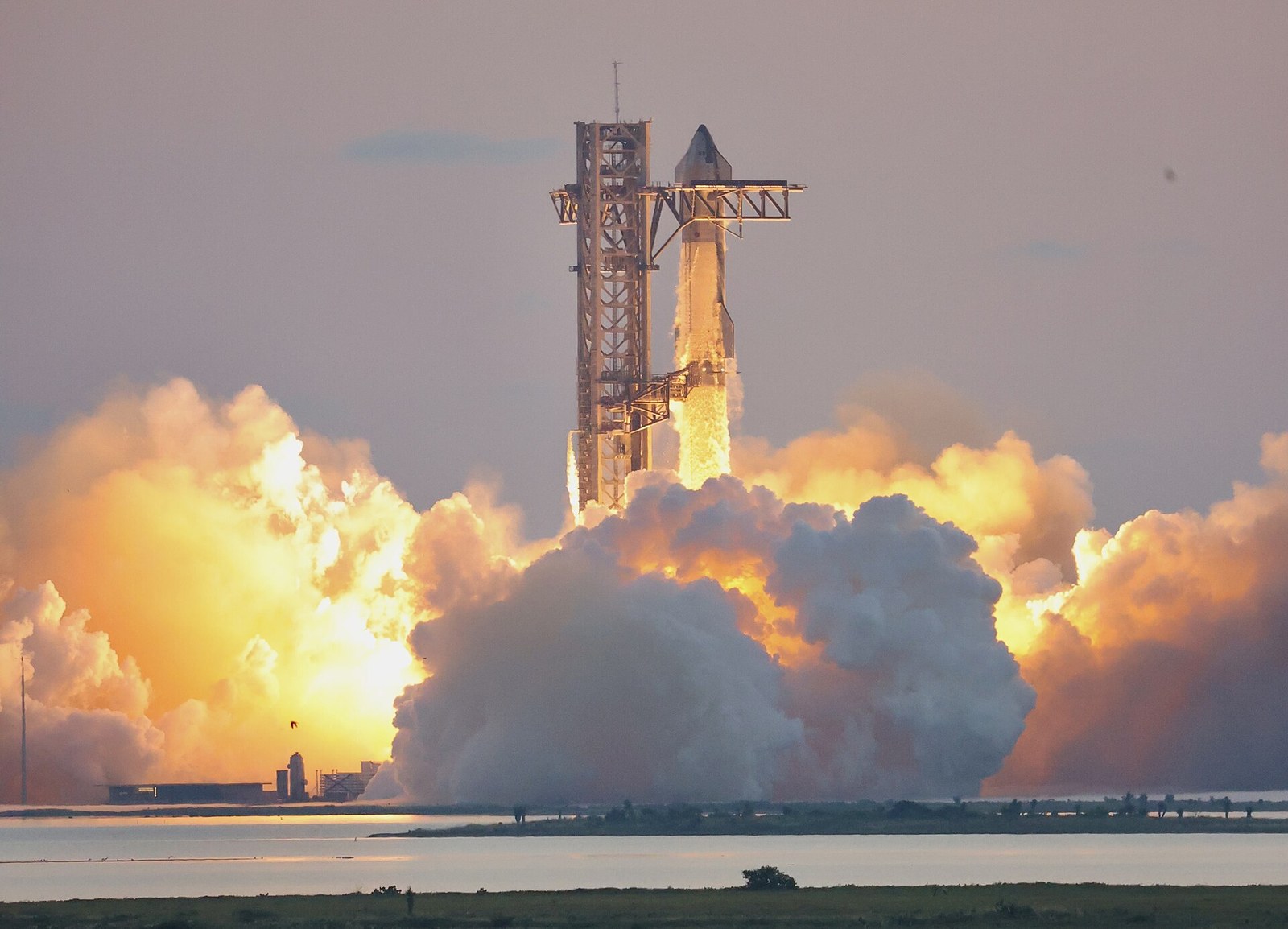
The rocket cleared the pad at Starbase on the Texas coast on the morning of September 28 and kept climbing until, for the first time in the program’s history, it reached orbit. Fourteen test flights into the effort, SpaceX’s Starship had finally done the thing the vehicle was built for, and it carried a real cargo along the way.
The ship released 26 Starlink V3 satellites one by one from an altitude of about 269 kilometers, the first time Starship had ever deployed a payload in orbit. For a rocket that has spent its life so far launching empty or nearly empty, the flight was a step toward the routine satellite service that is supposed to fund the rest of SpaceX’s ambitions.
It was not a clean step. On the way up, one of the ship’s Raptor 3 engines shut down early, and for a stretch the vehicle’s arrival in orbit was in doubt. The control team concluded that the remaining engines carried enough redundancy, a re-ignition succeeded, and the mission pressed on. The whole flight took about three hours, compressed from the nearly ten hours that had been planned.
The end of the mission carried more of the same. The Super Heavy booster fell back toward the Gulf of Mexico for its planned water landing, with its own engines stalling during the descent. The ship re-entered the atmosphere, flipped into a vertical position, and touched the water nose-first before it toppled over and caught fire.
Reuters reported the same day that the string of engine problems could weigh on NASA’s lunar timetable. Starship is the vehicle NASA has selected to land astronauts on the Moon under the Artemis program, and before it can carry people it has to prove its engines reliable enough for routine operations. An early shutdown on an uncrewed test flight is survivable; the same failure with a crew aboard is a different matter.
Getting to orbit at all has been the program’s central goal since the first full-stack flight in 2023. Earlier flights ended in breakup, and the ones since have inched the vehicle closer: successful booster landings, controlled ship re-entries, and now a full orbit with a payload on board. Each step has been watched closely because Starship is not just a launch vehicle but the platform SpaceX expects to carry its satellite business, its lunar contract and, eventually, its plans for Mars.
The V3 satellites themselves matter to the economics. Each one carries far more capacity than the satellites Starlink has flown before, which means a single Starship launch can add more bandwidth to the constellation than several Falcon 9 flights could. That is the arithmetic behind the push to make Starship routine: fewer, larger launches lower the cost of keeping the network growing.
Starship is the largest rocket ever flown, and its whole design rests on a promise of full reusability. The Super Heavy booster and the ship are both meant to fly again rather than be discarded, which is what makes the program’s cost targets possible. Every landing attempt, even a watery one, is practice toward catching the booster and, eventually, the ship.
The Raptor 3 engine is the newest iteration of the engine family that powers the stack, and it is supposed to be simpler and more durable than the versions before it. The early shutdown on this flight is exactly the kind of failure the test program exists to find. SpaceX has treated each anomaly as data, and the redundancy built into the design did what it was meant to do: one engine died and the mission still reached orbit.
The market Starship is aimed at does not grade on a curve. Starlink’s economics depend on launching thousands of satellites cheaply, and Starship’s much larger payload bay is central to the next generation of that constellation. The V3 satellites it carried are bigger and more capable than earlier models, and deploying them in volume is the point of the whole program.
The Artemis program is the harder test. NASA’s schedule for returning astronauts to the lunar surface already carries years of delay, and any question about engine reliability feeds directly into the confidence the agency needs before it puts people on top of the stack. The agency has repeatedly said it will not fly crews on hardware that has not proven itself over many flights.
The distance between a successful test and a dependable vehicle is where SpaceX now sits. Flight 14 showed the rocket can reach orbit and deploy a real payload. What it did not settle is whether the engines will hold up often enough for the cadence that both Starlink and Artemis require. Analysts said that question, not the first orbit, will determine how quickly Starship moves from experiments to work.
That is the quieter consequence of an otherwise triumphant flight. The orbital debut is real, and so is the list of systems that still misbehaved on the way there. For a company that sells certainty to NASA and to its own satellite business, the next flights will have to show fewer of them.