For seventeen years, the most unusual piece of real estate on Microsoft’s Redmond campus was a workshop where employees built things nobody had asked them to build. The Garage hosted side projects, week-long hackathons and a rotating cast of engineers testing ideas with no product owner and no budget line. This month, the program lost its operating spine.
Microsoft has ended central operations for The Garage, the internal innovation program that ran across 15 sites worldwide, according to people familiar with the decision. Employees were told the central team would no longer run the labs. The company said the experimental spirit the program cultivated is now reflected in everyday product development.
The Garage started small and became a fixture. It gave employees time, tools and, above all, permission to ship something minor without a business case. Projects that came out of it included Microsoft Pix, a camera app built around computational photography, and Mouse without Borders, a utility that let one keyboard drive several computers. Neither moved the company’s revenue line. Both sent a signal that a decent idea did not need a strategy deck to get built.
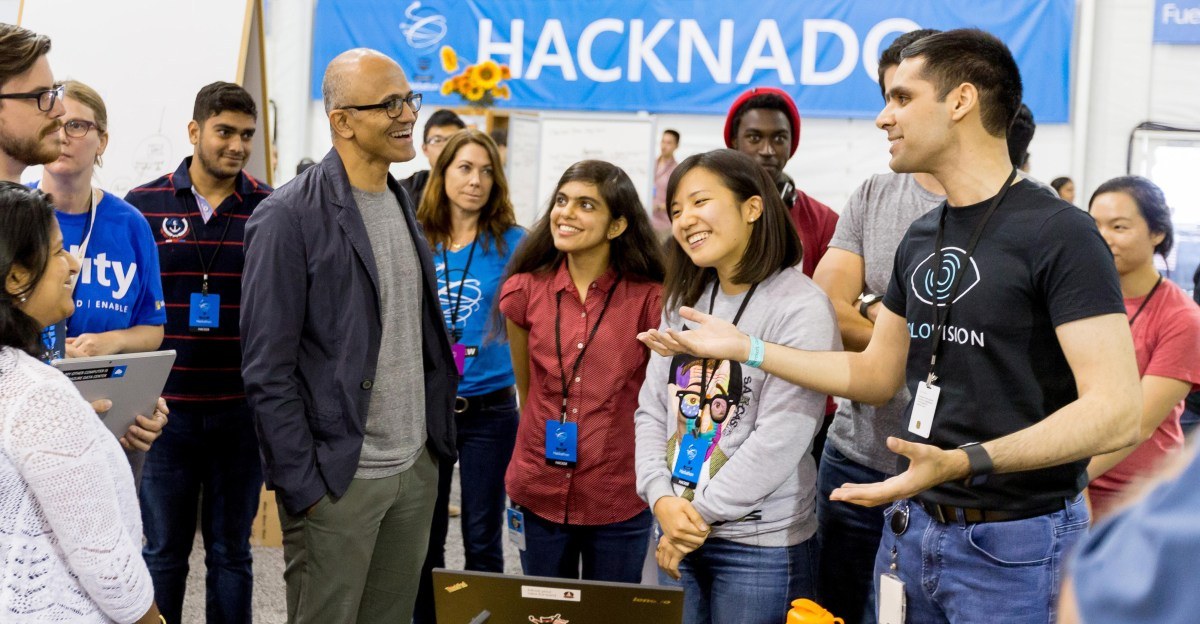
Satya Nadella visited the space early in his tenure as chief executive to see what engineers were doing on their own time. The episode became part of company lore, a chief executive treating unapproved work as a source of information rather than a compliance problem. That posture fit the growth-mindset language Microsoft pushed through the late 2010s, when internal experimentation was presented as evidence that a company of its size could still behave like a small one.
The annual global hackathon is now the open question. The event, which in recent years drew employees from offices on several continents, has no central owner. People involved in the program said no replacement structure has been announced, and it is unclear whether regional sites will run their own versions. For many engineers, the hackathon was the one week a year when they could work with colleagues from other divisions without filing a request.
A Microsoft spokesman pointed to the company’s statement that the program’s ethos lives on in product teams. Executives have argued that AI features now ship on weekly cycles, which makes a dedicated lab less necessary than it was in 2009, when The Garage opened and internal tools moved at the speed of a quarterly release. That argument has some merit. It also has a convenient shape for a company trying to hold down costs.
Microsoft has spent the past two years routing capital toward data centers and AI infrastructure while trimming elsewhere. Teams have been consolidated, and managers have been asked to justify headcount against a narrower set of priorities. An innovation lab that produces prototypes rather than revenue is an easy line to question in that kind of review, analysts said.
The pattern is familiar across large technology firms. Google restructured Area 120, its in-house incubator, in 2022, moving many participants into core teams. Meta has repeatedly reshaped its internal venture efforts. The economics are similar everywhere: an incubator’s output is hard to measure, its failures are visible, and its successes get claimed by whichever product group eventually ships them.
What employees lose is less tangible than a lease. The Garage gave junior engineers a way to lead something before they had the title for it, and gave senior engineers a place to test ideas that would never survive a roadmap review. Several Microsoft products trace their origins to prototypes built in that space, even when the shipping version was rebuilt by a mainstream team with a real deadline.
There is a counterargument inside the company. AI teams now run their own rapid experimentation, with model releases every few weeks and internal demos that move faster than any hackathon schedule. Engineers who want to try something new can often do it inside those groups, with compute and data The Garage never had. The lab’s tools were built for an era when the scarce resource was permission, not GPUs.
The 15 sites are the practical question. Some are rooms with machine tools and 3D printers, others are open floors set aside for short-term projects. People familiar with the program said the physical spaces have not all been reassigned, and that local teams are waiting for guidance. A lab without a central team tends to become storage.
For employees who joined Microsoft partly because it still acted like a place where a side project could become a product, the message is quieter than a layoff and harder to argue with. The company is not saying experimentation is dead. It is saying experimentation should happen where the roadmap already points.
That is a reasonable position for a mature business and a poor one for a company that has spent a decade telling recruits it rewards curiosity. The two positions can coexist for a while. They rarely do for long, because the people who care about the second one notice when the room gets reassigned.
What happens to the hackathon will be the test. If a regional office picks it up and runs it next year, the closure will look like a reorganization. If the calendar entry simply disappears, seventeen years of institutional habit will have been retired with a single internal note, and the engineers who used it will find somewhere else to build, or they will not.