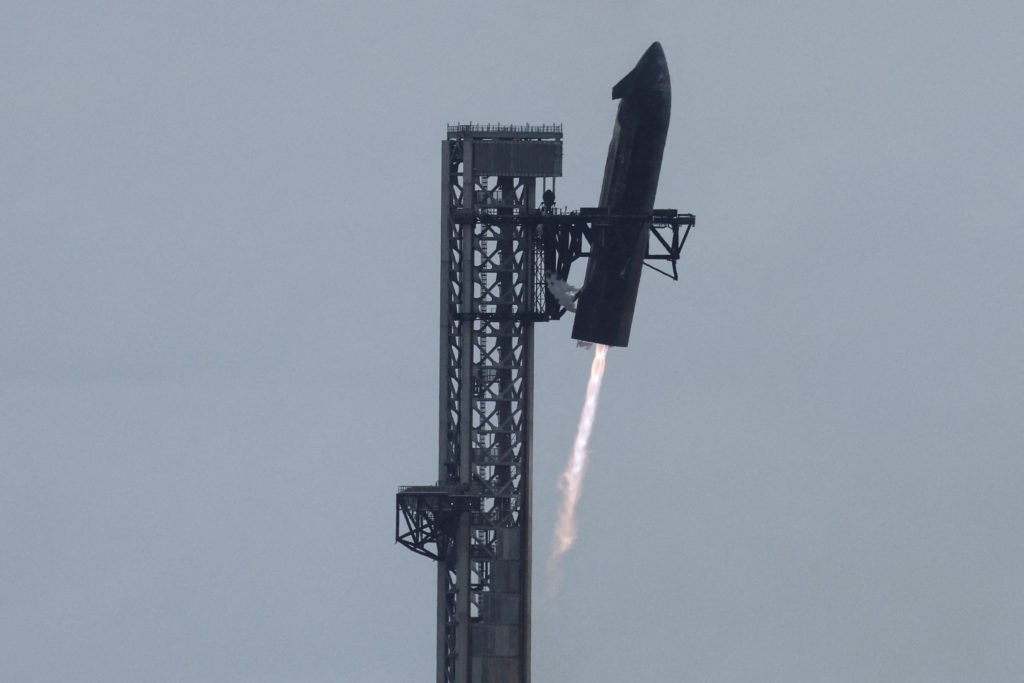
For most of Friday evening there was nothing over South Texas worth looking at. Then a bright point resolved out of the haze above SpaceX’s site at Boca Chica, trailing a plasma wake, and the two steel arms on the launch tower swung shut around it. The catch took a few seconds. The work behind it took years.
The vehicle had spent roughly 22 hours in orbit. It came home at about 17,000 miles an hour, fast enough that the air ahead of it turned to plasma and hot enough to test every tile on its belly. Ship 42, as SpaceX calls it, arrived on the fifteenth flight test of the program and was caught by the same tower that had thrown it into the sky the day before.
Before the descent the ship released 26 Starlink satellites. That detail matters less for the satellites themselves than for what it says about the vehicle: it flew a real mission, deployed real hardware, then came back intact instead of burning up over the Indian Ocean as every previous ship had.
SpaceX had caught a booster before. The Super Heavy first stage, the heavy half that lifts the stack off the pad, has been recovered repeatedly since the tower arms first closed on one in 2024. The ship is the harder half. It is the part that reaches orbital velocity, the part that takes the full heat of reentry, and until this week the part that was thrown away every time.
The flight a day earlier had already put the ship into orbit, which is where the two halves of the story split. The launch worked. The booster’s return did not: a fault in the descent meant it splashed into the Gulf of Mexico instead of returning to the pad. Half a chain of reuse, in other words, and the half that closed on Friday.
Engineers have described the ship’s return as the harder problem for the obvious reason. A booster separates at a few thousand miles an hour and falls back through air it has already disturbed. A ship reenters at orbital speed with a heat shield made of thousands of tiles, any one of which can lift and take the next one with it. Earlier flights lost tiles, burned through flaps and came apart, and each failure changed the design of the next vehicle.
What the catch does not prove is that the ship is reusable in any commercial sense. Catching is the easy verdict to watch. Refurbishment is the expensive one, and nobody outside SpaceX knows how many tiles will have to be replaced, how many engines pulled, how long the inspection takes. A vehicle that flies twice a year is a demonstration; a vehicle that flies twice a month is a business.
The economics push in one direction. A ship carries most of the manufacturing cost of the stack, the structures, the six engines and the heat shield, and throwing one away after each flight sets a floor under the price of a launch. Recovering it is the only route to the cadence SpaceX has promised for Starlink, whose next generation of satellites is heavier and wider than the ones the current rockets can carry in useful numbers.
The Starlink arithmetic is the reason the company keeps flying. Each ship that returns is a ship that can be turned around, and each turnaround adds capacity to a network that pays for the program. That circularity has funded the tests, absorbed the failures and given SpaceX the patience to iterate in public, which its competitors have watched with a mixture of admiration and dread.
Analysts who track the launch market have argued for years that the ship, not the booster, is where the cost advantage either arrives or evaporates. A person familiar with how customers price launch contracts said the reusable booster already reset expectations for the first stage, and that the upper stage is the line item everyone is now watching.
There is a second customer with a schedule of its own. NASA has contracted a version of the ship as a lunar lander for its Artemis program, a variant that needs to refuel in orbit, loiter, descend and lift off again. Every flight that returns adds evidence for the parts of that profile that are still theoretical, and every failure delays a program that has already slipped more than once.
The engineering culture around the program treats failure as data, which is easy to say and expensive to practice. SpaceX has blown up ships on the pad, lost them on ascent and watched them break up during reentry, then flown again within months. That tolerance is a function of who pays for the hardware, and it is not available to competitors who answer to quarterly results.
The tower itself has become part of the system. The arms that caught Ship 42 are the same ones that stack the vehicle, and the same ones that caught the booster. A launch site that can build, launch and recover without moving the hardware between facilities is a factory as much as a spaceport, and the comparison to an assembly line is one SpaceX’s executives have encouraged.
What remains untested is the human part. A ship rated to carry people has to demonstrate margins that an uncrewed cargo flight does not, and the certification path runs through agencies that move on their own timetable. The catch on Friday is a long way from a passenger rating, and the company has been careful not to conflate the two.
For now the record is narrow and specific. One upper stage left the ground, spent nearly a day in orbit, released its payload and came back to be caught by the arms that launched it. The reflight is the number to watch next. Until a recovered ship flies again, the chain that closed on Friday is still a chain with one link tested.